


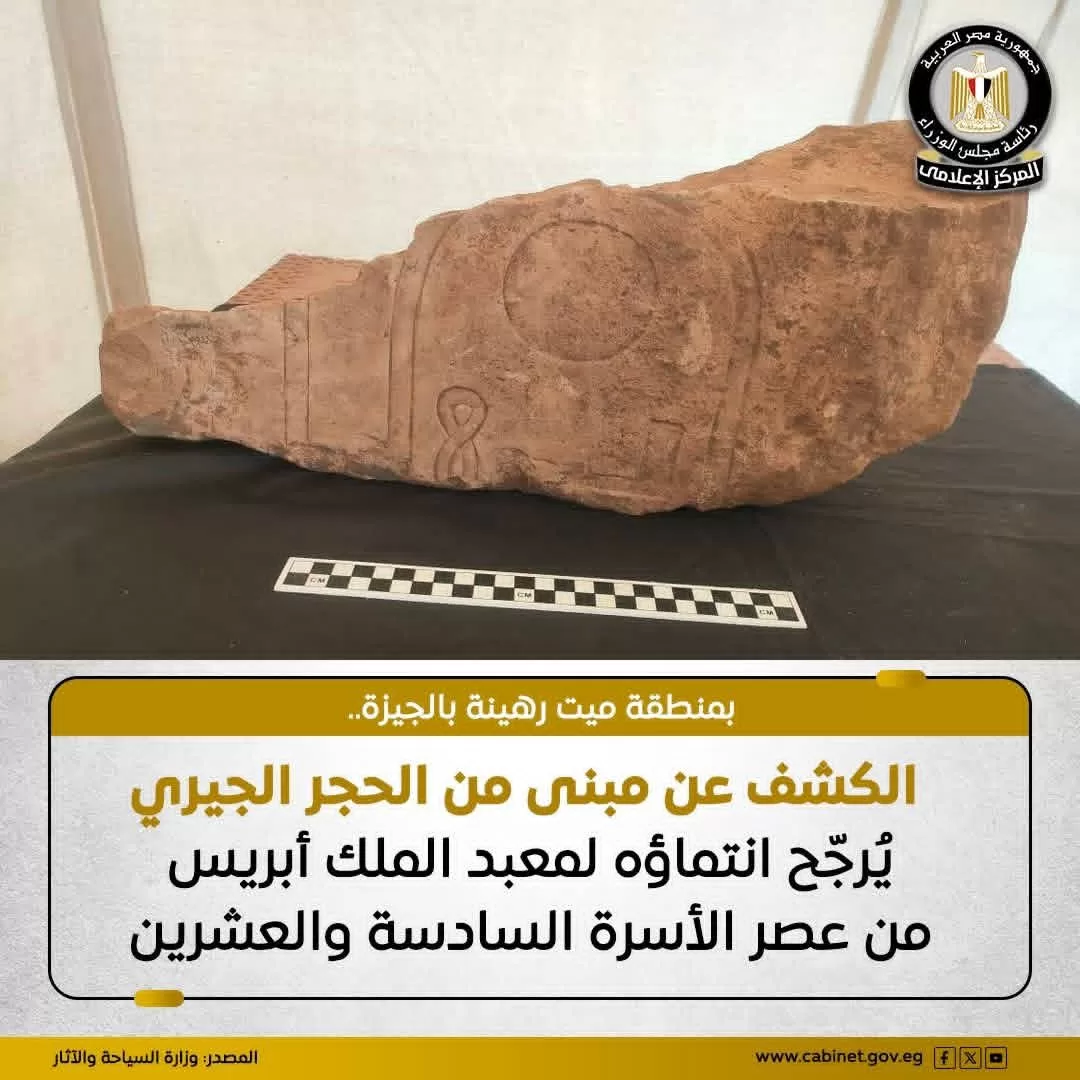
The joint Egyptian-Chinese archaeological mission, comprising representatives from the Supreme Council of Antiquities, Peking University, and the Shandong Institute of Cultural Heritage and Archaeology in Egypt, has uncovered a limestone structure believed to be part of the temple of King Apries from the 26th Dynasty.
The operation follows earlier discoveries of sections of the temple at Tell Aziz, located east of Mit Rahina, Giza Governorate.
This significant find offers new insights into the urban planning of ancient Memphis (Mit Rahina) and sheds light on religious practices spanning the Late Period through the Greco-Roman era.
Preliminary studies suggest that the southern sector of Tell Aziz formed part of Memphis’s core, with the temple remaining in use from the 26th Dynasty into the Roman period.
Excavations also revealed five headless sphinx statues, numerous stone fragments and blocks inscribed with hieroglyphs of the god Ptah, cartouches of King Apries, as well as a range of artifacts including pottery, glassware, and copper coins.
The mission is scheduled to resume in April, aiming to uncover additional architectural and archaeological elements that will further document the history of this prominent site.

