


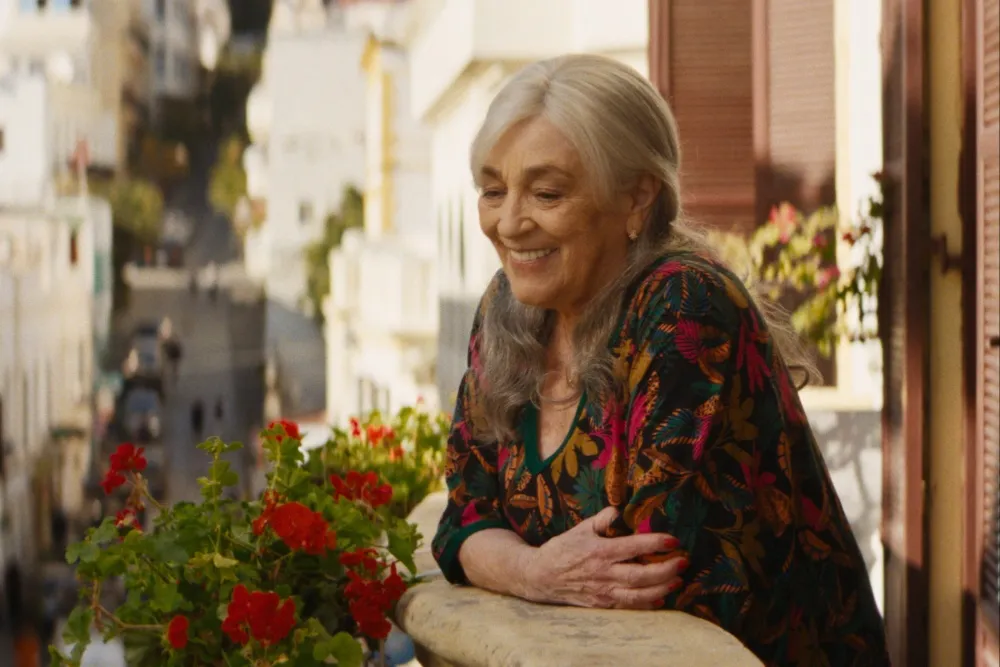
For María Ángeles, the idea of leaving the home she lived in for many years seems less like a relocation and more like a violent uprooting.
In the movie Calle Málaga, which received its Middle East premiere at the 46th Cairo International Film Festival, director Maryam Touzani presented a funny, but deeply moving tale of an elderly woman fighting for her right to happiness, and demonstrating her courage to choose to live her life on her own terms.
The protagonist is Maria Ángeles (Carmen Maura), a 79-year-old Spanish widow who has spent her entire life in the vibrant coastal city of Tangier that welcomed her parents when they fled from the dictatorship of the Spanish general Francisco Franco in the 1930s.
She cherishes even her simple daily routine as she waters the flowers on her balcony, and enjoys the romantic music coming from her record player. These scenes reflect Maria Angeles’s self satisfaction with her time alone as a widow.
In the opening scenes, we see her walking the cobblestone streets, exchanging lively greetings with local grocers and spice vendors, and preparing delicious meals, a simple life, but one in which she finds immense happiness.
Maria Ángeles’s routine is abruptly shattered by the arrival of her only daughter, Clara (Marta Etura), a nurse who left Tangier long ago for what she thought a “brighter life” in Madrid.
Broke after a painful divorce, Clara announces that the apartment on Calle Málaga, legally hers since her father’s death, will be sold within weeks.
María Ángeles must choose: relocate to Spain or accept a place in a government nursing home.
For her, the thought of leaving her beloved hometown and the apartment is something she can’t tolerate.
Too attached to Tangier to concede, she initially chooses the nursing home, a compromise that quickly proves unmanageable.
For her, the city and the apartment are her identity. Maria Angeles sees the apartment not merely as a place where she lives, but as the physical container of her entire history and her family’s difficult journey to freedom. Her strong resistance to relocation is because she is deeply connected mentally and spiritually to this place. Her fight is less about property and more about preserving her last remaining links to her past and maintaining her independence in the only world she has ever known.
Driven by her feeling as uprooted, she made a secret plan to reclaim her apartment. This leads her to convince Abslam (Ahmed Boulane), the local antique seller to whom she sold her furniture, to return her belongings. What begins as a negotiation swiftly blossoms into a love affair.
Co-written by Touzani and her husband Nabil Ayouch, and openly inspired by the director’s own grandmother from Tangier’s dwindling Spanish community, Calle Málaga is a comedy that never mocks age, but celebrates it.
The central strength of the film is Carmen Maura’s compelling performance as Maria Ángeles. She succeeded in showing the contradictions of the character of this old woman who inspires us to embrace life.
The Belgium-France-Germany-Spain-Morocco co-production is inspired by and dedicated to Touzani’s own grandmother from Tangier’s Spanish community. It is a touching film that reminds us not to give up on our happiness in our old age and that it is never too late to achieve our dreams.

