


Egypt tries to bring big film productions back to its historic sites by offering more facilities for cinema makers from all parts of the world.
This effort has gained a renewed boost in recent days, especially after well-known filmmakers, including Mel Gibson, offered support.
Gibson spoke recently in a positive manner about filming in the country.
Writing on X (formerly Twitter), the international cinema star wrote: “We’re shooting in Egypt, and it feels like stepping into something eternal. Some stories demand eternity as their backdrop”.
His post went viral on social media with many people around the world sharing it.
Gibson’s comment threw light on the hard work Egypt is doing these days to open the gates of its timeless sites and locations for global filmmakers.
It is noticeable that Egypt is trying to position itselfas a top filming destination.
To do this, concerned authorities adopt a mixed strategy that mixes policy change, practical support, and the natural appeal of the nation’s ancient locations and historic cities.
To facilitate the process for international filmmakers, the government has established the Egypt Film Commission which acts as the main authority for foreign productions.
New rules approved in late 2025 gave the commission control over permits, customs, and coordination with government bodies through a “single digital window”.
This aims at replacing slow procedures with one clear process so studios can work faster and with fewer surprises.
These changes sit within a wider national strategy to attract investment in the creative sector, specialists said.
Renowned film critic and president of the Alexandria International Film Festival for Mediterranean Countries, Alamir Abaza, described the single digital window as a “great idea”.
“It saves a lot of time for foreign filmmakers,” Abaza told The Egyptian Gazette.
He expected the new window and the new measures to contribute to the creation of jobs for local film crews.
As part of the facilities, Egyptian authorities are offering more support for crews, including help with bringing in equipment, arranging security, and linking foreign teams with local partners.
The commission also promotes Egypt abroad, highlighting its wide range of locations and skilled crews.
Specialists like Abaza expect these facilities to turn Egypt into a major film hub, one that rivals important regional cinema-making destinations, such as Morocco, Jordan and the UAE.
“Attracting international filmmakers to shoot in Egypt will benefit our country on all levels,including the political, economic and tourist levels,” Abaza said.
“Politically, the presence of global cinema stars and makers in our country will deliver a positive message about security in it,” he added.
Filming in ancient sites around the nation, he noted, would promote Egyptian heritage and attract more tourists from around the world.
“This will create jobs and bring in revenues,” Abazaadded.
Regional filmmaking hubs appear to be making a fortune from becoming venues for the international film industry.
Morocco, for example, generated around $163 million in revenues from foreign productions in 2025, according to the Moroccan government.
This marked a sharp rise from $54 million prior to 2021, according to Moroccan Minister of Youth, Culture and Communications, Mohamed Mehdi.
He noted that the industry had experienced a threefold increase in revenue over four years, driven by a 30% tax incentive, diverse landscapes, and major productions like Gladiator II.
Abaza expressed sorrow, meanwhile, at Egypt’s failure in the past to attract cinema producers who made films about the ancient Egyptian civilization.
He particularly mentioned the case of the American film, The Mummy, which was produced in 1999.
The film, he said, features the ancient Egyptian civilization.
“Despite this, it was shot in Morocco,” Abaza said. “Can anybody believe this?” he asked.
Egypt, he noted, should have been the first and most appropriate setting for shooting such a movie.
Nevertheless, Egypt’s strongest advantage remains to be its heritage.
From the Giza Pyramids plateau to new landmarks like the Grand Egyptian Museum, this strategically-located country provides a scale and history that few places can match.
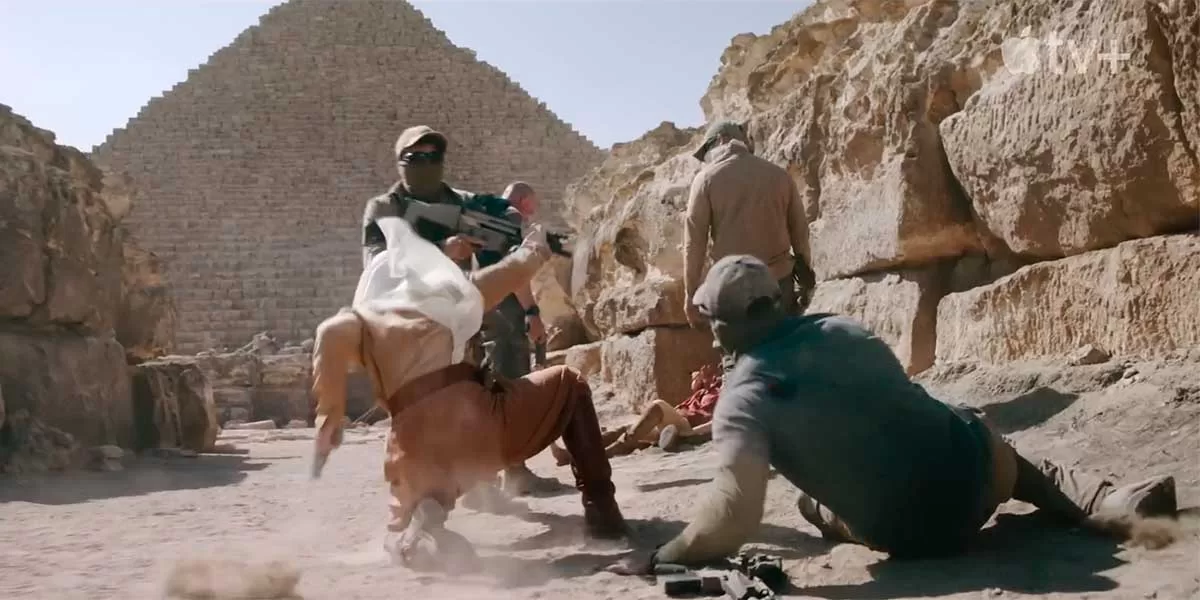
Recent projects show this clearly. A major action-adventure movie, titled Fountain of Youth, by Guy Ritchie shot scenes at the pyramids, with the team praising both the setting and official support.
Egyptian authorities handled permits and site protection to prevent any unexpected disruptions during filming.
Modern facilities also play a role. The Egyptian Media Production City offers large sound stages, backlots, and post-production services.
Filmmakers can shoot on location and in studio without leaving the country.
International promotion supports the push also. Egypt has taken part in major industry events, such as the American Film Market in Los Angeles, introducing itself as a cost-effective place for large productions.
Local officials point to deserts, coasts, historic districts, and modern cities, all close to each other, as a practical advantage.
“All these steps can create a breakthrough,” film producer, Safy El-Din Mahmoud, told this newspaper.
“When foreign cinema producers film here, this opens the door for great opportunities, including cooperation, job creation and communication with distinguished industry icons,” he explained.
By welcoming global filmmakers, Egypt wants to reinforce its image as a centre of world heritage.
This strategy is also meant to build local talent, and restore Egypt’s role as a regional film hub.
With simpler rules, financial incentives, and some of the world’s most famous historical sites, Egypt hopes this mix will bring more major productions back to its landscapes.

