


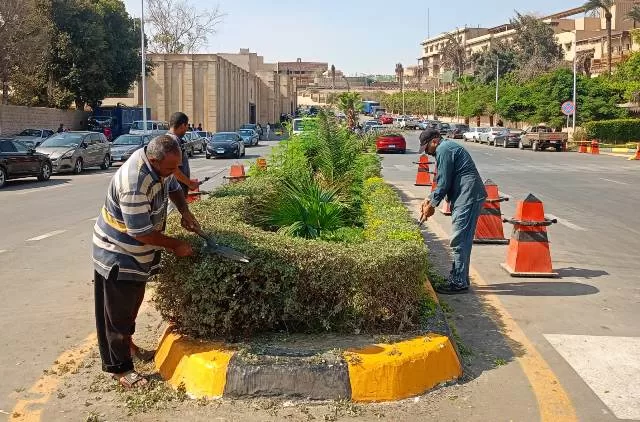
CAIRO – Giza Governor Adel el-Naggar said continued maintenance works will be carried out in the area surrounding the Grand Egyptian Museum (GEM) following official inauguration to preserve civilized appearance and aesthetic character achieved through recent development works.
The governor said all accomplishments are the result of integrated and sustained efforts over several months rather than temporary or short-term actions.
In statements to MENA Sunday, the governor explained that the development and upgrading works covered a wide area surrounding the museum and the Pyramids, extending from the Desert Road at Remaya Square to Sphinx International Airport, in addition to the Fayoum Road from Remaya Square to the Ring Road, as well as the Tourist Road and the Southern Ring Road.
Naggar added that building façades along these routes were repainted to reflect a modern and civilized image befitting Egypt’s stature before visitors from around the world.
The development works also included the Maryouteya and Mansoureya axes, where modern paving, pedestrian sidewalks and decorative lighting poles were installed to highlight the beauty of the trees and green areas at night.
Around 4,000 trees, including 2,200 palm trees, have been planted, with green spaces exceeding 92,000 square meters, in line with environmental considerations and sustainability objectives.
He further stated that six new wells were dug in coordination with the Ministry of Water Resources and Irrigation to provide irrigation water for the landscaped areas without affecting the water supply allocated to residents.
All drives, the governor emphasized, represents a significant environmental measure that supports the state’s efforts towardس water conservation and sustainable development.
Naggar pointed out that the project also included artistic and aesthetic enhancements along the Desert Road through the installation of more than 750 sculptures depicting historical, artistic, and political figures symbolizing Egypt’s long history.
The Ring Road, he added, has been transformed into a harmonious visual scene, adorned with flags and banners bearing motifs from ancient Egyptian civilization, and equipped with illuminated night displays that allow tourists and visitors arriving from Cairo and Sphinx airports to enjoy an impressive, integrated view from their arrival until reaching their destinations.
He concluded by affirming that efforts will continue after the opening, through a regular maintenance plan to preserve the area’s aesthetic and organiسational character and to ensure its sustainability as a distinguished gateway showcasing modern Egypt to the world.

