


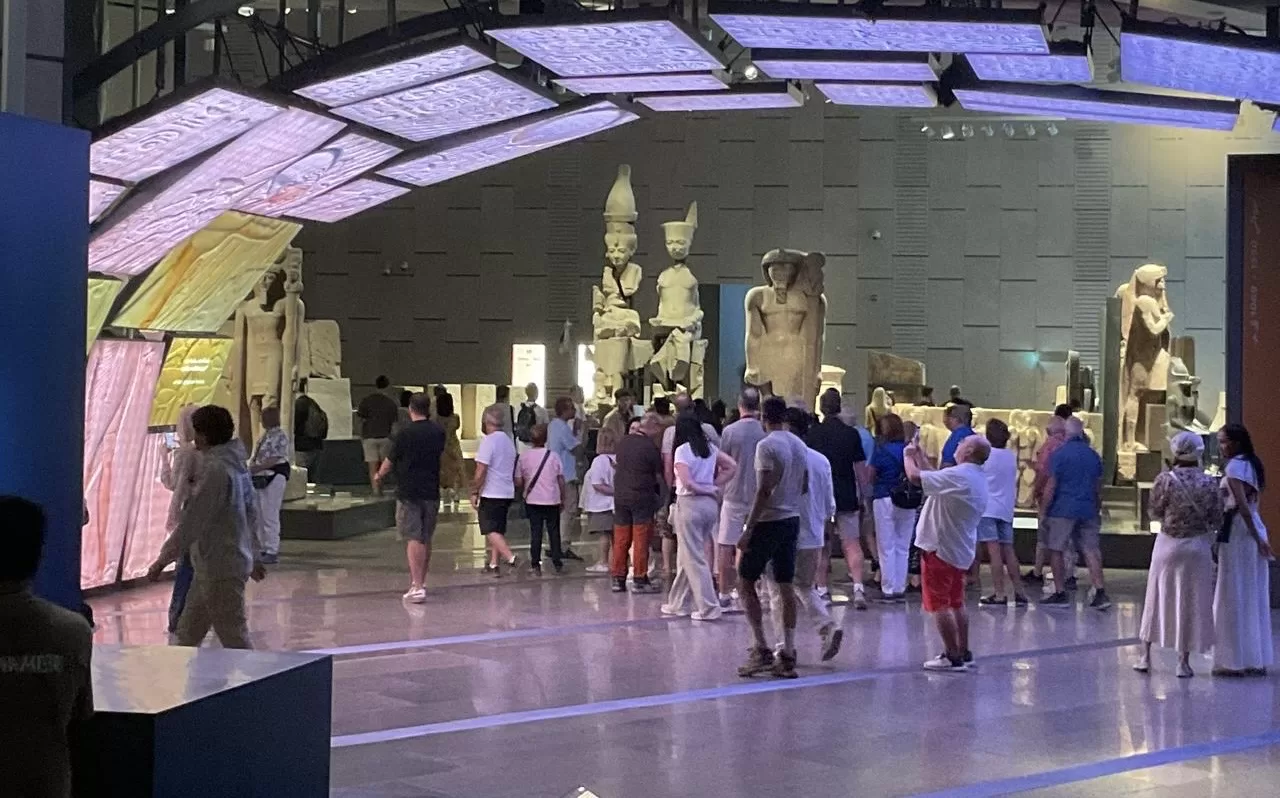
The Grand Egyptian Museum (GEM) prepares to welcome visitors to a new way of thinking: turning museum visits into an act of stewardship.
The new thinking derives from a new national etiquette campaign that draws on age-old principles of harmony and cosmic order.
The campaign is designed to gently guide the millions of people who pass through the GEM’s doors.
Titled “Guardians of History”, the campaign is the Ministry of Tourism and Antiquities’ newest effort to protect the museum’s world-class treasures,while improving visitor behaviour.
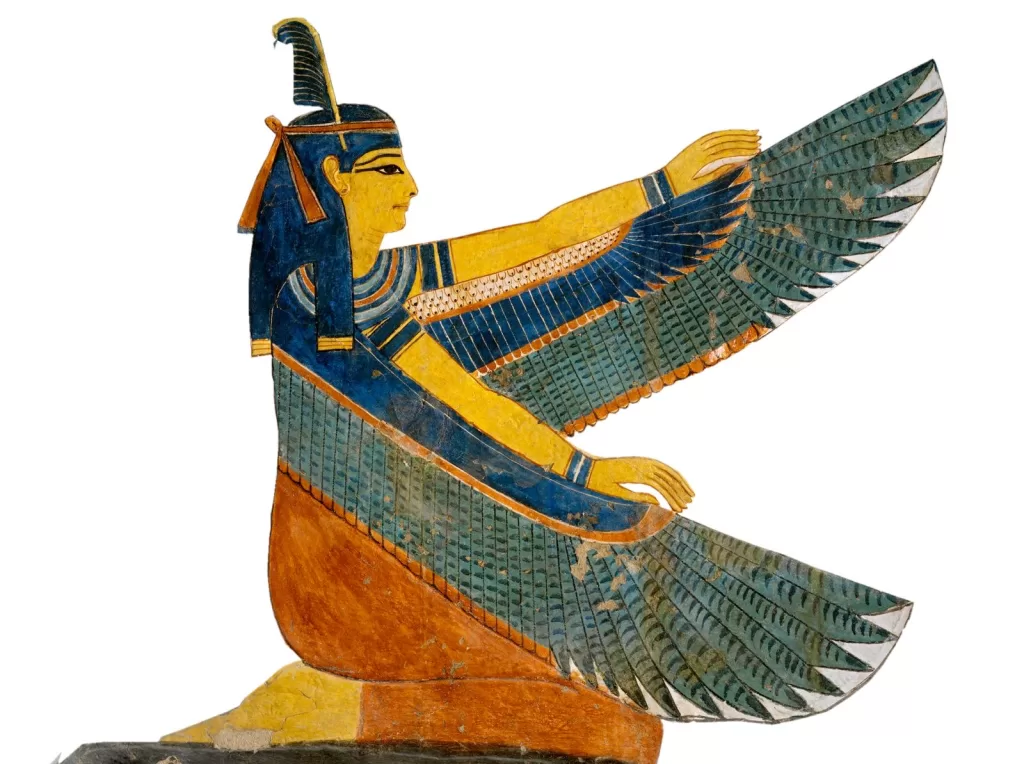
But rather than relying on stern warnings or the familiar “do not touch” signs that fill museums worldwide, the campaign draws its philosophical backbone from Maat, the ancient Egyptian goddess of truth, balance and responsible conduct.
Each etiquette guideline is framed as an echo of Maat’s timeless confessions, beginning with the phrase “I have not…”, transforming what could have been a routine set of rules into a personal pledge to safeguard humanity’s collective past.
This blend of cultural pride and gentle persuasion, museum officials say, is at the heart of the initiative’s tone.
“This is about awareness, not accusation,” Museum CEO, Ahmed Ghoneim, told The Egyptian Gazette.
“We want to correct behaviour in a respectful, non‑confrontational way,” he added.
He noted that the new campaign would depend on gentle reminders, rather than on harsh criticism.
The initiative emerged after the museum’s employees observed behaviour patterns during the weeks that followed the facility’s opening last November.
With tens of thousands of people entering the museum each day, similar problems kept emerging, across ages, social backgrounds and nationalities.
Ghoneim described the problems as “deeply-rooted”.
“We needed a larger public-awareness effort,” Ghoneim said. “Cleanliness, noise levels, and respecting the space required communication that went beyond what we were already doing,” he added.
Such challenges appear to be common around the world. Heritage sites everywhere struggle with overcrowding, rule-breaking and over tourism.
However, Egyptian officials believe their new way of reviving an ancient moral framework to subtly shape modern behaviour is tantamount to a culturally intelligent form of sustainability.
The etiquette campaign’s four core dos and don’ts remain straightforward.
Visitors are encouraged to respect other guests and museum staff, walk calmly, keep their voices low, maintain queues and personal space, and handle museum-issued devices carefully.
They are asked not to touch artefacts or display cases, not to bring food or drinks into the galleries, not to use flash photography, and not to run or behave disruptively inside the exhibition spaces.
Beneath these guidelines lies a set of implicit messages: pride in Egyptian heritage, a sense of responsibility, curiosity, and the idea that “this is your museum”.
Officials also hope to subtly promote greater engagement with the institution itself, reinforcing the idea that respect applies to all heritage sites across the country.
The museum is careful not to overwhelm visitors with rules. Instead, the messages are designed to be subtle and positive.
Rather than simply ban food, the campaign invites visitors to enjoy the museum’s restaurants.
Instead of reminding people about long lines, the museum encourages advance online booking to enjoy an easy visit.
Even transportation options, the newly installed waste-sorting system, and the museum’s many services, restrooms, prayer rooms, restaurants, lockers, are promoted as part of an overall narrative of care and comfort.
Accessibility is highlighted too: wheelchair-friendly pathways, Braille signage and inclusive facilities are presented not as regulations, but as features of the GEM’s welcoming design.
“We want to gently encourage new behaviour that enhances the visitor experience,” Ghoneim said. “We are not talking about strict directives, but about invitations.”
Experts have, meanwhile, welcomed the new effort. Renowned Egyptologist, Zahi Hawass, described the new initiative as something “essential” for Egyptian museums.
Poor behaviour during visits, he said, can cause serious damage to fragile antiquities.
“One careless touch can harm an object that survived thousands of years,” Hawass, the former minister of antiquities, said.
He hoped the campaign would not be limited to the GEM.
“It should be expanded to all other museums nationwide as well as major archaeological sites,” he told The Gazette.
Hawass noted that such initiatives may be less necessary in many foreign museums, where longstanding museum-going traditions and strict enforcement have made proper etiquette more routine.
Rieko Oka, wife of the former Japanese ambassador to Egypt, also praised the campaign.
Etiquette, she said, is an essential factor, especially for international tourists who come from diverse cultural backgrounds.
“Using ancient Egyptian gods and themes to explain the rules enhances familiarity with the ancient civilisation and makes the guidelines feel more fun and not too demanding, even though the content is the same,” she told The Gazette.
For the museum’s leadership, the initiative’s rollout has been organic.
Instead of relying solely on official channels, Ghoneim reached out to actors, singers, content creators, universities and producers to spread the message.
Some creators proposed ideas or volunteered to help, leading to a wide range of communication channels.
“Everyone wants to contribute,” Ghoneim said. “So we decided that the initiative would originate from the museum and then expand outward.”
The campaign’s video content, some starring well‑known figures, others produced in-house, will be released gradually.
The approach is indirect: instead of lecturing viewers, the videos show short scenes, depicting someone behaving inappropriately and someone else correcting them kindly.
Ghoneim unveiled his plan to phase out the content of the campaign, noting that he wants it to keep going.
“If people embrace the campaign and feel affinity with it, we will have succeeded,” Ghoneim said. “True, the initiative comes from the museum, but it belongs to everyone.”

