


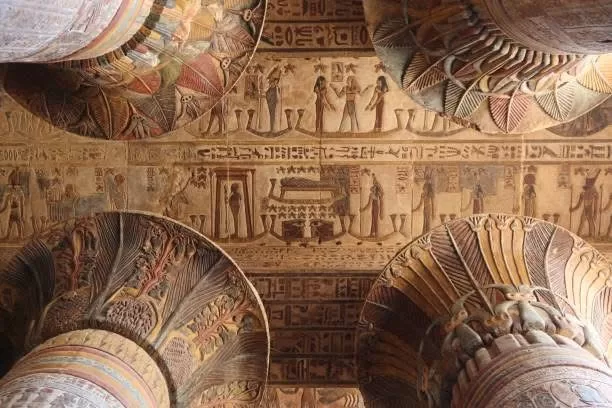
In the quiet Nile-side town of Esna, south of Luxor, a temple ceiling is drawing global attention for its fascinating colours and rare celestial imagery.
The Temple of Khnum, a Ptolemaic-and-Roman‑era monument dedicated to the ram-headed creator god, has emerged as one of Egypt’s most vivid showcases of ancient astronomy, with zodiac scenes once hidden for centuries under soot.
The temple’s entrance hall, supported by 18 towering columns, is one of the best-preserved examples of painted sacred architecture in Egypt.
Each column is topped with a carved floral capital, its lotus and palm leaves glowing again in shades of blue, red, and green.
The hall forms what researchers describe as a stone forest, guiding visitors towards a ceiling that ancient priests once treated as a map of the universe.
What most captivates visitors is the temple’s astronomical ceiling. Spanning multiple bays, the panels depict a full zodiac alongside planets, star clusters, and protective deities.
Aries through Pisces appear in sequence, reinterpreted with unmistakably Egyptian touches: Scorpio coils beneath a field of stars, while Sagittarius emerges as a centaur‑like archer shaped by both Greek and local traditions.
Rows of Egyptian decans, the 36 star groups that divided the night into hours, run between these figures.
Hybrid creatures, winged serpents, and symbols linked to the lioness goddess Sekhmet complete the composition. The imagery blends Greek zodiac concepts with older Egyptian astronomical traditions, forming a rare fusion of science, ritual, and myth.
The carvings reveal the scaled wings of vulture goddesses, the flowing garments of deities, and soft colour transitions on planets and constellations.
Each scene reflects what ancient Egyptians believed to be the ordered universe, one governed by Ma’at, the cosmic principle of balance.
The ceiling highlights a tradition that long predates the Ptolemies. Egyptians created a 365‑day solar calendar around 3000 BC, predicted the annual Nile flood by tracking the heliacal rising of Sirius, and followed planetary movements with surprising precision.
Egyptologist Hussein Bassir described ancient Egyptian astronomy as one of the most remarkable examples of the creative interaction between humans and the cosmos.
“The sky was not an abstract realm but a living system tied to agriculture, festival cycles, and beliefs about creation and rebirth,” he told The Egyptian Gazette.
Bassir, director of the Antiquities Museum at the Library of Alexandria, added that astronomical knowledge supported the agricultural state, regulated seasons, and shaped ritual life.
“Watching the sky was essential to understanding nature and organising society,” he said. “Celestial images reflected fundamental ideas about birth, death, and cosmic renewal.”
Within this tradition, the Temple of Khnum at Esna offers one of the richest surviving sources for studying late ancient Egyptian astronomy.
“Its significance also lies in the cultural interactions it reflects,” Bassir said.
During the Ptolemaic and Roman periods, he added, Egyptian traditions encountered Babylonian and Greek astronomical ideas.
Rather than adopting them wholesale, Egyptians reinterpreted and integrated these elements into their own religious system.
“The zodiac at Esna, though Mediterranean in origin, appears fully embedded in an Egyptian sacred programme, showing how foreign knowledge was reshaped within a local framework,” Bassir said.
“This makes Esna an exceptional case study for understanding how astronomical ideas moved and transformed across cultures,” he added.
Esna’s cosmic imagery is closely tied to its central deity. Khnum, the god of creation who shapes humans on a potter’s wheel, aligns naturally with a ceiling that expresses cosmic order and the origins of life.
The sky at Esna is not background decoration, but a theological statement about renewal and divine structure.
Ancient Egyptian astronomy, Bassir said, must be viewed within its historical context.
“Though not astronomy in the modern scientific sense, it represented highly advanced observational knowledge,” he said.
“Egyptians tracked celestial cycles, regulated calendars, and used the heavens as a medium for religious and artistic expression,” he added.
Magdy Shaker, chief archaeologist at the Ministry of Tourism and Antiquities, said Egyptians relied on a solar calculation systemthat was later adopted by other civilisations.
“They predicted the Nile flood by observing the heliacal rising of Sirius at dawn from the eastern horizon of ancient Memphis,” Shaker said.
“Their year contained 365 days, divided into 12 months of 30 days plus five festival days,” he told The Gazette.
Shaker noted that Egyptians understood the planetary motion, including the retrograde path of Mars, and were the first to determine true north with great accuracy, evident in the precise alignment of the pyramids.
One corridor in the Great Pyramid aligned with the celestial north pole of its era, then near the star Thuban in Draco, he said.
He added that our ancestors classified stars into imperishable and never-weary groups, and identified five wandering stars, namely Mars, Jupiter, Mercury, Saturn and Venus, as deities travelling across the sky in boats.
Shaker said royal tombs in the Valley of the Kings include elaborate star scenes, particularly from the Ramesside period, where 14 seated figures appear as markers of time.
“Egyptians measured time with water clocks at night and shadow-based devices by day,” he added.
From the New Kingdom onward, he said, astronomical scenes covered temple and tomb ceilings, depicting constellations, lunar months and the hours of day and night.
“Astrology relied in ancient Egypt on the belief that earthly events mirrored those unfolding among the gods, and that Greek and Roman scholars acknowledged their debt to Egyptian knowledge,” he said.
Thinkers, such as Greek philosopher Pythagoras and mathematician Archimedes, travelled to Heliopolis and Memphis to study astronomy with Egyptian priests, he added.
It is this long tradition of sky-watching from star lore and timekeeping to the exchange of astronomical knowledge across cultures that forms the backdrop to the Esna temple’s renewed significance.
That legacy is currently reflected in a new exhibition, ‘Destiny in the Stars: The Beginnings of the Zodiac’, at the Egyptian Museum and Papyrus Collection in the German capital of Berlin.
The six‑month show, which opened last week and is organised in co-operation with the Egyptian‑German mission at Esna, presents the newly restored zodiac alongside scenes from Dendera and a selection of ancient time‑measuring instruments.
Together, they highlight Egypt’s central role in the early history of astronomy.
The exhibition offers a rich educational experience, tracing the zodiac’s deep roots and its enduring influence on human culture.
Rare manuscripts, artefacts and immersive astronomical displays guide visitors through thousands of years of sky‑watching traditions.
Today, the Temple of Khnum at Esna stands as a vivid testament to the Egyptians’ passion for observing the sky and their ability to transform that passion into art, architecture, and religious meaning, specialists said.
“Esna shows that ancient Egypt was not only a civilisation of monumental stone but also a civilisation of time, order, and cosmic imagination,” Shaker said.

