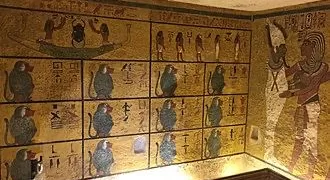




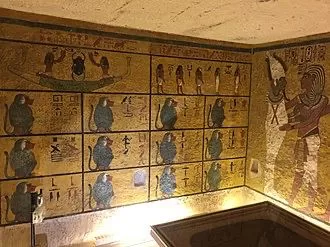
Egypt’s Supreme Council of Antiquities (SCA) has firmly denied recent foreign media reports suggesting that King Tutankhamun’s tomb (KV62) in Luxor’s West Bank faces structural threats, insisting the tomb is in excellent condition and poses no risk of collapse.
SCA Secretary General Mohamed Ismail Khaled rejected allegations that cracks and increased humidity levels are causing deterioration in the tomb’s wall paintings.
“These claims are completely unfounded,” he stated, adding that the tomb remains in a remarkable state of preservation and faces no danger to either its structural integrity or its vivid wall art.
The SCA emphasised that regular, ongoing monitoring of the tomb is conducted in collaboration with the Getty Conservation Institute — the primary partner in the conservation project for King Tutankhamun’s tomb — as well as several other international preservation specialists.
Recent scientific examinations and studies performed by the Getty Conservation Institute confirm that there have been no significant changes or deterioration in the tomb since its discovery more than a century ago, in November 1922.
“The marks and cracks observed on the tomb’s walls are not new,” Khaled clarified, “They have remained unchanged for over 100 years.”
The Getty Institute’s report, referenced by Egyptian authorities, suggests that recent media attention was based on a research paper containing inaccurate assumptions and exaggerated interpretations, possibly resulting from misreading data, outdated information, or confusion with another tomb in the Valley of the Kings.
Furthermore, Khaled highlighted that the tomb has undergone extensive restoration and conservation following the highest international standards, supervised by Getty Conservation Institute experts.
Today, King Tutankhamun’s tomb is considered one of the best-preserved tombs in the Valley of the Kings.
Egyptian authorities encouraged the international press to refer to trusted scientific sources and official updates to avoid spreading misinformation about this iconic archaeological heritage site.

