




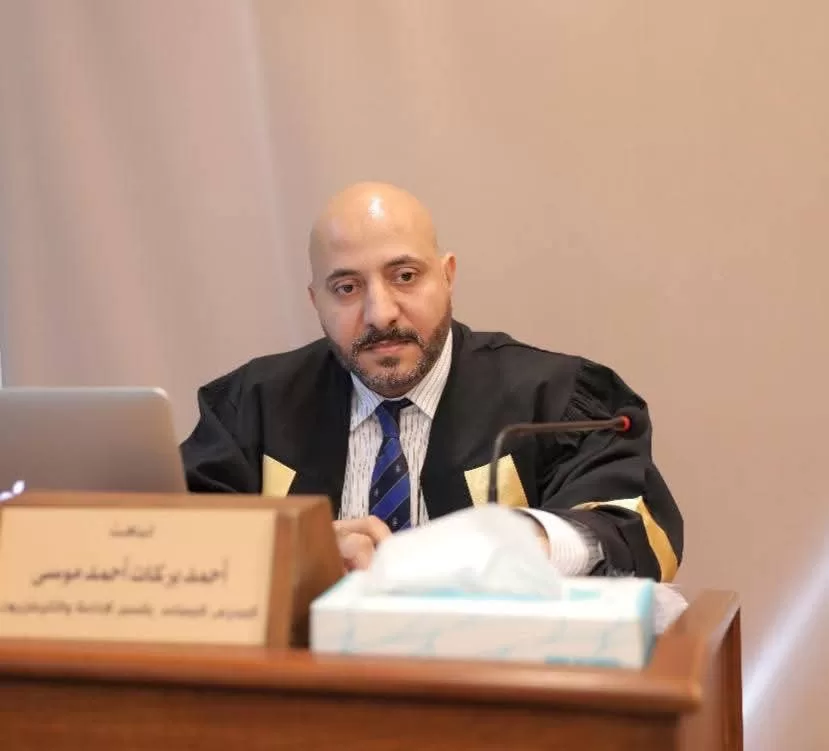
The Faculty of Mass Communication at Al-Azhar University has recently hosted the successful defense of a doctoral thesis that proposes a comprehensive professional and ethical framework for media coverage of terrorist attacks targeting places of worship. The thesis was presented by Ahmed Barakat Ahmed Moussa, assistant lecturer in the Radio and Television Department and director of Al-Azhar University’s Media Center.
Entitled “American Satellite Channels’ Coverage of Terrorist Incidents on Places of Worship in Light of Media Bias Theories,” the research examined the role of ideological bias in the coverage of such incidents by major U.S. news outlets. The defense was held in the presence of Professor Salama Dawoud, President of Al-Azhar University.
Following the defense, the examination committee unanimously recommended awarding Moussa a PhD with first-class honors. The committee also recommended that the thesis be printed and distributed to academic institutions across Egypt and the Arab world.
The examining committee comprised: Professor Mahmoud Abdel-Ati Muslim, Professor and Head of the Radio and Television Department (supervisor), Professor Arafa Amer, Professor of Radio and Television and former Vice Dean of the Faculty (internal examiner), Professor Princess Samah Farag, Dean of the Faculty of Mass Communication at Sinai University and Professor at Cairo University (external examiner).
The study focused on the media coverage of the March 15, 2019 terrorist attack on two mosques in Christchurch, New Zealand, which claimed the lives of 51 worshippers. By analyzing reports from CNN and Fox News, Moussa investigated the influence of media bias and political partisanship on the portrayal of the tragedy.
The research found significant discrepancies between the two networks. CNN promptly categorized the incident as a “terrorist attack,” emphasizing its humanitarian dimensions. It featured survivor testimonies, victim stories, and criticism of former U.S. President Donald Trump’s stance on gun control and right-wing extremism. The channel underscored the broader context of political rhetoric contributing to violent ideologies.
Conversely, Fox News initially described the event as a “mass shooting” and avoided labeling it as terrorism. Its coverage largely centered on defending Trump, framing criticism of him as politically motivated, and downplaying the threat posed by far-right extremist groups. Fox News also questioned the objectivity of other media outlets, portraying their reporting as potentially destabilizing.
Based on these findings, Moussa developed a professional code of conduct comprising 20 actionable guidelines aimed at enhancing the ethical and professional standards of media coverage of terrorist attacks on places of worship. The committee endorsed the dissemination of this code to media institutions and regulatory bodies to support responsible journalism in times of crisis.

