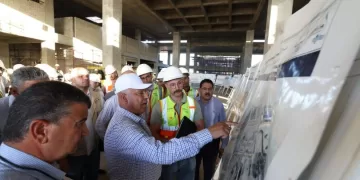





Minister of Transport, Kamel El-Wazir, has inspected construction works on a 210-km section of the country’s planned high-speed electric railway linking Aswan and Luxor, as the government continues its nationwide railway modernisation programme.
Accompanied by the governors of Aswan and Luxor, El-Wazir toured stations and construction sites along Line 2 of the high-speed rail network, a 1,100-km route connecting 6th of October City, Aswan and Abu Simbel.
The minister reviewed progress at nine stations on the Aswan–Luxor section, including high-speed rail stations at Aswan Airport, Edfu and Luxor, as well as regional stations serving New Aswan, Kalabsha, El-Sebaiya, Daraw, Esna and Armant.
Line 2 will comprise 36 stations, including 13 high-speed rail stations and 23 regional stations.
According to a statement from the Ministry of Transport, El-Wazir reviewed construction timetables, passenger movement plans and investment opportunities at the stations. He instructed contractors to accelerate implementation while maintaining the highest quality standards.
The minister said the stations had been strategically selected to serve population centres, road networks and Nile crossings throughout Upper Egypt. Access roads and parking facilities are being developed to improve connectivity for neighbouringtowns and villages.
El-Wazir also inspected track-laying works being carried out by Egyptian companies and highlighted the strategic importance of the railway as a key component of the Alexandria–Cairo–Aswan–Toshka logistics corridor.
The corridor is expected to connect agricultural production areas in Toshka, West Aswan and West Minya with consumer markets in Cairo and export facilities in Alexandria. It will also enhance access between major tourist destinations, including Abu Simbel, Aswan, Luxor, Abydos and the Giza Pyramids.
In addition, the line will link mining and quarrying areas in Abu Tartour, Qena and Aswan with export ports, while helping to reduce emissions associated with diesel-powered transport.
The ministry said the three-line high-speed rail network is expected to generate thousands of direct and indirect jobs and cut travel times between governorates by more than half compared with existing road and rail services.
Line 2 will also serve logistics zones in Farshout, NagaaHammadi, Qena and Toshka, while providing links to a number of new urban developments across Upper Egypt. It will connect with Line 1 at Hadayek October Station and with Line 3 at Qena Station.
Egypt’s high-speed rail network will extend over approximately 2,000 km and include 60 stations, two main workshops and five maintenance depots. The fleet will comprise 41 high-speed trains, 94 regional trains and 41 freight locomotives.
The second line will also feature a control centre, a major maintenance workshop, and three maintenance and storage facilities along the route.

