
It is al-Mouled al-Nabawy then, the time for hundreds of millions of Muslims across the globe to remember, a dear occasion they wait from year to year; Prophet Muhammad’s birthday.
Al-Mouled (Prophet’s birthday), falls on the 12th day of the third month of the Islamic calendar, Rabei al-Awal. This year it is tomorrow.
Muslims’ celebrations around the globe vary from a country to another, but still they share the very essence of the occasion, as an opportunity to remember Prophet Muhammad’s teachings and way of life, which all Muslims seek to emulate.
However, not all Muslims commemorate al-Mouled, arguing that it was not marked at the time of Prophet Muhammad, neither was it outlined in Islamic teachings.
In Egypt, people are so keen to mark the occasion and share Muslims’ feelings of the elevated and solemn religious occasion, through religious rituals, such as reflecting on Qur’an and sayings of the Prophet. However, Egyptians’ celebrations have a special characteristic, namely halawet al-Mouled (al-Mouled sweets).
Many days before the occasion, a Cairo visitor can easily feel a festive mood on most streets of the capital, mainly in popular districts, where shops offer various types of sweets, mostly traditional forms well known to all Egyptians.
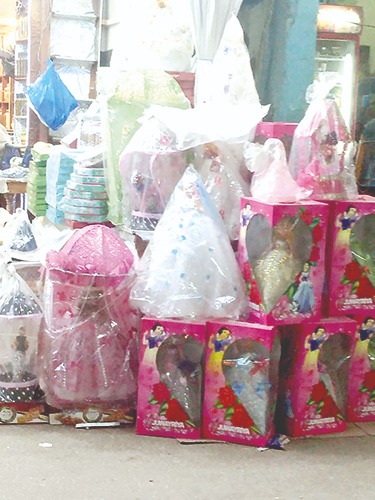
For most people nationwide, the Arousa (a doll in the form of a bride), for girls, and a doll Horse, for boys, are the two major traditional symbols of al-Mouled sweets. They are colourful sugar-syrup dolls with remarkable attires and pleasant paper garments.
The Arousa and the Horse do not seem to be as popular today as used to be in old days, and are rarely seen at present. People buy other forms of sweets for al-Mouled, such as “Foolia” (caramelised peanuts) and “Semsemia” (caramelised sesame treat) and other types of caramelised nut bars and coconut sweets.
Historical resources suggest that the celebrations for the birth of Prophet began to have these particular aspects under the Fatimids who ruled Egypt for almost two centuries that ended in 1171. At the time they highly cared about religious occasion, thinking this could get them closer to the people.
“The most common tale about the Arousa and the Horse, suggest that they first appeared under Fatimid Caliph el Hakem Bi-Amr Allah el Fatimi, who dearly loved his wife and used to accompany her out on the occasion of the Prophet’s birthday,” said Mohamed Afifi, member of the Cairo University Council for Culture.
“The look of the Caliph’s wife, cladded in a bright white dress, with a jasmine crown on her head, inspired sweet makers to produce a doll representing her, and a horse for the ruler. They competed to make the sweet bride and the horse look more attractive,” Afifi told the Egyptian Mail. The horse has a knight wielding his sword on its back and a flag raised at his back.
Caliph Al-Hakim gave orders allowing marriages ceremonies to take place only on the Prophet’s birthday. The occasion soon became a season of marriage and pleasure, and candy makers excelled in producing doll brides, covering them with fabulous white dresses, according to Afifi.
The sweet brides soon became a symbol of celebration, not only for the al-Mouled, but marriage, as a happy social occasion.
This has become a well-established social custom for long centuries, and a fiancé should offer his future wife the Arousa on the Prophet’s birthday, keeping the sweet Horse for himself. This still even persists today, albeit on a smaller scale.
Over the recent years, plastic dolls have come to replace the sweet ones, and are widely spread. The sweet dolls resisted for some time, but seemed to surrender, though for many, they reflect some spiritual feelings of the religious, and social al-Mouled.
Very few factories still produce the old forms of al-Mouled sweets, namely the Arousa and the Horse, and most of them are in Upper Egypt where demand on the doll is higher than in Cairo, for instance.
“We heat the sugar to reach the boiling point, so that it can be formed easily, and then we pour the liquid wooden molds, taking the shape of the bride or the horse,” Sayed El Araby, a merchant of al-Mouled sweets in down town Cairo, explained.
They are then left to cool and dry to remove the moulds and get the doll or the horse out. Then they are decorated with various forms of bright sullivan paper, he added.


Editor-in-Chief
Mohamed Fahmy
Board Chairman
Tarek Lotfy
Sweet Arousa, Horse symbols of good old days

ADVERTISEMENT

The Egyptian Gazette is the oldest English-language daily newspaper in the Middle East.
It was first published on January 26, 1880 and it is part of El Tahrir Printing and Publishing House.
Discussion about this post