




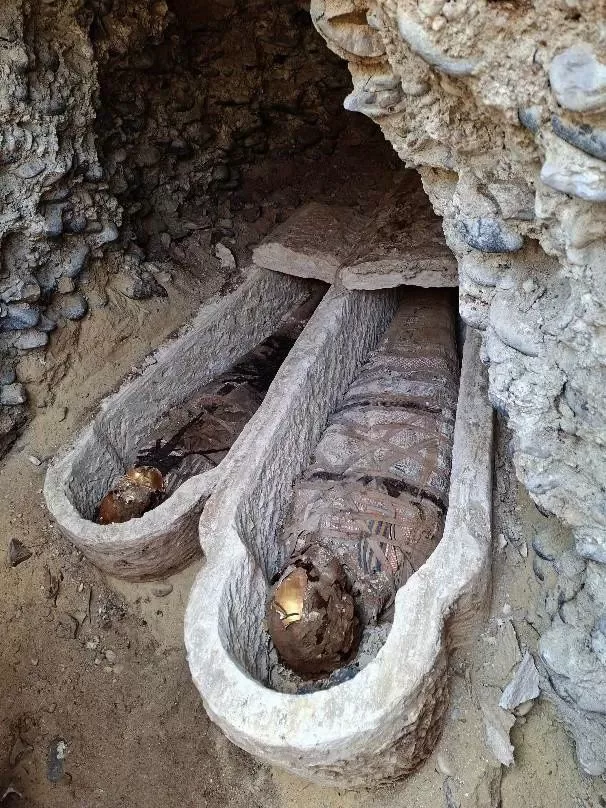
Egypt’s Ministry of Tourism and Antiquities announced a new archaeological discovery in the Bahnasa area of Minya Governorate on Saturday, shedding fresh light on funerary practices during the Greek and Roman periods.
The find revealed a Roman-era tomb containing several mummies, some wrapped in bandages decorated with geometric patterns, along with wooden coffins, three golden tongues, and a copper tongue, in addition to evidence of the use of gold leaf on certain mummies.
According to a statement from the Ministry of Tourism and Antiquities, a Spanish archaeological mission from the University of Barcelona and the Institute of the Ancient Near East, led by Maite Mascort and Esther Ponce Melado, has made the discovery.
Egyptian Minister of Tourism and Antiquities Sherif Fathy praised the find, noting that it continues a series of important discoveries in the region and underscores the richness and diversity of Egyptian civilisation throughout history.
For his part, Hisham el-Leithy, Secretary-General of the Supreme Council of Antiquities, added that the site offers valuable insights into burial traditions in Bahnasa during the Greek and Roman eras.
He highlighted the unearthing of a rare papyrus inside one of the mummies, containing a passage from the second book of Homer’s Iliad, including the “Index of Ships,” which lists participants in the Greek campaign against Troy, adding an important literary and historical dimension to the find.
Professor Mohamed Abdel-Badi, Head of the Egyptian Antiquities Sector at the Supreme Council of Antiquities, explained that excavations east of Ptolemaic Tomb No. 67 revealed a trench containing three limestone burial chambers.
These chambers housed the cremated remains of adults and an infant, as well as animal remains, notably cats, wrapped in cloth.
The team also discovered a collection of small terracotta and bronze statues, including representations of the god Harpocrates and a figure of Cupid.

