


Initiative to boost collaboration in new, renewable energy launched
Egypt’s President Abdel Fattah El Sisi paid a work visit to Djibouti, where he held a summit and comprehensive talks with President Ismail Omar Guelleh, on several bilateral and regional issues, as part of the continued efforts to develop strategic partnership ties between the two sisterly countries in various fields.
President Sisi and President Guelleh discussed ways to strengthen bilateral relations and joint coordination on regional developments in the Red Sea and the Horn of Africa.
Sisi and Guelleh held extensive political consultations, and stressed the deep fraternal, historical and strategic relations between the two countries and their peoples, as well as their commitment to step up efforts to upgrade co-operation in various fields, in addition to bolstering coordination on regional and international issues of common interest.
They highlighted the efforts being exerted to further deepen co-operation in many fields, including defence, security, combatting extremist ideology, media, energy, trade, economics, communications, agriculture, irrigation and water resources, education, higher education, culture, health, social solidarity, tourism, youth and sports. They also emphasised their countries’ pivotal role in their regional and international surroundings.
President Sisi extended congratulations to Djibouti on the election of its former Foreign Minister Mahmoud Ali Youssef to the post of Chairperson of the African Union Commission, wishing him success in his major and noble mission in serving the continent and its peoples.
Guelleh, for his part, reaffirmed Djibouti’s support for Khaled el-Anani, the candidate of Egypt, and the Arab League and the African Union, for the post of Director-General of the United Nations Educational, Scientific and Cultural Organisation (UNESCO), in the elections scheduled to be held in October 2025.
The two presidents announced the launch of a joint initiative to further boost collaboration in new and renewable energy, considering the importance of energy sector for achieving sustainable development, prosperity and well-being for the Djiboutian people.
They agreed to lay the foundation stone for the project of supplying and installing a solar power plant in the village of Omar Jagaa in Carta, over the coming few days, in addition to other energy projects. They also highlighted a host of major port projects Egypt is carrying out there.
Sisi and Guelleh called for speeding up efforts for the opening of Egypt’s Banque Misr-Djibouti over the coming days. They lauded bilateral co-operation in countering terrorism and extremism, welcoming the opening of Al-Azhar centre for teaching Arabic there.
They welcomed Egypt’s forthcoming dispatch of medical convoys to treat patients in Djibouti, referring to efforts to enhance healthcare links between both countries.
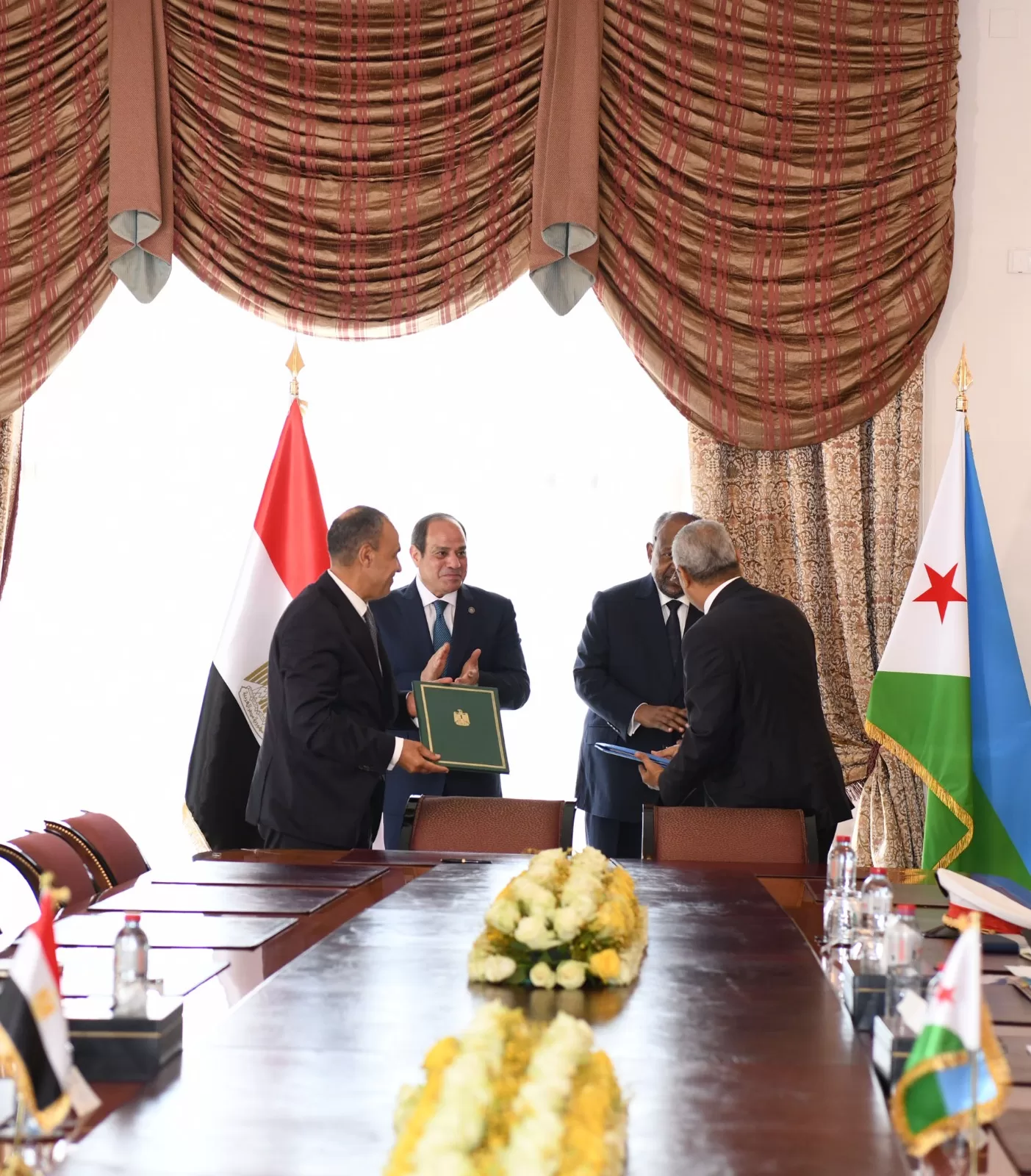
The two leaders signed MoUs to boost co-operation in the field of youth and sports and media, and scientific research.
On regional issues, they welcomed efforts that would support security and stability in Somalia, and its territorial integrity and unity, and strengthen the capabilities of the Somali state institutions and the federal government to face any challenges.
Referring to Gaza, the two presidents condemned the renewed Israeli aggression against the Strip, which formed a flagrant violation of the ceasefire agreement, and affirmed the outcomes of the extraordinary Arab summit held in Cairo in March, namely achieving a just and comprehensive peace based on the two-state solution.
They condemned the Israeli blocking of the entry of humanitarian aid into Gaza, urging Tel Aviv to stop violating the ceasefire agreement, and to return to the negotiating table.
Discussing Sudan, Sisi and Guelleh affirmed utter rejection of any attempts to threaten the unity, sovereignty and territorial integrity of the country and emphasised the need for all Sudanese forces to engage in a comprehensive political process.
The two presidents voiced concern over the deteriorating political and security situation in South Sudan, calling on all parties concerned to avoid escalation and resolve differences through peaceful and diplomatic means, to preserve the security and stability of South Sudan and the region.
They also stressed the importance of strengthening coordination on issues related to the Red Sea, and voiced rejection of any practices that could lead to destabilise security and freedom of navigation in the vital navigation corridor for international trade.

