




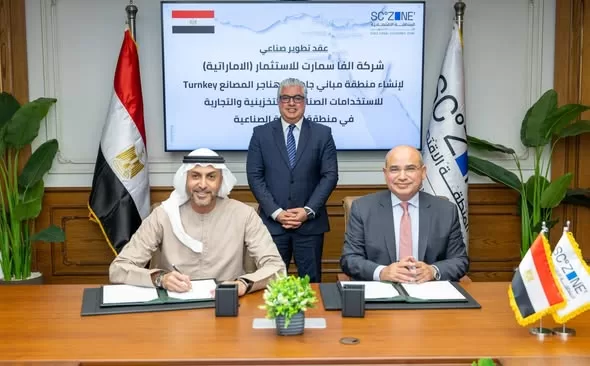
The Suez Canal Economic Zone (SCZone) has signed a $100 million investment agreement to develop an integrated ready-built factory complex in the Ain Sokhna Industrial Zone, as part of efforts to accelerate industrial expansion, attract fresh investment and boost Egypt’s export capacity.
SCZone chairman Walid Gamal El-Din witnessed the signing ceremony on Tuesday at the authority’s headquarters in Egypt’s New Capital.
The project will be carried out in two phases across a total area of 500,000 square metres, with each phase covering 250,000 square metres. Direct investment stood at around $100 million, equivalent to approximately LE5 billion, while the development is expected to draw additional industrial investments exceeding $150 million. It is also projected to generate around 5,000 direct jobs and more than 7,000 indirect employment opportunities.
The complex is being developed as a fully integrated ready-factory ecosystem, enabling manufacturers to commence operations within less than 90 days. It will include fully equipped industrial units, a logistics zone comprising warehouses and a global distribution centre, in addition to an administrative and commercial district featuring business hubs, co-working spaces and a digital management centre.
Gamal El-Din said the Ain Sokhna Industrial Zone had become a leading industrial and logistics platform, supported by its integration with Port of Ain Sokhna and its strategic position on major international trade routes. He added that the project would support Egypt’s drive to localise industry, expand exports and maximise opportunities created by global supply chains.
The development is expected to attract a broad range of industries, including engineering, light electronics, food processing and agro-industries, packaging, light chemicals, automotive components, household appliance parts, as well as e-commerce and logistics-related activities.
Implementation is scheduled over a maximum six-year period. The first phase will include infrastructure and utility works with a power capacity of 25 megawatts, alongside completion of 50% of the industrial units, with operations due to begin in the second year.
The second phase will focus on logistics and service expansions, as well as completion of the remaining project components to achieve full operational capacity.

