




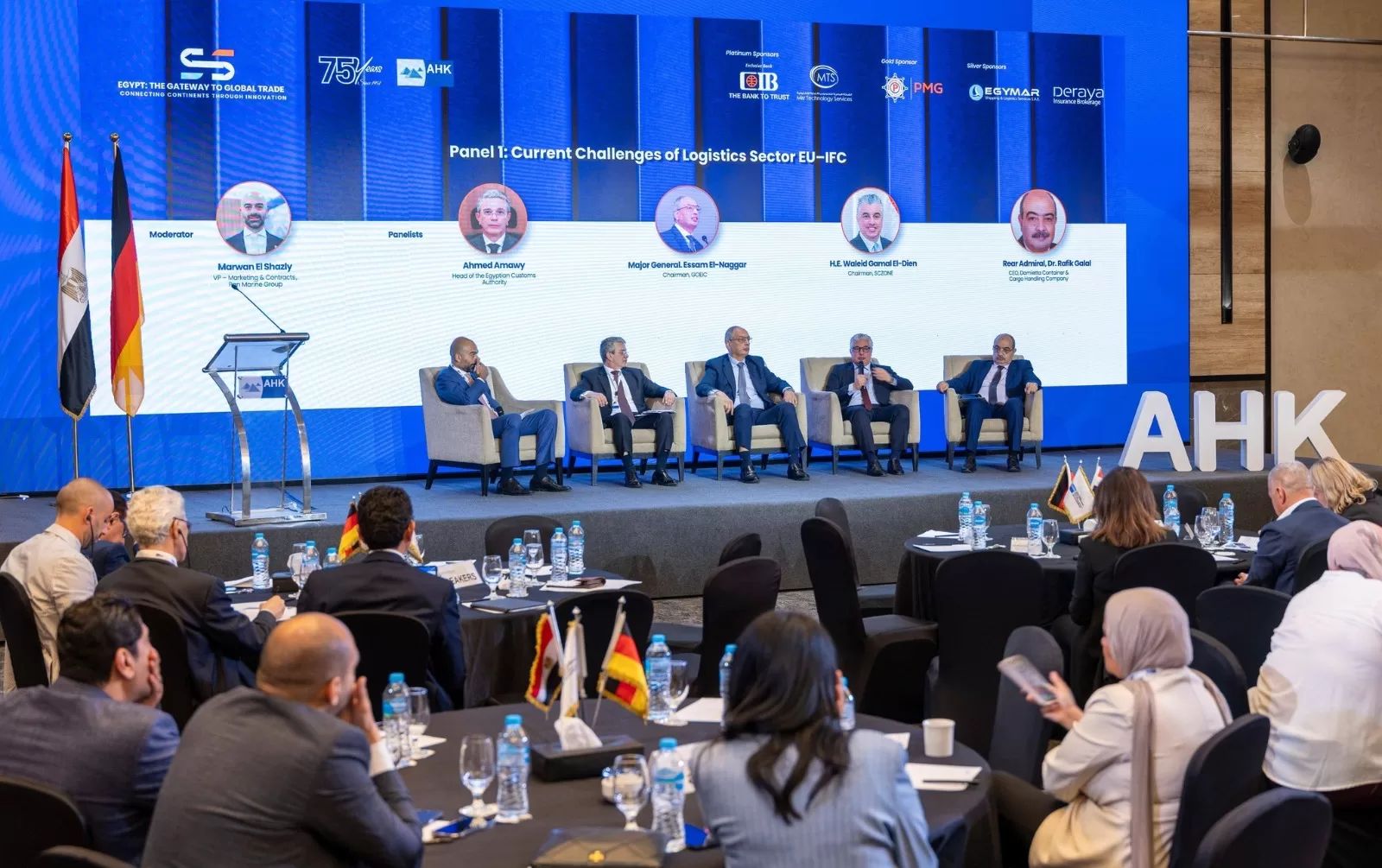
“Egypt: The Gateway to Global Trade – Connecting Continents Through Innovation”, has been the key theme of a conference organised by the German-Arab Chamber of Industry and Commerce – (AHK Egypt).
The event featured participation of many senior officials, business leaders, international institutions and companies operating in transport and logistics.
Chairman of the Suez Canal Economic Zone (SCZone), Walid Gamal El-Din, took part in the first panel discussion of the conference, on the key challenges facing the logistics sector and ways to enhance its efficiency amid global shifts.
The panel discussion, titled “Current challenges of the logistics sector”, was moderated by Marwan El-Shazly of Pan Marine, alongside Ahmed Amoui, Head of the Egyptian Customs Authority; Essam El-Naggar, Head of the General Organisation for Export and Import Control; and Rear Admiral Dr Rafik Galal, Chairman of Damietta Container and Cargo Handling Company.
The SCZone is repositioning itself as an integrated industrial and logistics hub, capitalising on global supply chain transformations, Gamal El-Din said.
Despite challenges, the authority has attracted around $16 billion in investments over three years and nine months, he added.
The current fiscal year has already recorded a new high, with total investments reaching $7.1 billion so far, including $1.8 billion over the past two months alone, the SCZone chief noted.
Referring to operations, he highlighted steady growth in revenues and throughput, noting that container traffic at East Port Said Port rose from 2.4 million containers in 2024 to 5.6 million in 2026, accounting for around 70 per cent of Egypt’s transit trade.
Arish Port has also developed from near-idle status to handling between 4.5 and 5 million tonnes annually, alongside the national project to develop Sokhna Port and link it with logistics corridors extending to Alexandria.
Gamal El-Din added that this growth aligns with a clear strategy to localise industry, targeting sectors such as renewable energy (solar panels and cells), pharmaceuticals, metals—particularly aluminum—chemicals including phosphate fertilisers, as well as battery and electric vehicle industries, in addition to food and textiles.
The SCZone offers strong competitive advantages, including low labour costs, competitively priced energy, a strategic location close to global markets, international trade agreements and advanced infrastructure, he further said, pointing to the successful rollout of ship bunkering services at SCZone ports in cooperation with relevant authorities.
In the meantime, he said the authority expects to close the year with the highest revenues and surplus in its history, with growth exceeding 30 per cent, supported by the opening of new factories in the second half of the year—further boosting investor confidence and reinforcing the SCZone’s position as a strategic hub in global supply chains.
The total investment cost of port projects affiliated with the authority stands at approximately $1.675 billion, including $1.516 billion in implemented contracts between July 2022 and April 2026, covering 14 projects.

