







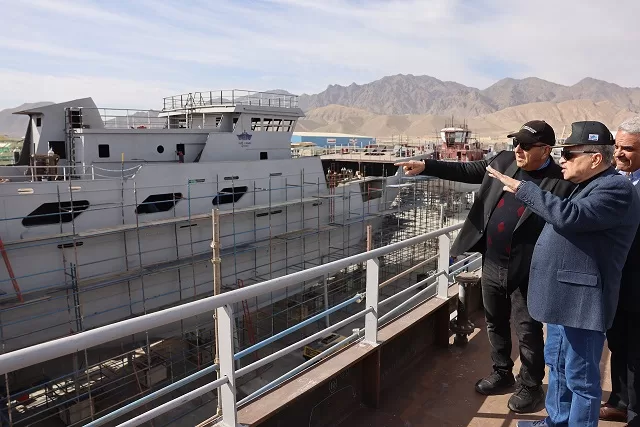
Vice Admiral Osama Rabie, Chairman of the Suez Canal Authority (SCA), inspected ongoing construction of several marine units at the South Red Sea Shipyard Company and reviewed work at the tourist yacht factories of the Suez Canal Company for Modern Boats in Safaga.
The visit comes within the framework of a partnership between the SCA and the South Red Sea Shipyard Company aimed at localizing the maritime industry and strengthening cooperation with the private sector.
During the tour, Rabie inspected the tugboats Azm 3 and Azm 4, reviewing the results of sea trials and towing tests ahead of their delivery and operation.
He also checked on the fishing vessels Rizk 2 and Rizk 3, whose hull construction has been completed in preparation for launching.
At the yacht factory, Rabie was briefed on the final outfitting works ahead of sea trials for a new tourist yacht, continuing the production line that previously delivered the yachts Nasr and Irada. The yacht is 37 meters long, 8.2 meters wide, weighs 135 tons, and is equipped with MTU engines with a total power of 2,600 horsepower, featuring a Sport Fisherman design.
Rabie also followed up on the construction of two wooden and fiberglass tourist launches, each with a capacity of 13 passengers. Hull construction has been completed, with equipment and machinery currently being installed, ahead of their operation in maritime tourism within the Suez Canal.
The SCA chairman was also briefed by Mustafa El-Degishy, Chairman of the South Red Sea Shipyard Company, on progress in building 12 deep-sea fishing vessels and the implementation timeline for six marine tugboats as part of a series of 10 Azm-class tugboats with a bollard pull of 90 tons.
Four tugboats have already been completed, alongside the construction of two similar units for export to the Italian company NERI.
Rabie said the strategy to localize maritime industries is advancing rapidly, in line with President Abdel Fattah El Sisi’s directives to meet the needs of Egyptian ports and modernize the national fishing fleet.
He added that production capacity is set to increase in the coming period, supporting local demand and opening export markets under the “Made in Egypt” label.
For his part, El-Degishy said the partnership has expanded the company’s capabilities, workforce, and projects, positioning it for higher production rates in the maritime industry.

