


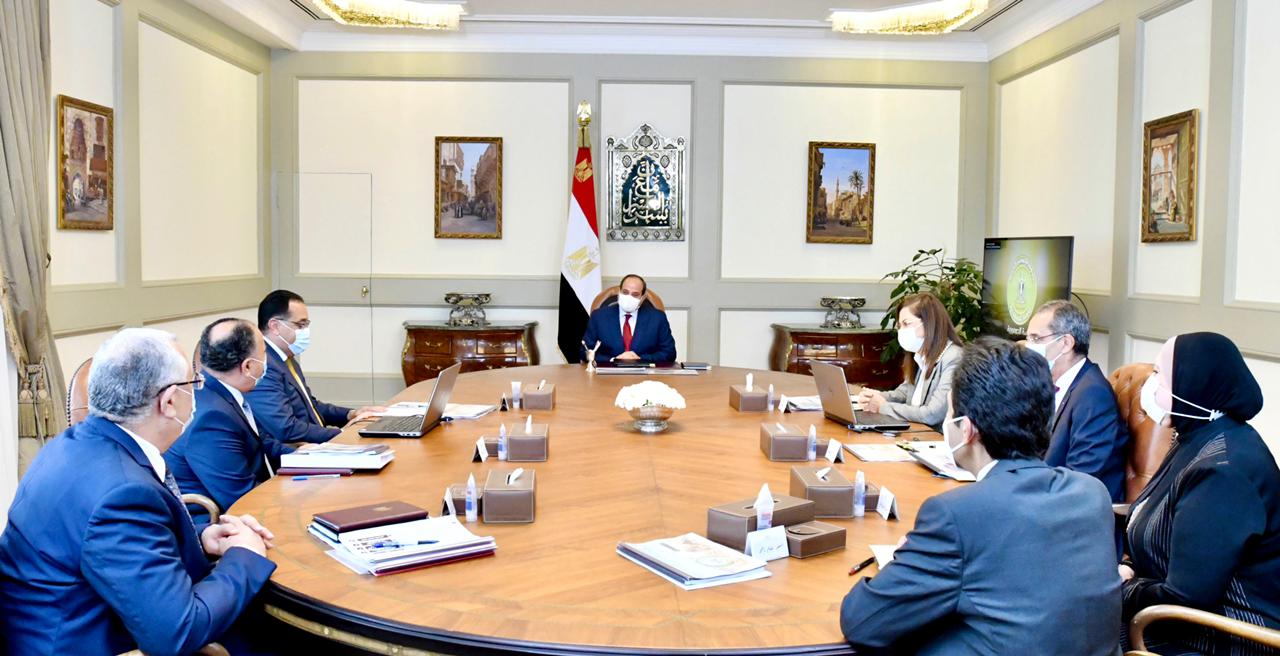
President Abdel Fattah El Sisi called for promoting transformation to the green economy through relying on clean energy and strengthening efforts to localise the industry to reduce the country’s import bill.
The president’s remarks came during his meeting with Prime Minister Moustafa Madbouli, Minister of Planning Hala el-Saeed, Minister of Finance Mohamed Maeet, Minister of Communications and Information Technology Amr Talaat, Minister of Agriculture al-Sayed al-Qusier and Minister of Trade and Industry Nevine Gamea, Presidency Spokesman Ambassador Bassam Radi said.
During the meeting, the president said that this would lead to the development of the Egyptian industrial sector in general, create more job opportunities and increase the domestic product.
The president also called for strengthening industries based on agricultural production, for their returns on the economy and society.
President Sisi, meanwhile, followed up the progress of the national programme for structural reforms as part of Egypt Vision 2030 strategy.
He directed the government to step up efforts in structural reforms, especially those related to the development of manpower and basic services for citizens. He also called for completing efforts to increase social protection and family development coverage.
The president also called for the development of technical education and vocational training and the health and education sectors, stressing the important role of the private sector in support of the main axes of the national programme.
The programme represents the second stage of the economic and social reform process aiming to transform the Egyptian economy into a productive one with competitive advantages.
The priority economic sectors in the structural reforms programme were also reviewed, especially in the field of technology-intensive manufacturing, the agricultural sector and the communications and information technology sector.
The programme also focuses on a number of main axes in those sectors, including developing the legislative system, facilitating government transactions, improving transport and logistics efficiency and boosting financial inclusion.
The president also reviewed the strategic objectives of agriculture and telecommunications sectors as well as structural reforms of the industries, which aim to raise the rates of investment in the manufacturing sector, while placing more emphasis on localising and deepening the industry, promoting industrial exports, creating new job opportunities and supporting small and medium industries.


Discussion about this post