




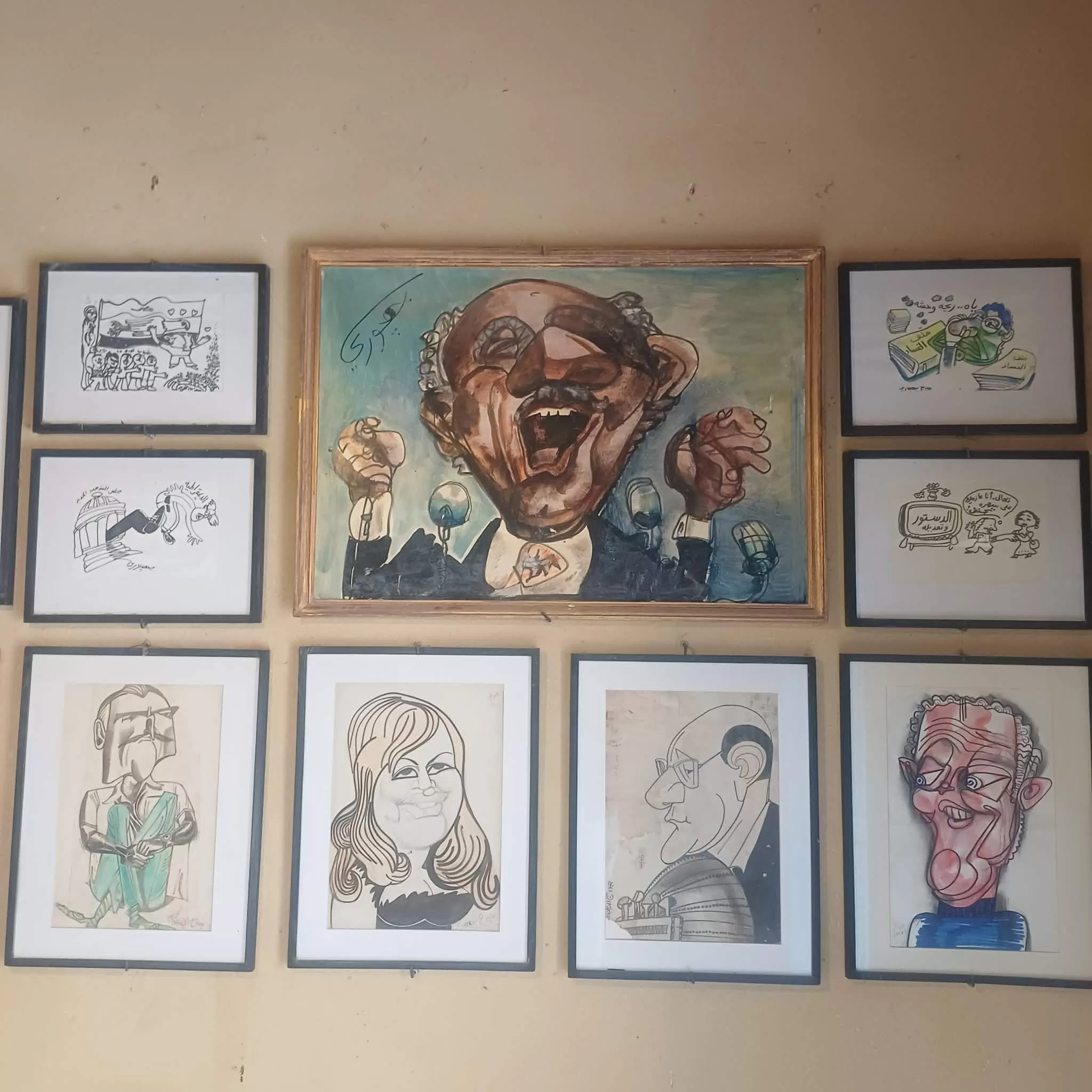
Egypt’s Caricature Museum stands as a unique cultural landmark dedicated to preserving one of the country’s most expressive art forms. Located in Tunis Village in Fayoum, the museum is the first to be dedicated to caricature in the Middle East. It is a rare effort to document the social and political history of Egypt through satirical drawings.
Founded by renowned visual artist Mohamed Abla, the museum operates under the umbrella of the Fayoum Art Centre, established in 2006, with the Caricature Museum officially opening its doors in 2009.
Today, the museum houses hundreds of original works by some of Egypt’s most influential caricature artists, including Salah Jahin, Ragheb Ayad, Bahgat Osman, Zeinab Al-Sigini, Rakha, and the internationally acclaimed Santriz.
According to Ibrahim Abla, director of the Fayoum Art Centre and son of the museum’s founder, the museum’s collection functions as an “open history book”.
“Caricature allows visitors to understand how people lived, dressed, and thought during different historical periods,” he explains. “Through these drawings, you can trace Egypt’s political and social transformations, from the 1919 Revolution and the 1923 Constitution to the era of the Free Officers and Gamal Abdel Nasser,” he told the Egyptian Mail.
The museum’s exhibition design follows a chronological narrative, presenting works from the 1920s through subsequent decades.
Each wall reflects a distinct historical moment, turning satire into a visual archive of collective memory. Rare original pieces by Rakha, often referred to as the father of Egyptian caricature, form one of the most valuable sections of the collection.
Beyond preservation, the museum functions as a dynamic cultural platform. It hosts annual events, such as Caricatunis, a caricature and satirical portrait competition that attracts artists and enthusiasts from across Egypt. Each edition focuses on a specific theme and concludes with a public exhibition and printed catalogue, reinforcing dialogue between generations of artists. The institution also aligns with broader cultural development strategies through workshops, grants, and educational programmes for children and young artists.
“The Fayoum Art Centre reflects Mohamed Abla’s long-held belief that artists must remain actively engaged with their communities rather than isolated within studios,” Abla added. This philosophy is evident in initiatives like “Entilaq” (Starting Point), launched in collaboration with the Sawiris Foundation.
Now in its second year, the programme offers fully funded grants to nine Egyptian artists under the age of 30, enabling them to dedicate several months entirely to creative production.
The initiative received more than 600 applications, with 43 artists selected to participate in a recent group exhibition at the Mahmoud Mokhtar Museum in Cairo, according to Abla.
Grant recipients will reside in Fayoum from February to May, contributing to community-based workshops in cooperation with the Ministry of Social Solidarity.
The museum’s impact extends beyond the arts. “Tunis village has emerged as a model for eco-cultural tourism, where interaction between residents and visitors has helped sustain local crafts, cultural initiatives, and environmentally conscious practices,” Abla said.
Caricature, as Abla notes, represents a form of Egyptian soft power, one that transcends language barriers and communicates shared human concerns through humour and critique.
This cultural significance was recently reinforced when Fayoum Governor Ahmed Al-Ansary announced the official registration of the Caricature Museum building on the governorate’s list of architecturally distinctive structures.
The decision recognizes the museum as the first building in Tunis village to be documented under updated construction and preservation regulations.
The building exemplifies environmentally sustainable rural architecture inspired by Hassan Fathy’s principles. Constructed using local materials, such as mud bricks and natural stone, and featuring domes, vaults, and load-bearing walls, the structure harmonizes with the village’s visual identity while responding to contemporary environmental challenges.
In an era dominated by fast digital consumption, the Caricature Museum in Fayoum offers a slower, reflective encounter with Egypt’s cultural memory. By blending art, history, architecture, and community engagement, it stands as a testament to how cultural institutions can shape both local identity and national narratives.

