




Islam Made Simple
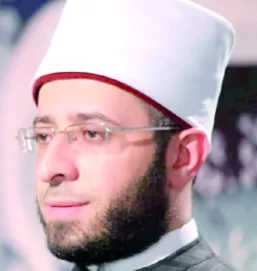
Dr Osama Al-Azhari, Minister of Awqaf (Charitable Endowments)
Ladies and gentlemen, daughters and sons of the great Egyptian people, and the Arab and Muslim nations, welcome to a new journey with the Ever-Glorious Book of Allah, in which we dive into the depths of the twenty-fifth part of the Ever-Glorious Qur’an. We extract from its treasures priceless pearls, from its light guidance, and from its eloquence the values and lofty principles that Allah has placed within it.
This glorious part is rich with great passages that give life to hearts, illuminate minds, and instill wisdom and balance in souls. So let us drink from its pure spring and seek shade in its blessed meanings.
We have chosen to pause at a number of verses, signs, sciences, knowledge, values, and morals, and to dive into the seas of the Ever-Glorious Qur’an to extract those gems.
The first reflection: A reflection on science
Allah Almighty says: “And of His signs are the running (ships) in the sea like landmarks.” [Qur’an 42: 32]
Do you know, dear all, the meaning of “And of His signs”? That is, among the evidences of His greatness, the proofs and arguments of divine majesty. The Lord of the Worlds tells you: And of the signs of greatness and the indications of Allah’s magnificence are “the ships running in the sea like landmarks.”
What does “the ships running through the sea like landmarks” mean? It refers to the ships that cut across the surface of the water, traversing seas and oceans, in which skilled sailors, who know the sea routes, sail, guided through the darkness of the sea by navigating using the stars.
Here we reach complex sciences, where astronomers and sailors observe the stars, memorise their groups, and use them to determine directions. From this foundation, great sciences emerged among Muslims, such as marine sciences, the science of stars, and science of astronomy.
For example, there was a great traveller –one of the greatest in history– the brilliant genius Ahmad ibn Majid. This great scholar was among the most skilled Muslim sailors in history. Early European explorers were guided by him, and it is claimed that through him they found the route around the Cape of Good Hope, reached the coasts of Kenya, and through it they sailed to India.
In order for Ahmad ibn Majid to become a great scholar and an expert in marine sciences, he had to master advanced sciences and knowledge in astronomy, geography, weather, winds, and navigation.
Civilisation was born and sciences advanced through guidance by the signs of the Ever-Glorious Qur’an. Our Lord says: “And way marks; and by the star they are guided.” [Qur’an 16: 16] He also says: “And of His signs are the running (ships) in the sea like landmarks.” [Qur’an 42: 32] Then the Qur’an takes us to another scene: Allah Almighty says: “In case He (so) decides, He quiets the wind, (and) so they linger on motionless on its surface. Surely in that are indeed signs for every (man) most patient, constantly thankful.” [Qur’an 42: 33] The Qur’an stimulates minds, calls for contemplation and discovery, and the use of intellect across various sciences.
Turning Point in Marine History
Throughout history from Adam (PBUH) until the year 1809 ships sailed the oceans relying on the power and direction of the wind. But in 1809, the patent for the first steamship was registered, marking a decisive turning point.
Ships began to cover distances in days instead of months. Time accelerated, social structures changed, communication and transportation sciences developed, and economic balances shifted. We must understand these sciences and carry the banner of leadership, to ensure civilisation and survival for our nation.
The second reflection: A reflection on morals
Allah Almighty says: “And the ones who avoid the great (kinds) of vice and obscenities, and when they are angry, it is they (who) forgive.” [Qur’an 42: 37]
Those skilled scholars of marine sciences are themselves the pious ones who avoid major sins and immoralities, and those who when they are angered, forgive. This verse calls us to self-control when angry. The Prophet (PBUH) said: “Anger is a burning ember kindled in the heart. If one of you feels it, let him sit if he is standing, and lie down if he is sitting. If his anger does not subside, let him perform ablution, for anger is from fire, nothing extinguishes fire except water.” (Sahih Abi Dawud, no. 4782; narrated by Ahmad, no. 21386).
The third reflection: A scene from History
Allah Almighty mentions the story of Pharaoh and Moses (PBUH), saying: “And leave the sea becalmed; (Or: furrowed) surely they are a drowned host.” [Qur’an 44: 24]
Then the Qur’an moves us to a description of Egypt: “They left how many gardens and springs”, “And plantations and how honorable a station,” And what comfort they used to (enjoy) cheerfully!” [Qur’an 44: 25-27]
Reflect upon this divine description of Egypt: gardens, springs, crops, noble dwellings, and abundant blessings. It is a magnificent image of Egypt, one that we must strive to restore to its glory by working diligently, uniting, and properly extracting our country`s resources and take good care of them.
The fourth reflection: A reflection on the people of Tubba’
Allah Almighty says: “Are they more charitable, (i.e., better) or the people of Tubba’ and the ones even before them? We caused them to perish; surely they were criminals.” [Qur’an 44: 37]
The Tubba’s were ancient Yemeni kings. Among them was a righteous king named Tubba’, who lived approximately seven hundred years before the Prophet Muhammad (PBUH) received the revelation, When Tubba’ reached Yathrib (Madinah Munawwarah), he intended to destroy it, but he heard from the rabbis and monks that this city would be the place of migration for the Prophet of the end times. He, therefore, respected it and composed poetic lines expressing his love for the Prophet (PBUH). These verses later reached the Companion Abu Ayyub al-Ansari.
Conclusion
Indeed, a righteous servant is beloved even by inanimate things. When Allah loves you, everything loves you: the sky, the earth, the mountains, and even the universe around you. We ask Allah to make us among His beloved servants.
Until another meeting with a new part of the Ever-Glorious Qur’an.
Until we meet again, stay noble; stay safe.

