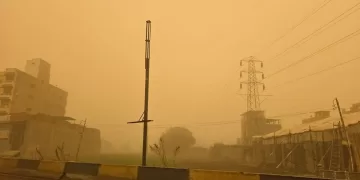





Cairo woke on Thursday to a pale, subdued sun filtered through a thin layer of haze and dust – the kind that softens the city’s sharp edges and signals a day of shifting weather.
Commuters moved through the morning traffic under a sky that appeared calm but carried the promise of change, typical of Egypt’s unpredictable spring season, when warmth, dust, and sudden rain can arrive within hours.
Abbas Sharaky, Professor of Geology and Water Resources at Cairo University, said the current storm is one of the strongest to hit Egypt’s deserts, and typically occurs during March and April.
“Strong winds have been blowing for hours across several regions, most notably Minya, Beni Suef, the Farafra, Dakhla, and Kharga oases, as well as Ras Gharib, with speeds ranging between 40 and 80 km/h,” Sharaky said.
He noted that winds are expected to ease within a few hours but will continue across the New Valley and Upper Egypt governorates throughout the day at varying intensities.
Across Greater Cairo, temperatures hovered in the mid-20s Celsius, offering a mild and comfortable start to the day, while cooler air is expected in the evening. Although the weather feels gentle on the surface, forecasts point to unstable conditions in several parts of the country, a reminder that April rarely follows a steady pattern.
Meteorological forecasts indicate that parts of northern Egypt — including the Delta, Canal cities, Sinai, and the Red Sea mountain ranges — may experience moderate to heavy rainfall, accompanied by thunderstorms and active winds. These winds, which could reach up to 40 km/h, raise concerns about dust, reduced visibility, and localised flooding in exposed areas.
“This storm is known as Khamasin winds, as it can occur over a period extending for about 50 days and is usually accompanied by sand and dust. However, the associated rainfall has helped reduce its intensity across different governorates,” Sharaky added.
He also pointed out that such storms play a key role in the movement of sand dunes in Egypt’s deserts, which can shift at a rate of about six metres per year, as seen in the dunes of the Dakhla Oasis.
The current conditions reflect a broader wave of spring instability Egypt has experienced in recent days. Seasonal transitions between winter and summer often create this kind of atmospheric fluctuation — mild temperatures in urban centres, cloud build-up along the coasts, and sudden showers driven by shifting pressure systems over the Mediterranean.
In Cairo, the day appears calmer than in other regions, but dusty air and warnings of poor air quality highlight another seasonal challenge: suspended particles that frequently accompany spring winds.
For residents planning their day, the advice is to make the most of the mild temperatures, remain alert to sudden winds or rainfall in northern regions, and prepare for cooler conditions in the evening.

