



By Dina Yehia
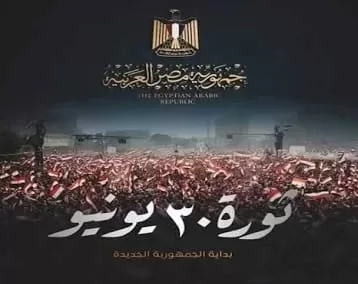
The June 30 Revolution stands as a pivotal event in modern Egyptian history, symbolising a profound awareness of the nation’s cultural identity and embodying a historic moment of unity across all state institutions. Engraved in the collective memory of Egyptians, it represents a unique national milestone that reflects the highest ideals of unity between the public and the Egyptian Armed Forces a turning point whose outcomes have profoundly shaped the country’s future.
During those historic days, millions of citizens took to the streets, driven by their dreams and hopes of rescuing the nation from the spectre of division and safeguarding its authentic identity. The Egyptian people freely expressed their unwavering commitment to preserving the state, its heritage, and its national institutions, while aspiring toward a stable, secure future defined by peaceful coexistence. Consequently, the revolution was instrumental in protecting state institutions, safeguarding resources, and consolidating the foundations of security and stability. It has since become a powerful source of soft power for Egypt, successfully restoring its identity, culture, and rich cultural heritage.
The momentum of this popular movement culminated on July 3, when millions of protesters successfully encouraged the Egyptian Armed Forces to meet their core demands and bring an end to Mohamed Morsi’s presidency. In a televised statement, then-Defence Minister Abdel Fattah El Sisi announced the ousting of Morsi and the suspension of the 2012 Constitution. Following this, the President of the Supreme Constitutional Court, Adly Mansour, was ordered to assume the presidency until early elections could be held.
In the wake of the June 30 Revolution, major developmental achievements have been realised under the leadership of President Abdel Fattah El Sisi. Today, Egypt’s ongoing development projects continue to shape public awareness, strengthen national identity, and preserve the collective memory of the revolution. This forward-looking momentum was clearly reflected in the fruitful sessions of the National Dialogue, which underscored that education serves as the fundamental gateway to the New Republic.
In alignment with Egypt Vision 2030, the Ministry of Education has launched several innovative educational initiatives tailored for children. Among these, Foreign Minister Badr Abdelatti and Education Minister Mohamed Abdel Latif launched the “Madrastak Fe Masr” (Your School in Egypt) initiative. This programme aims to provide distinguished educational services for the children of expatriate Egyptians, utilising the latest technological tools to facilitate their study of the Egyptian curriculum while strengthening their cultural and educational ties to their homeland.
Concurrently, as part of continuous efforts to develop communities and improve the quality of life, the youth-led “Ehna Adha” (We’re Up to It) initiative was launched in Cairo under the auspices of the Ministry of Youth and Sports, aiming to empower young people and raise awareness across various fields.
Experts have widely praised these state-led efforts. Dr Mohamed Nassef, Director of the National Center for Child Culture, emphasised that developed, digitised educational initiatives significantly enhance children’s creative and critical thinking skills when engaging with scientific curricula. He noted that these programmes successfully empower children to question, analyse, and critically evaluate online content.
Similarly, Prof. Mahmoud Hassan Ismail, from the Faculty of Postgraduate Childhood Studies at Ain Shams University, highlighted the vital role of educational development in fostering intercultural dialogue, promoting tolerance, and countering chaos and extremist ideologies. Speaking to the Egyptian Mail, Prof. Ismail explained that these initiatives play a major role in how children and teenagers interact with modern mass media technologies, particularly social networking sites. While noting that these tools can improve the quality of media products, he cautioned that they can also distort content and convey unrealistic connotations, which could potentially affect young minds negatively.
“We must pay attention to the dangers of using these technologies on children and employ them in a way that benefits the child,” Prof. Ismail stated. He highly commended the joint efforts exerted by the Ministry of Education and the Ministry of Youth and Sports to promote the integration of modern technology and artificial intelligence (AI) within these educational frameworks. “These initiatives are working to support the talented students in this field and help them achieve their goals,” he concluded.

