

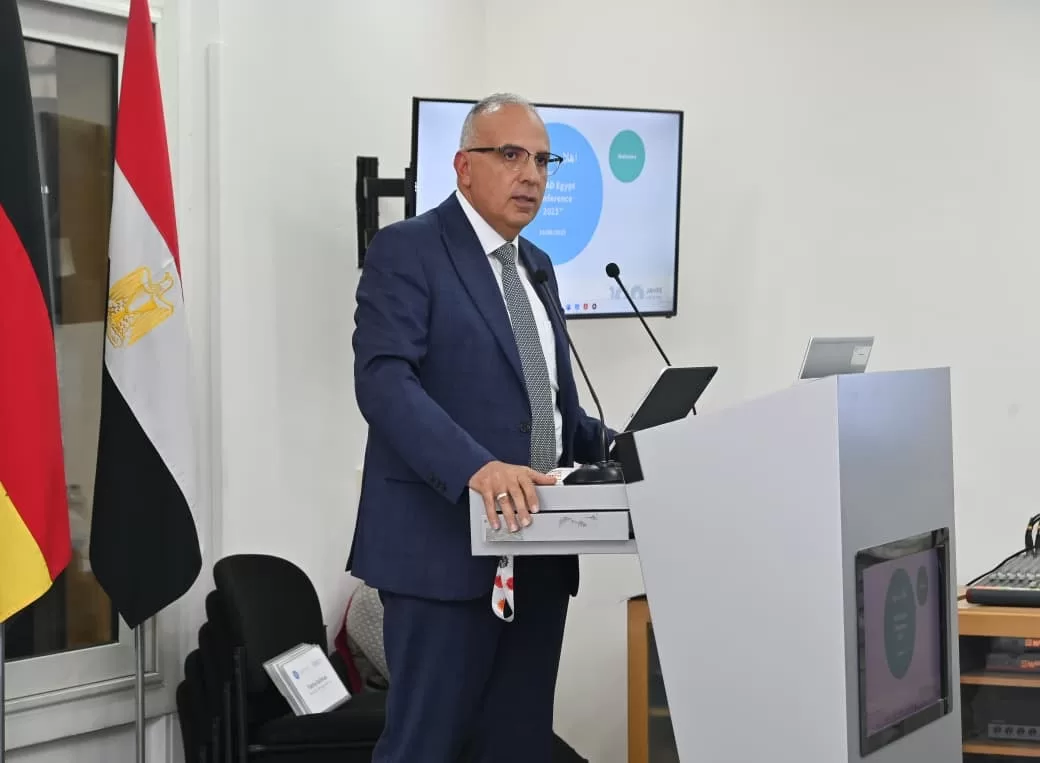
Egypt’s Minister of Water Resources and Irrigation Hani Sewilam said Egypt is facing major water challenges with per capita water availability not exceeding 560 cubic meters annually and with over 98% of its water needs coming from the Nile River – a resource originating outside its borders.
The minister said these challenges, compounded by population growth and negative impacts of climate change, require fostering innovative ideas, relying on modern technologies and enhancing international cooperation in pursuit of water and food security and sustainable development.
In his address Wednesday during a celebration organized by the German Academic Exchange Service (DAAD) marking the centenary of its establishment, in the presence of DAAD President Joybrato Mukherjee, Wiebke Bachmann, Director of DAAD’s Regional Office in Cairo and Andreas Fiedler, Deputy ambassador of Germany to Egypt, Sewilam congratulated DAAD on its centennial, that he described as a century of global excellence in academic exchange, along with more than six decades of remarkable achievements in Egypt that strengthened scientific cooperation and educational partnerships.
The celebration reflects the strength as well as the continued Egyptian-German collaboration in education, science and innovation, which has empowered generations of professionals through knowledge and capacity-building, he said.
The minister explained that his ministry has adopted a comprehensive strategy based on innovation, digitalization, climate adaptation, and governance.
The strategy – referred to as Egypt’s second-generation irrigation system (2.0) – rests on nine pillars including: expanding the treatment and reuse of agricultural drainage water and desalination for intensive food production, applying smart management tools using data and modern monitoring and control technologies.
Sewilam further said the second-generation system places human capital development at its core, with the ministry working to prepare a new generation of water specialists equipped with the skills needed to handle digital transformation, climate change and sustainable water management.
He also said that the ministry has recently selected a group of outstanding staff members to lead the implementation of this new approach. These individuals were evaluated based on technical expertise, language proficiency, personal and communication skills, crisis management abilities, and knowledge of modern technologies relevant to the ministry’s work, added the minister.
The ministry continues to address gaps in certain specializations and skills by empowering young engineers and researchers to master modern tools such as remote sensing, smart irrigation systems and artificial intelligence for water modeling, while instilling a culture of innovation and continuous learning, Sewilam said.

