


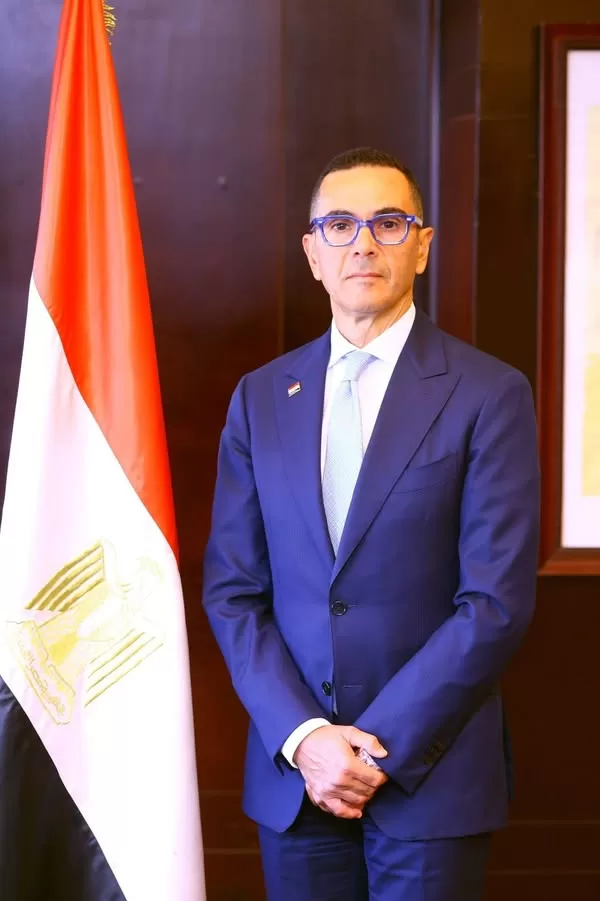
BERLIN – Egypt’s Minister of Investment and Foreign Trade Hassan el-Khatib said the Egyptian government seeks to provide clear, stable and long-term policies being key elements luring true investors.
During his participation in the Arab-German Economic Forum held Berlin, the minister reviewed the features of Egypt’s economic vision, reform steps adopted by the State over the past decade and ways to strengthen the economic partnership with Germany and European countries.
In his speech at a high-level session held entitled “Partner Country Egypt: A Strategy for Business and Investment with Tremendous Opportunities for German Companies,” the minister of investment said, Egypt is participating as an active voice in shaping visions and directions.
Political stability and modern infrastructure have made Egypt an attractive environment for foreign investors, Khatib added.
He pointed out that Egypt has witnessed tremendous economic transformations over the past decade, with the state pumping investments amounting to dlrs 553 billion, directed to infrastructure, including roads, ports, airports and new cities.
Khatib added, “We have expanded the inhabited area from 6% of Egypt’s area to approximately 12%, through the construction of 24 new cities, thus attesting to the great to effort exerted to fill an investment gap that has lasted for decades.”
The minister said the development experience has brought about two major challenges: an increased role for the state in the economy, while the private sector’s contribution to investment declined from 75% to 24%, as well as a rising debt-to-GDP ratio.
Khatib referred to Prime Minister Mostafa Madboul’s directives last year, saying instructions were clear to work to enhance a competitive, inclusive and sustainable investment climate by empowering the private sector to lead growth in the coming years.
The minister noted that the Egyptian government – for the first time in four decades has adopted a sound monetary policy based on targeting inflation, not just the currency exchange rate.
According to Khatib, the decision to liberalise the exchange rate on March 6th was a result of this vision and that signs of recovery have begun to appear clearly, encouraging investors to return.
The minister reviewed the most prominent features of the financial and tax reforms, explaining that the official tax rate is 22.5%, but the actual rate bears additional burdens due to fees imposed by several entities.
“We conducted a thorough survey and found that there are approximately 96 entities imposing fees and we are currently working to consolidate them into a unified fee to reduce the real tax burden on investors. President Abdel Fattah El Sisi has approved this proposal and we are working to implement it soon,” Khatib said.
He also noted that the Ministry of Finance has submitted more than 40 measures to Parliament to facilitate procedures between the Tax Authority and the tax community, with a view to opening a new chapter based on trust and transparency.
For his part, Engineer Mostafa el-Bagoury, CEO of Siemens Egypt, emphasized the depth of the historical and strategic partnership between Siemens and Egypt, noting that the company has been operating in the Egyptian market since 1901, more than 124 years, across the various vital sectors.
Siemens’ CEO pointed out that the company began its operations in Egypt with infrastructure projects in the field of communication and later expanded to include energy, transportation and industry sectors, becoming a key partner in the implementation of a number of the largest national ventures, including giant power plants and high-speed rail projects, along with speed and smart control centers in the New Administrative Capital.
“Egypt possesses unique capabilities that make it a promising regional investment hub, including its strategic geographic location, advanced infrastructure and the digital transformation taking place across various sectors, with strong support from the political leadership and the Egyptian government,” he added.

