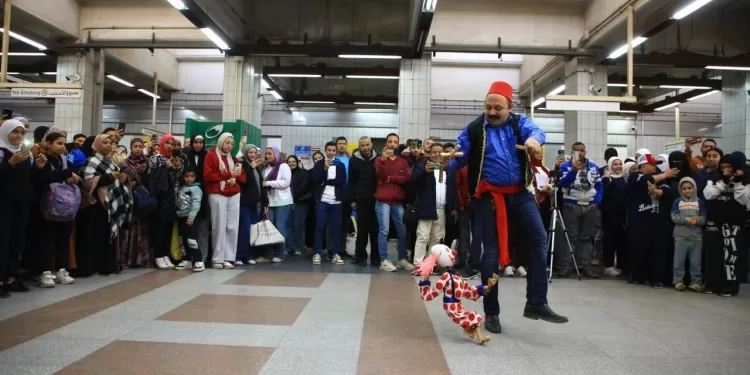




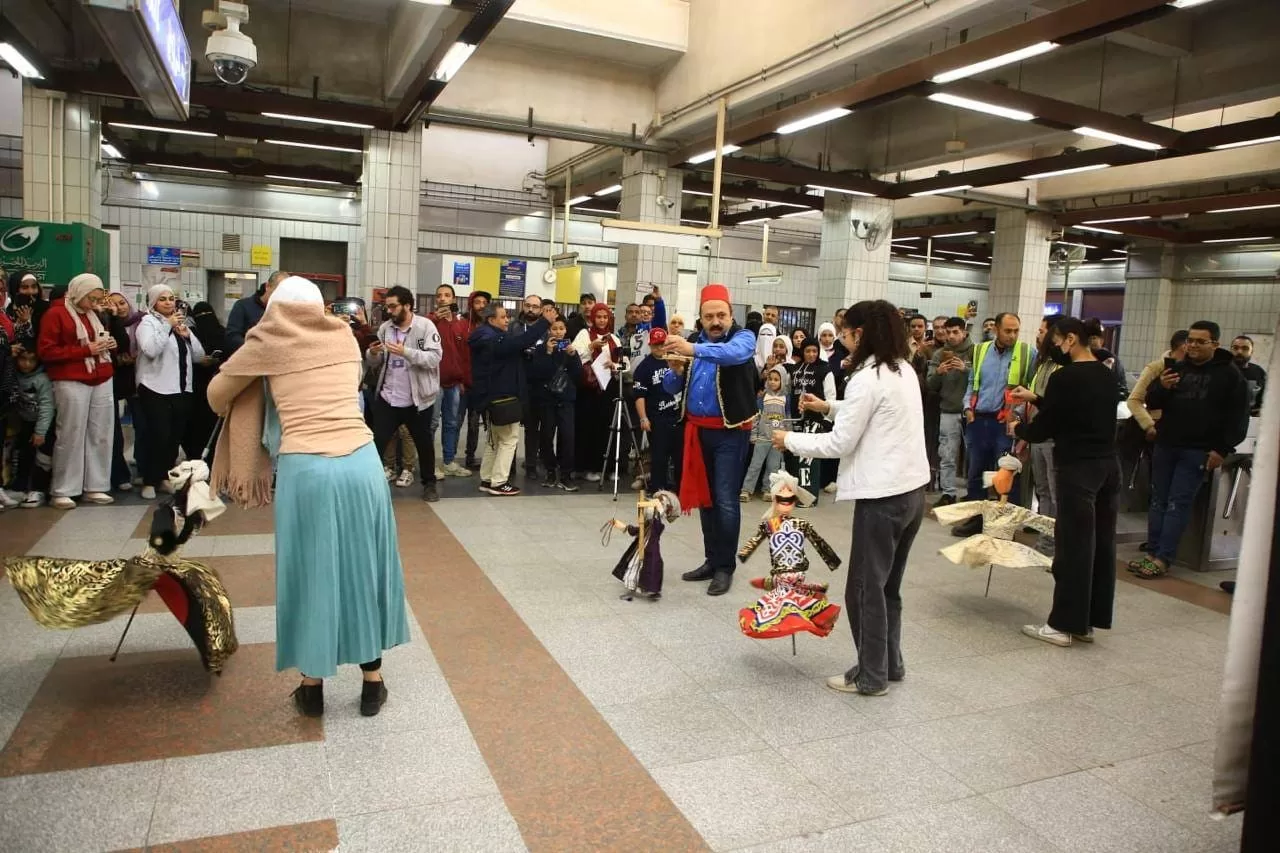
What began as an ordinary morning commute at the Cairo University underground station turned quickly into something totally unexpected and unplanned.
Between the rush of students and workers, a crowd began to gather, not to wait for a delayed train, but for a live puppet show.
Scenes from the iconic Egyptian puppet production Al-Leila Al-Kebira (Grand Night) unfolded in the middle of the station, as performers brought traditional characters to
life in a space rarely associated with art or theatre.
A few moments into the show, the daily rhythm paused, and the station transformed into an open cultural space, drawing dozens, even hundreds, of onlookers.
This initiative is organised by the Ministry of Culture in collaboration with the Ministry of
Transport.
It reflects a growing effort to move art beyond traditional venues and into public spaces, directly into the flow of everyday life, specialists said.
“Art usually mirrors society and plays a vital role in delivering meaningful messages that can elevate people’s attitudes,” Alaa Hasaballah, a researcher at the Academy of
Arts, an affiliate of the Ministry of Culture, said.

Speaking to The Egyptian Gazette, he explained that artistic performances were for decades largely confined to theatres and galleries.
These spaces, he said, required a certain level of cultural engagement from audiences.
“But not everyone has the awareness or the habit of attending exhibitions or performances, even when they are accessible or state-supported,” Hasaballah said.
By contrast, he added, initiatives like the metro performance aim to reverse that dynamic, bringing art to people rather than expecting them to seek it out.
“Such initiatives are important because they take art out of closed spaces and into the street, making it accessible to people from different backgrounds,” Hasaballah said.
For many of those passing through the station, the experience was both surprising and engaging.
Salma, a 20-year-old university student, said she was on her way to the university when she suddenly saw a crowd of people and heard music.
“At first, I didn’t understand what was happening, but then I stopped,” Salma said. “It
felt like something joyful is happening in the middle of a very ordinary day.”
Mahmoud, another Cairo University student, described the moment as “unexpected” but
memorable.
“It’s not something you expect to see in the metro,” Mahmoud told this newspaper.
“It made people pause and look around differently, having changed the atmosphere, even if it lasted only for a few minutes,” he added.
All reactions were the same, a point Hasaballah sees as central to the initiative itself.
“It is a form of social dialogue,” he said of the initiative and the puppet show.
“If you bring art to people, you should also be ready to listen to their reactions, including
criticism. This interaction is what gives such initiatives their real value,” he added.
While many people gathered with curiosity and excitement, others appeared more hesitant, unsure how to respond to a performance in such an unconventional setting.
For some, encountering theatre in a transit space was entirely new.
“People were often amazed, especially young audiences,” Hasaballah noted. “But others were more surprised and not fully ready to accept it. These things take time to have
their full impact.”
This gradual shift appears to be part of a broader vision to integrate culture into daily
life, not as a separate activity, but as something that coexists with routine.
According to Hasaballah, this approach is set to expand further.
He revealed that the Academy of Arts plans to organise an art exhibition inside Opera underground station.
He also referred to ongoing efforts to rethink where and how art is experienced across Egypt.
As the performance came to an end, commuters resumed their journeys, but not without carrying a fragment of that unexpected moment with them.
For a brief time, the Cairo underground had become more than a place for the transit movement. It had turned into a shared cultural space.
Whether such initiatives will have a lasting impact remains to be seen.
For now, they offer a glimpse into a different possibility, one where art is no longer
confined to stages and galleries, but becomes part of the city’s everyday rhythm, specialists like Hasaballah said.