


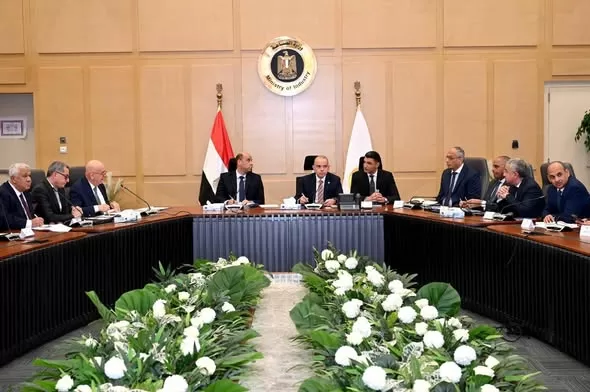
The ministers of investment and foreign trade, industry and labor on Monday affirmed the government’s full support for enhancing the competitiveness of the ready-made garments sector and increasing its contribution to national exports.
The remarks were made during an expanded meeting between the three ministers and members of the Apparel Export Council of Egypt (AECE), with the participation of six relevant government bodies, to discuss mechanisms for boosting ready-made garments exports and improving the business environment.
Investment and Foreign Trade Minister Mohamed Farid Saleh said, in a statement issued by the Ministry of Investment, that developing the operational system within the industrial sector represents a key pillar for increasing the stability of production processes and enhancing the quality of Egyptian products.
He highlighted the importance of expanding specialised training programmes to upgrade workforce skills in line with global developments in production patterns, and building a base of trained cadres capable of backing the growth of national industry.
Farid added the coming phase will focus on supporting companies’ expansion into foreign markets and maximising the benefits of international trade agreements, alongside continuing the export rebate program and linking it to companies’ actual performance indicators, in a way that encourages higher export growth rates and the achievement of ambitious export targets.
For his part, Industry Minister Khaled Hashem stressed the ministry’s commitment to localising the ready-made garments industry across all its value chains, increasing value added and enhancing the competitiveness of Egyptian products locally and globally.
He noted that fully-serviced industrial land plots are being offered periodically through the Egypt Digital Industrial Platform, adding that the current offering includes 1,272 fully serviced plots distributed across 35 industrial zones in 23 governorates, including around 800 plots in Upper Egypt.
Meanwhile, Labor Minister Hassan Raddad affirmed the ministry’s keenness to advance joint efforts to create a decent working environment that boosts production and exports.
Raddad stressed his ministry’s readiness to address challenges related to working hours, the minimum wage and work permits for foreign nationals, in a manner that ensures balanced labour relations and supports investment stability.
The meeting concluded with agreement on a number of executive tracks for the coming period, including enhancing institutional coordination between government bodies and the export council, developing financing, training and technology tools within production chains, improving customs clearance procedures and providing industrial land through more flexible mechanisms. These measures aim to enhance supply chain efficiency and support plans for production and export expansion, particularly in Upper Egypt.

