


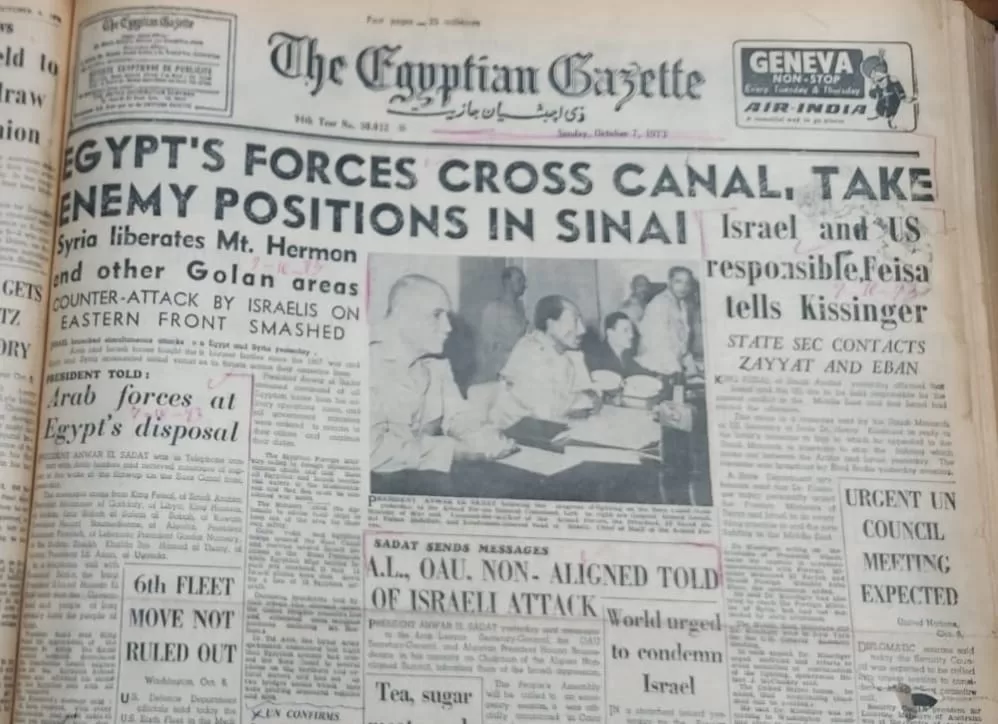
The Egyptian Gazette was fortunate to document the 1973 October War in real time. The newspaper’s archives capture the atmosphere of determination and sacrifice during the war.
Headlines from those days reflected both military operations and the national spirit, the crossing of the Suez Canal, breaching of the Bar Lev Line, and the fierce battles that followed.
The coverage also highlighted Egyptians’ unity, Armed Forces’ resilience, and shifting dynamics on the international stage.
Revisiting those pages today offers a historical record and stands as a reminder of defining moments when Egypt reclaimed dignity and reshaped its future.
War’s eve
Hours before the October War, the Egyptian Mail featured reports about rising regional tensions: Zaire and Togo cutting ties with Israel, Jordan and Syria drawing closer, Saudi Arabia warning Washington over oil, and an Israeli diplomat under scrutiny in Norway.
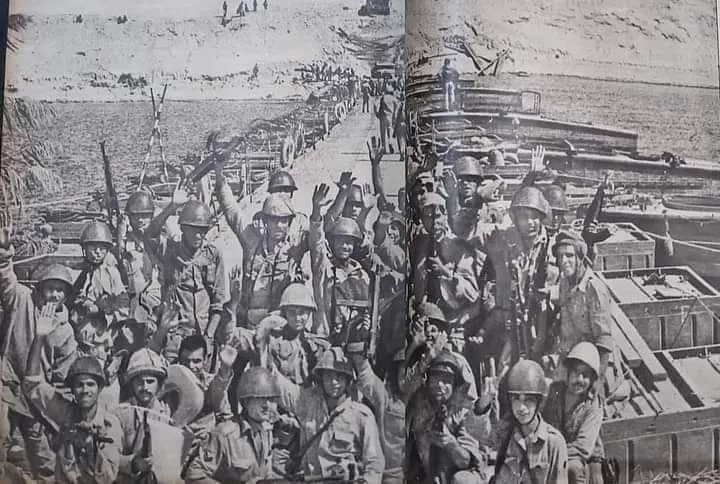
Egyptian advance
Egyptian forces advanced further east of the Suez Canal after crushing repeated Israeli counterattacks, destroying 57 aircraft and 92 tanks as enemy troops retreated and surrendered with equipment. President Anwar El Sadat directed operations from Armed Forces Command while meeting Chinese, Soviet, French, Jordanian, Iranian, and British envoys. Arab and international backing mounted. India and Bangladesh also sided with Egypt and Syria. In Washington, President Nixon cut short his holiday, instructing Secretary of State Kissinger to raise the crisis at the UN (The Egyptian Gazette, Oct. 8, 1973).
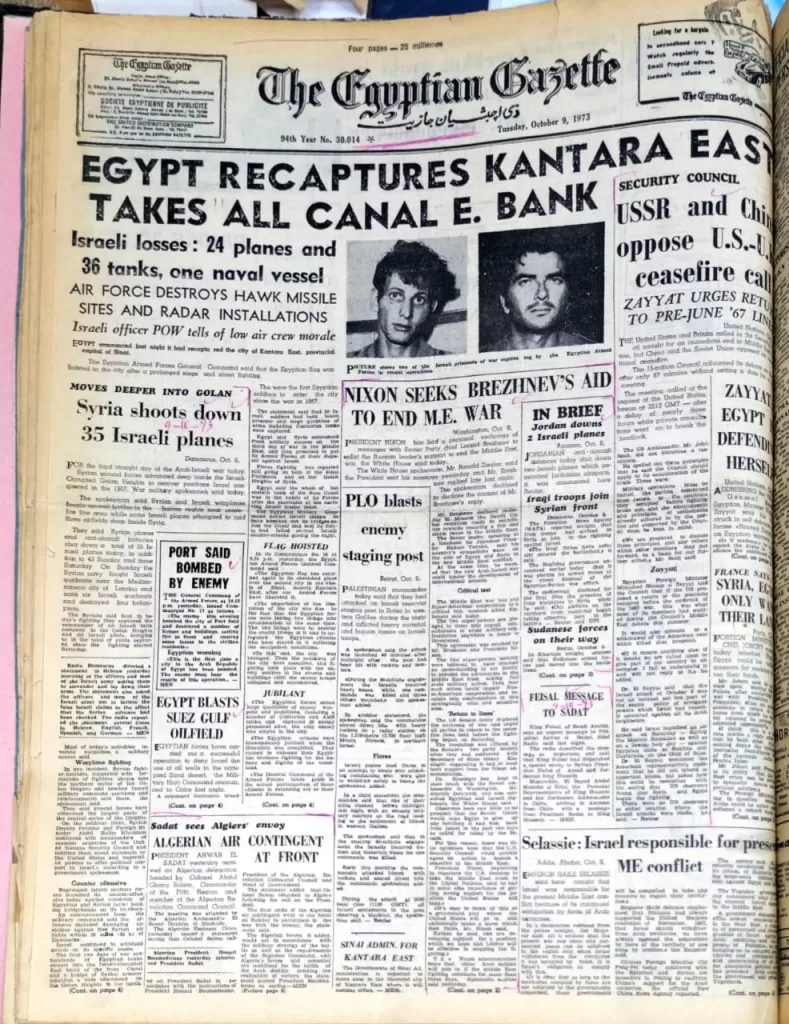
Canal recaptured
Egyptian forces recaptured Kantara East and the entire Suez Canal East Bank, destroying 24 aircraft, 36 tanks, and one naval vessel. The Air Force also struck Hawk missile sites and radar positions. A captured Israeli officer admitted to collapsing aircrew morale. Diplomatically, Nixon urged Brezhnev to end the war, but the USSR and China blocked a US-UK ceasefire call at the UN. Egyptian Foreign Minister Mohamed Hassan el Zayyat demanded Israeli withdrawal to pre-1967 borders. (The Egyptian Gazette, Oct. 9, 1973).
Admitting failure
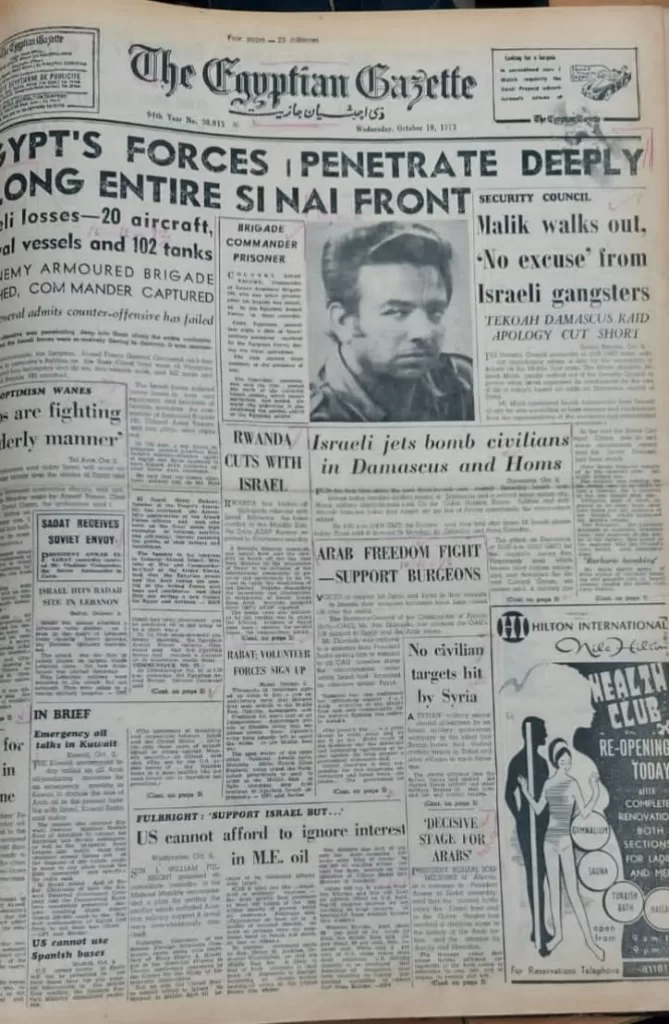
Egyptian forces advanced deeply into Sinai, destroying 102 Israeli tanks and 20 aircraft, and capturing Col. Assaf Yagury, commander of an Israeli armoured brigade. Egyptian television aired footage of captured Israeli soldiers. An Israeli general admitted their counter-offensive had failed. At the UN, the Soviet envoy walked out over Israeli raids on Damascus, while Rwanda cut ties with Israel. In Washington, Senator Fulbright warned US support for Israel must be balanced with Middle East oil interests (The Egyptian Gazette, Oct. 10, 1973).
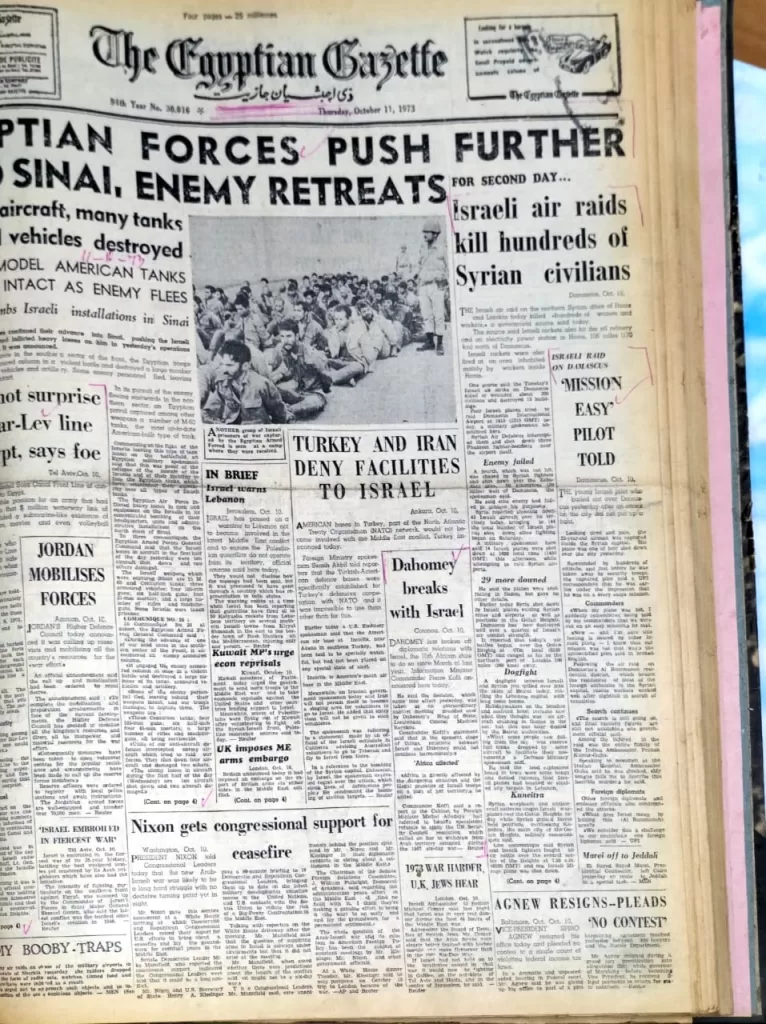
Fiercest war
On October 11, 1973, The Egyptian Gazette reported the advance of Egyptian forces into Sinai, capturing 15 modern American tanks intact after smashing Israeli defences. Ten aircraft and numerous tanks and vehicles were destroyed, while the Air Force bombed enemy installations. A captured Israeli officer admitted, “Power, not surprise, won Bar-Lev Line for Egypt.” Photos of more Israeli POWs reinforced the image of Egyptian dominance.
Turkey and Iran denied Israel some facilities. In Washington, Nixon gained congressional backing for a ceasefire. The Gazette summed up the mood: Israel was “embroiled in fiercest war”.
Air power domination
On October 12, 1973, The Egyptian Gazette headlined: “Egypt’s air force, anti-aircraft down 32 Israeli planes”. Among them were Phantoms destroyed with their bomb loads, proving the strength of Egypt’s defences. The Air Force also struck enemy gatherings in Sinai, destroying 20 tanks and several guns.
Gen. Ahmed Ismail, Commander-in-Chief, praised the troops’ “great exploits” as a “major step on the path of victory”.
Diplomatically, President Sadat met Kuwaiti Defence Minister Sheikh Saad El Abdullah, reflecting Arab solidarity. The report also noted “unfailing backing for Egypt” abroad, yet highlighted US military aid to Israel. In Britain, fears over oil supplies grew.
Precision strikes
On October 13, 1973, the Egyptian Mail reported continued Egyptian military successes and growing international tensions. A “Night air attack blasted enemy H.Q. and radar in mid-Sinai”, while ground battles caused “200 Israeli casualties and big armour losses”. Egypt also reported “15 aircraft downed, three missile boats sunk, and Ras Sudr set afire”.
Egypt warned the US that “arms to Israel are provocative of Arab opinion”, even as Washington rushed Phantoms and ammunition to Tel Aviv. US Secretary of State Henry Kissinger warned the “US will take firm stand”. Saudi King Feisal sent an “urgent message to President Nixon”, while Libya pledged support to Egypt.
Battlefield gains
Egypt lodged a strong protest after two American reconnaissance planes violated its airspace, even as Washington rushed tanks and aircraft to Israel, some reportedly downed over Syria still bearing US markings. On the Suez front, 37 Israeli soldiers surrendered north of the Gulf, their commander handing the Israeli flag to an Egyptian officer before the prisoners saluted Egypt’s flag. Egyptian air defences destroyed 16 enemy aircraft in 24 hours, raising Israeli air losses to over 300, while strikes on two armoured groupings inflicted heavy casualties (The Egyptian Gazette, Oct. 14, 1973).
Algeria protested to Washington, London, and Madrid over volunteers fighting for Israel. Regional solidarity deepened with Mauritania joining the Arab League and Somalia sending 250 tonnes of supplies to Egypt and Syria.
King Faisal refused to meet a US envoy, warning: “I will cut off oil”.
Israel in crisis
Egyptian forces pressed a sweeping new offensive across Sinai, destroying 150 enemy tanks and downing 44 aircraft in the past 48 hours, according to the military command. The Israeli Armoured Corps Commander was reported killed, while Tel Aviv admitted 656 deaths, a figure Egypt insisted was far below the real toll (The Egyptian Gazette, Oct. 15, 1973).
President Anwar El Sadat, with Vice President Hussein El Shafei and War Minister Gen. Ahmed Ismail, reviewed operations as troops consolidated gains deep in Sinai. Arab solidarity surged: Saudi troops joined Syria in the Golan battles, King Faisal pledged to use all means including oil, and Libya warned the US against arming Israel.
The US vowed to continue arms shipments, including 46 Phantom jets and tanks from Europe. Pro-Arab protests spread in London and US cities, as NATO warned of oil embargo risks.
Egyptian commandos
Egyptian commandos launched a surprise shock assault on enemy positions, inflicting heavy losses in personnel and equipment. Airstrikes destroyed 23 Israeli vehicles, including tanks, while ground troops broke through defence lines to liberate new positions. One of the war’s fiercest tank battles ended with seven Israeli tanks destroyed (The Egyptian Gazette, Oct. 16, 1973).
In Washington, President Nixon defended US arms aid to Israel, likening involvement to the 1958 Lebanon intervention. In Tokyo, officials warned Japan’s oil reserves would last just 79 days if Arab supplies are cut.
Military observers see the commando success and deepened Egyptian presence in Sinai as a turning point, with Israel suffering mounting casualties and supply pressure. As Egypt consolidates its gains, the conflict enters a critical phase.
Peace framework
President Sadat explains Egypt’s position on the Arab-Israeli conflict at the parliament. He demanded Israeli withdrawal to pre-June 1967 borders, respect for Arab rights, and a just peace based on international supervision. He proposed an immediate ceasefire contingent on complete Israeli withdrawal, and an international peace conference, including Arab states and Palestinian representatives.
Sadat rejected ambiguous promises and stressed Arab strategic and economic strength. He highlighted Egypt’s military preparedness, including Zafer missiles, and praised the Egyptian and Syrian forces for their October 6th achievements. He also warned that any aggression would be met with proportionate response (The Egyptian Gazette, Oct. 17, 1973).
Oil embargo escalates
Arab oil-producing nations have implemented monthly five-per cent reductions in oil exports to countries supporting Israel militarily or politically.
President Nixon praised Sadat’s October 16 peace initiative, reflecting potential diplomatic shifts. Egyptian forces continued fierce fighting Sinai, destroying 21 Israeli aircraft and numerous tanks, with cumulative losses at 269 planes and 492 tanks (The Egyptian Gazette, Oct. 18, 1973).
Strikes intensified
Egyptian forces launched powerful strikes across Sinai on October 19, 1973, shooting down 15 Israeli aircraft and tightening encirclement of enemy ground units in key sectors. Military communiqués ordered Israeli troops to surrender or face destruction.
Saudi Arabia cut oil production by 10 per cent, warning the US of halting exports if support to Israel continued. Abu Dhabi ceased shipments to the US entirely.
Tanzania became the 14th African nation to sever ties with Israel, highlighting global opposition to occupation.
Escalating US aid
On October 20, 1973, former US President Richard Nixon requested Congress to approve $2.2 billion in emergency military aid to Israel. In the first 12 days of the war, the US had already supplied $825 million in arms (the Egyptian Mail).
An Israeli pilot taken hostage confirmed that 33 US Phantom fighter jets, flown by American pilots, had been delivered to Israel. On the battlefield, Israeli forces suffered major losses.
Libya suspended all oil exports to the US, Qatar cut production by 10 per cent, and Abu Dhabi urged other Arab nations to adopt similar measures.
US military support
A captured Israeli pilot appearing on Egyptian television confirmed that Israel had received dozens of US-supplied Phantom jets and American support personnel, fuelling Arab suspicions of direct US involvement in the conflict. Meanwhile, political resistance to President Nixon’s $2.2 billion emergency aid request for Israel grew in Washington, with one senator warning: “We don’t want a world war — this could escalate dangerously.” (The Egyptian Gazette, Oct. 21, 1973).
Advance at Deversoir
Egyptian Armed Forces launched powerful counterattacks east of the Suez Canal, regaining strategic ground and inflicting heavy losses on Israeli forces. According to The Egyptian Gazette on Oct. 22, 70 tanks, 40 tracked vehicles, and 25 aircraft, including 12 helicopters, were destroyed. Egyptian air defences downed additional aircraft attempting to resupply encircled Israeli units.
The victories at Deversoir highlight Egypt’s tactical superiority and resilience, signalling a turning point in the October War.
The October War of 1973, as documented by The Egyptian Gazette, stands as a defining chapter in Egypt’s history. From the daring crossing of the Suez Canal to decisive battles at the Bar Lev Line and Deversoir, Egyptian forces demonstrated resilience, tactical skill, and national unity. The conflict reshaped the regional balance of power, challenged assumptions of Israeli invincibility, and brought global powers into sharp focus through arms shipments, diplomacy, and economic leverage.

