



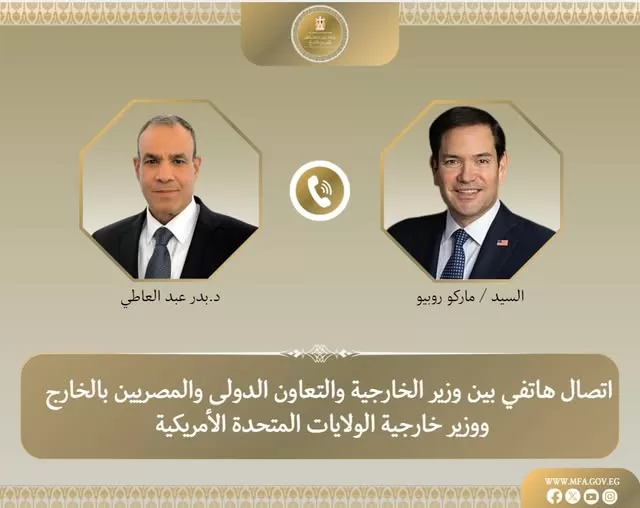
Egypt’s Minister of Foreign Affairs, International Co-operation and Egyptian Expatriates, Badr Abdel-Aati, held a phone call on Friday with US Secretary of State Marco Rubio to discuss escalating regional developments and avenues to further strengthen the longstanding strategic partnership between the two countries.
According to a Foreign Ministry statement, the two officials exchanged views on the intensifying military escalation across the region and the widening scope of ongoing conflicts, alongside key regional dossiers including the Palestinian issue, the crisis in Sudan, developments in Lebanon, and Egypt’s water security.
Both sides underscored the depth of the Egypt–US strategic relationship, which spans more than four decades, and expressed a shared commitment to advancing bilateral co-operation in a manner that supports mutual interests and contributes to regional peace and stability.
The discussions also addressed the economic repercussions of rising geopolitical tensions, particularly their impact on the global economy and Egypt’s domestic outlook. Abdel-Aati highlighted the urgent need for enhanced economic support and liquidity to cushion the effects of surging energy and food prices, as well as declining tourism revenues and reduced income from the Suez Canal.
He reiterated Egypt’s firm commitment to diplomatic solutions and political dialogue, pointing to ongoing mediation efforts by Egypt, Turkey and Pakistan aimed at de-escalation and encouraging conflicting parties to engage in peace negotiations.
On the Palestinian issue, Abdel-Aati outlined Egypt’s efforts to advance the second phase of the US President’s peace initiative, including the deployment of an international stabilisation force, enabling a Gaza administrative committee to begin operations, and facilitating the return of the Palestinian Authority to assume full governance responsibilities.
He called for intensified international efforts to protect Palestinian civilians and to create conditions conducive to the resumption of political negotiations toward a just and lasting settlement. Abdel-Aati also condemned attacks by Israeli settlers against Palestinian civilians and property in the West Bank, describing them as violations of international law that undermine prospects for peace.
Regarding Sudan, Rubio commended Egypt’s role in facilitating a temporary humanitarian ceasefire as a step toward a permanent cessation of hostilities. Minister Abdel-Aati stressed the importance of a Sudanese-led political process to chart the country’s future, free from external interference, while preserving its sovereignty and territorial integrity.
On Lebanon, Abdel-Aati briefed his US counterpart on his recent visit, calling for an immediate halt to Israeli escalation and reaffirming Egypt’s rejection of any violations of Lebanon’s sovereignty, territorial integrity, or civilian infrastructure. He also urged full implementation of United Nations Security Council Resolution 1701 to support stability in the country.
Turning to water security, Abdel-Aati expressed appreciation for a message sent by US President Donald Trump to President Abdel Fattah El Sisi, acknowledging Egypt’s position on the issue. He stressed that the Nile River remains vital to Egypt’s survival amid acute water scarcity, describing water security as an existential matter.
The minister reaffirmed Egypt’s commitment to cooperation with Nile Basin countries in accordance with international law and mutual benefit, while rejecting unilateral measures and criticising what he described as Ethiopia’s continued intransigence.
The two sides agreed to maintain close coordination and consultations in the period ahead to further strengthen bilateral ties and support efforts to restore regional stability.

