




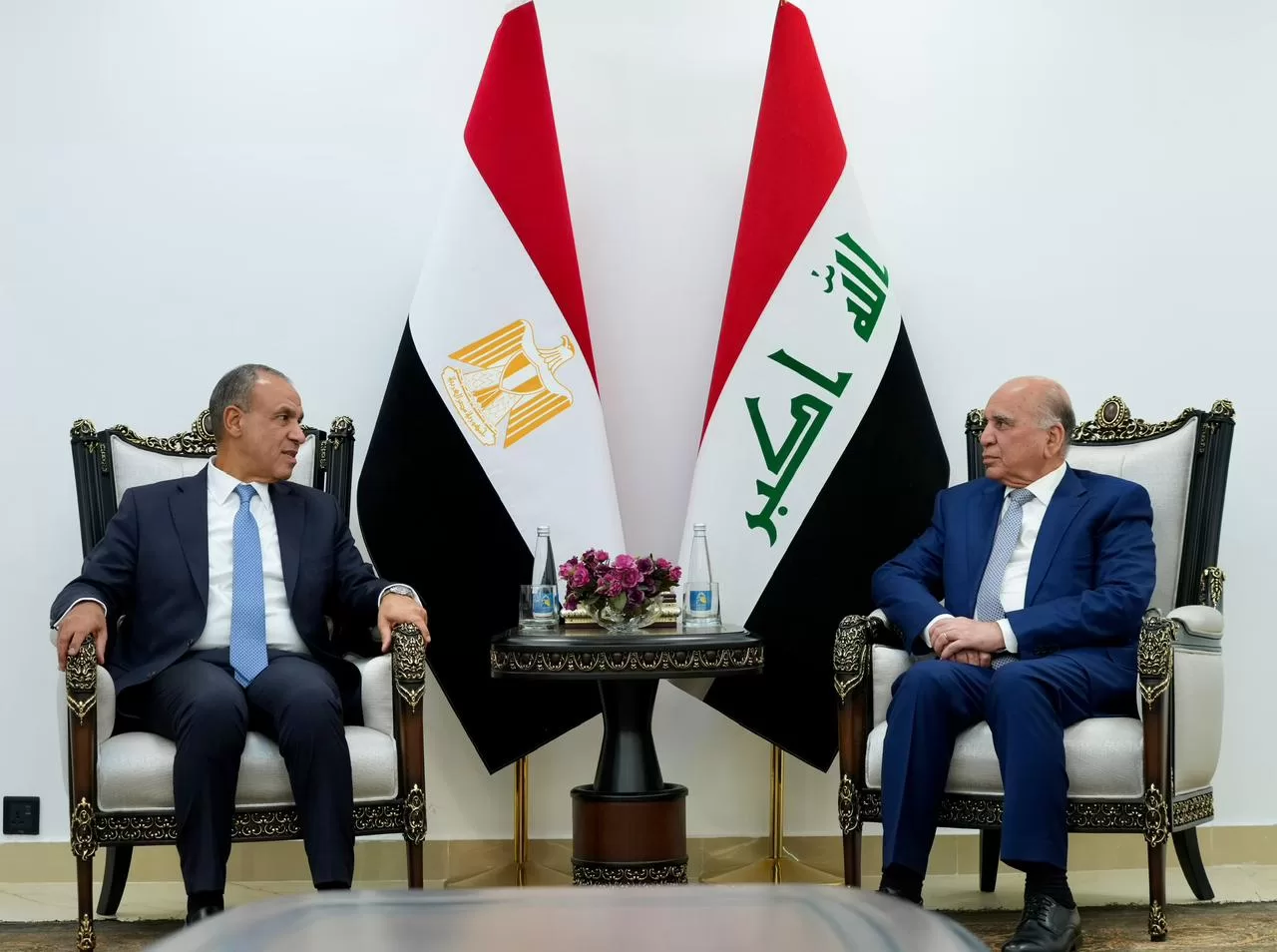
Egypt’s Minister of Foreign Affairs, International Co-operation and Egyptian Expatriates Affairs, Badr Abdel-Aati, stressed the importance of capitalising on the recently announced two-week suspension of military operations to advance de-escalation efforts and prioritise diplomatic engagement, warning of the grave risks facing regional stability.
His remarks came during consultations held late on Thursday in Baghdad with Iraqi Deputy Prime Minister and Minister of Foreign Affairs, Fuad Hussein.
The two sides discussed the rapidly evolving regional developments and ways to support security and stability in the region.
Minister Abdel-Aati underscored Egypt’s deep pride in the longstanding fraternal and historic ties binding Egypt and Iraq, affirming Cairo’s commitment to further strengthening bilateral co-operation across various fields.
The two ministers exchanged views on the latest regional developments, particularly following the announcement of a two-week ceasefire. In this regard, Abdel-Aati emphasised the need to build on this significant step to sustain de-escalation efforts, give precedence to diplomacy and negotiations, and contain the increasingly dangerous situation in the region.
He also reviewed Egypt’s intensive efforts in recent months to reduce tensions in coordination with regional partners, foremost among them Pakistan.
Reaffirming Egypt’s firm stance, Minister Abdel-Aati condemned all unjustified attacks targeting the Gulf Arab states, as well as Iraq and Jordan, reiterating Egypt’s full solidarity with its Arab partners in confronting any threats to their security, sovereignty, and stability. He stressed Egypt’s categorical rejection of any infringement on the unity and territorial integrity of Arab states, while highlighting the importance of taking into account Arab countries’ security concerns within the framework of ongoing Iranian-American negotiations.
The foreign minister further emphasised the necessity of adhering to the principles of good neighborliness, respect for sovereignty, territorial integrity, and non-interference in internal affairs among Arab states, including in relations between Iraq and its neighbouring Gulf countries.
In the same context, Abdel-Aati warned of the serious implications of the continued Israeli aggression against Lebanon, noting that it undermines both regional and international efforts. He pointed to Egypt’s ongoing contacts with regional and international partners to press for immediate intervention to end the aggression, consolidate the ceasefire, and prevent further escalation.
At the conclusion of the meeting, the two ministers agreed to maintain close coordination and consultations in the coming period to strengthen bilateral relations and intensify efforts to de-escalate tensions and contain the situation. They reaffirmed that political and diplomatic solutions remain the only viable path to preventing the region from sliding into further instability and chaos.

