



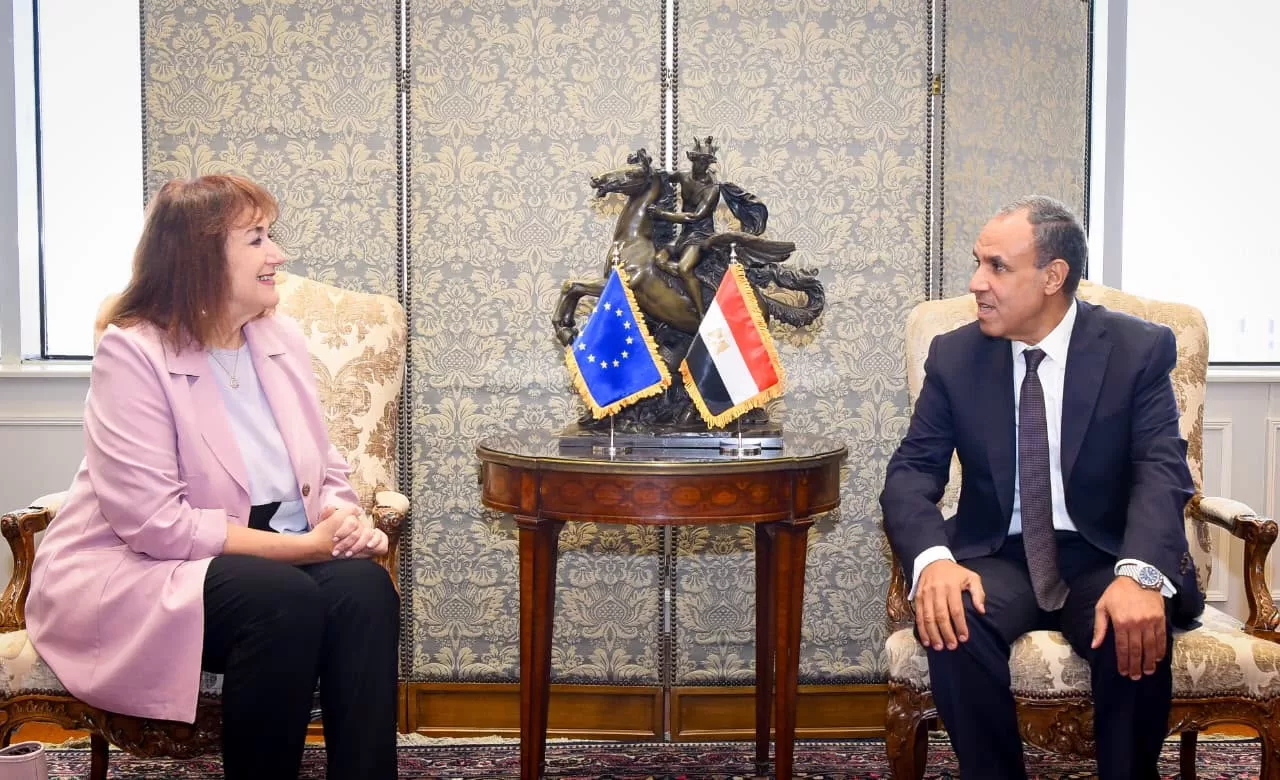
Egypt’s Foreign Minister Badr Abdel-Aati held political consultations on Saturday with Dubravka Šuica, the European Commissioner for the Mediterranean, to review Egypt–EU relations and discuss the latest regional and international developments of mutual interest.
During the consultations, Minister Abdel-Aati praised the remarkable progress in Egypt–EU relations, particularly following last year’s Egypt–EU Summit, which injected fresh momentum into bilateral co-operation, especially in implementing the six pillars of the Egypt–EU Strategic and Comprehensive Partnership. He emphasised the importance of building on the outcomes of both the summit and the 11th Egypt–EU Association Council meeting, held in Luxembourg in mid-June, to further advance the partnership.
The foreign minister underscored the need to deepen economic, trade, and investment co-operation across a wide range of sectors, noting that economic co-operation remains a fundamental pillar of the strategic partnership. He expressed appreciation for the European Union’s continued support for Egypt’s economic reform programme and financial stability. He also stressed the importance of strengthening co-operation on migration and mobility by adopting a comprehensive, long-term strategic approach that moves beyond short-term crisis management.
Minister Abdel-Aati welcomed the launch of the Mediterranean Pact, describing it as an important milestone in strengthening Euro-Mediterranean co-operation. He reaffirmed Egypt’s commitment to working closely with its European partners on the basis of partnership, mutual respect, and shared responsibility to deliver tangible outcomes that serve the interests of the peoples on both shores of the Mediterranean. He also presented Egypt’s vision for the pact, along with a number of proposed initiatives and projects aimed at supporting its implementation.
The consultations also covered regional developments, including the latest progress in negotiations between the United States and Iran. Minister Abdel-Aati briefed the European Commissioner on Egypt’s assessment of the rapidly evolving regional situation and its ongoing diplomatic efforts to resolve regional crises. He emphasised the importance of sustaining the momentum created by the signing of the memorandum of understanding between the United States and Iran, paving the way for more durable arrangements that would consolidate de-escalation, enhance regional security and stability, and ensure freedom of navigation in accordance with international law.
The foreign minister also stressed the need to refocus international attention on the Palestinian issue in order to create the conditions necessary for the full implementation of the first phase of the US President’s peace plan and facilitate the transition to its second phase. He further briefed Commissioner Šuica on Egypt’s principled positions regarding the latest developments in Lebanon, Libya, and Sudan.
For her part, Commissioner Šuica reaffirmed the European Union’s commitment to further strengthening its strategic and comprehensive partnership with Egypt, describing the country as a key partner for the EU in the Southern Mediterranean. She praised Egypt’s pivotal role in promoting regional peace and stability, addressing shared challenges, and fostering co-operation across both shores of the Mediterranean.

