


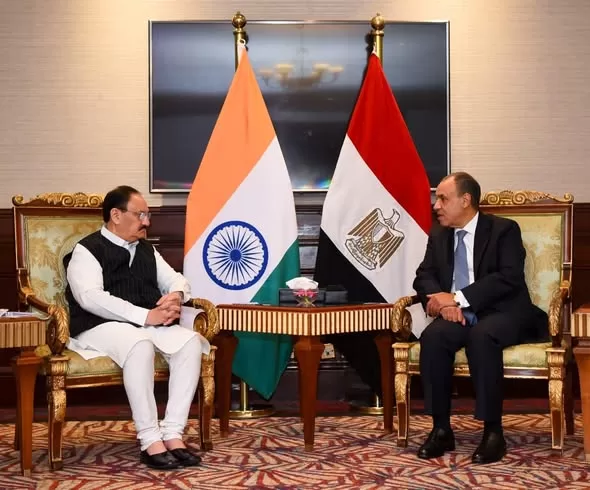
Minister of Foreign Affairs, Emigration and Expatriates Monday affirmed Egypt’s keenness to strengthen cooperation with India in the domains of pharmaceutical industries, medical supplies, petrochemicals, fertilizers, and food security, with a view to utilizing the great potential both countries possess in these sectors.
Abdelatty made the remarks during a meeting with Indian Bharatiya Janata Party (BJP) National President and Union Minister for Health and Family Welfare and Chemicals and Fertilisers Jagat Prakash Nadda.
The Indian official is on an official visit to Cairo to participate in the third edition of the Global Congress on Population, Health and Human Development (PHDC 2025), set to be organized by the Ministry of Health and Population on November 12-15.
During the meeting, Abdelatty reviewed progress of the strategic partnership between Egypt and India, particularly following the launch of the first round of the Egypt-India strategic dialogue that took place in October.
He highlighted Egypt’s efforts to increase domestic fertilizer production through the establishment of new plants to meet local and regional market needs and enhance food security.
The fertilizers industry is envisaged to open up new prospects for trade exchange with India, Abdelatty said, adding that there is potential for establishing an Indian industrial zone within the Suez Canal Economic Zone, in light of the presence of numerous Indian companies operating in Egypt with total investments worth $4 billion.
The top Egyptian diplomat touched on the outcomes of his recent meeting with BJP president in India, underscoring the importance of continuing activating economic, trade and investment cooperation.
Abdelatty urged putting into effect the outcomes of the strategic dialogue, including holding an Egypt-India business forum, convening the next session of the cooperation committee between the two countries in the first quarter of 2026 and launching a joint chamber of commerce, with the aim of doubling the volume of trade exchange between Egypt and India over the next five years to reach $12 billion.

