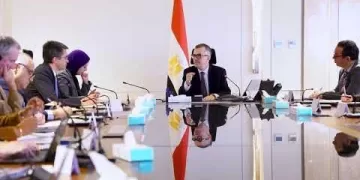











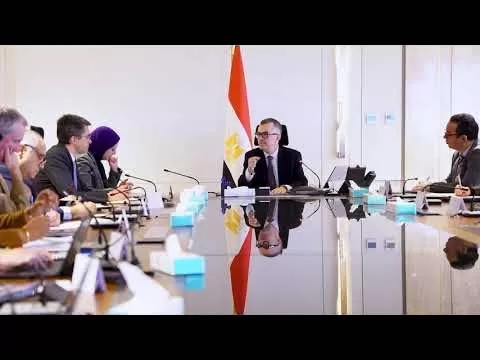
Minister of Planning and Economic Development Ahmed Rostom on Sunday discussed in a meeting with Stephane Guimbert, the World Bank’s Country Director for Egypt, Yemen and Djibouti, ways of enhancing the bilateral strategic partnership and providing technical support for Egypt’s annual and medium-term development plans.
Rostom underlined the importance of fostering coordination with international financing institutions, particularly through close cooperation between the Ministry of Planning and Economic Development and the Ministry of Foreign Affairs and International Cooperation, to ensure integrated efforts aimed at accelerating structural reforms and maximizing the benefits of international partnerships in support of sustainable development goals.
He said the Planning Ministry’s top priority at present is the preparation of the annual development plan and the three-year medium-term plan, which place “the Egyptian citizen at the heart of the development process”.
The minister noted his ministry’s new strategy is based on reprioritizing public investments to ensure spending efficiency and tangible social returns, while stimulating economic clusters that generate employment opportunities, thereby directly supporting social protection programs, such as the Takaful and Karama program.
Rostom reaffirmed the government’s commitment to sustaining the Haya Karima (Decent Life) initiative to improve quality of life in rural Egypt, and to swiftly implementing its second and third phases in line with presidential directives.
The minister stated the partnership with the World Bank is evolving towards a more integrated model that balances fiscal discipline with social investment, by focusing on job creation and human development.
He also noted the government is not merely planning for growth, but laying the foundations for a resilient and sustainable economy capable of meeting citizens’ aspirations.
For his part, Guimbert reiterated the World Bank’s commitment to providing all necessary technical support and expertise to the Egyptian government in several key areas, including fiscal governance through support for public expenditure reviews and domestic resource mobilization, to ensure a robust medium-term fiscal framework.
The World Bank’s director added collaboration with Egypt also extends to the social protection and health sectors, through providing advanced analysis to support the Universal Health Insurance System (UHIS), along with strengthening economic resilience by bolstering the management of economic clusters that contribute to job creation.

