




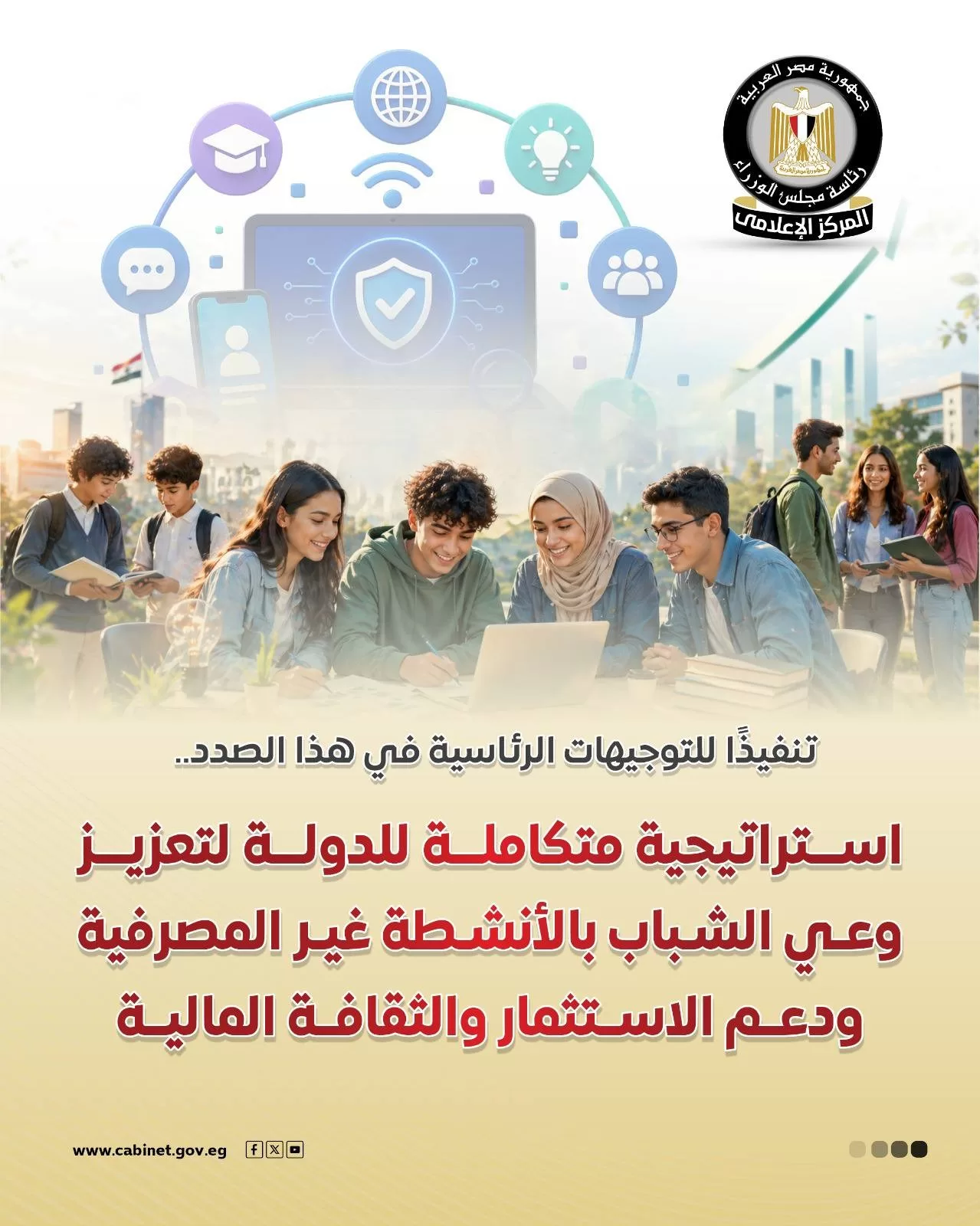
The government has rolled out a comprehensive plan to boost financial awareness among young people, focusing on non-banking financial tools, such as investment, insurance, and leasing.
This strategy aims to build a financially literate generation that understands modern investment tools, digital finance, sustainable investment, and entrepreneurship.
Officials see this as a key part of improving living standards and encouraging broader participation in the economy, in line with Egypt’s Vision 2030.
The new push gained real momentum in February 2022 when the government signed three cooperation protocols with the Ministries of Youth and Sports, Higher Education and Scientific Research, and Education to spread financial literacy across different age groups.
On the digital front, the authorities launched “I-invest” in September 2025, Egypt’s first dedicated online platform offering educational videos on non-banking finance.
Two months later, they introduced the “Mahfazti” podcast, designed to deliver simple, relatable financial advice to Gen Z listeners.
A significant step came in April 2026 with the signing of a memorandum of understanding between the Ministry of Education, Hiroshima University, and Japan’s Sprix.
The partnership seeks to integrate financial literacy into Egyptian schools, using the Test of Fundamental Academic Skills (TOFAS).
Professor Tamer Shawky, an educational psychology specialist at Ain Shams University, highlighted other recent changes in the school curriculum.
This academic year, he said, general secondary schools introduced subjects on AI and programming.
Second-year secondary students are now studying a new programming and artificial intelligence course.
“Interestingly, this subject isn’t graded on a pass-or-fail basis,”professor Shawky told The Egyptian Gazette.
“Students who successfully complete the course will have their names registered on the stock exchange, and a personal investment portfolio worth LE500 will be opened in their name,” he added.
He described mastering AI and programming as among the most important skills of the 21st century.
“Equipping students with the ability to work with digital tools, understand software, and engage with modern technology opens real opportunities in tech and digital fields,” he said.
According to official data, the Financial Regulatory Authority’s awareness programmes have reached 77,266 people between 2022 and March 2026.
These efforts include training 298 certified financial awareness trainers. The programmes have also delivered lectures to 7,843 university students and provided summer training for another 1,315 students since 2023.
Other initiatives include the “Y-Champions” competition and the launch of 10 financial awareness clubs in schools and universities in October 2024.
Education experts say these efforts are vital for Egypt’s future.
Kamal Moghieth, a senior expert at the National Centre for Educational Research, stressed the importance of building a strong foundation early.
“Investing in financial knowledge and culture is essential for sustainable development and long-term social stability,” Moghieth told this newspaper.
“Introducing these concepts early helps students develop critical skills long before university, preparing them to meet both local and global job market demands,” he added.

