


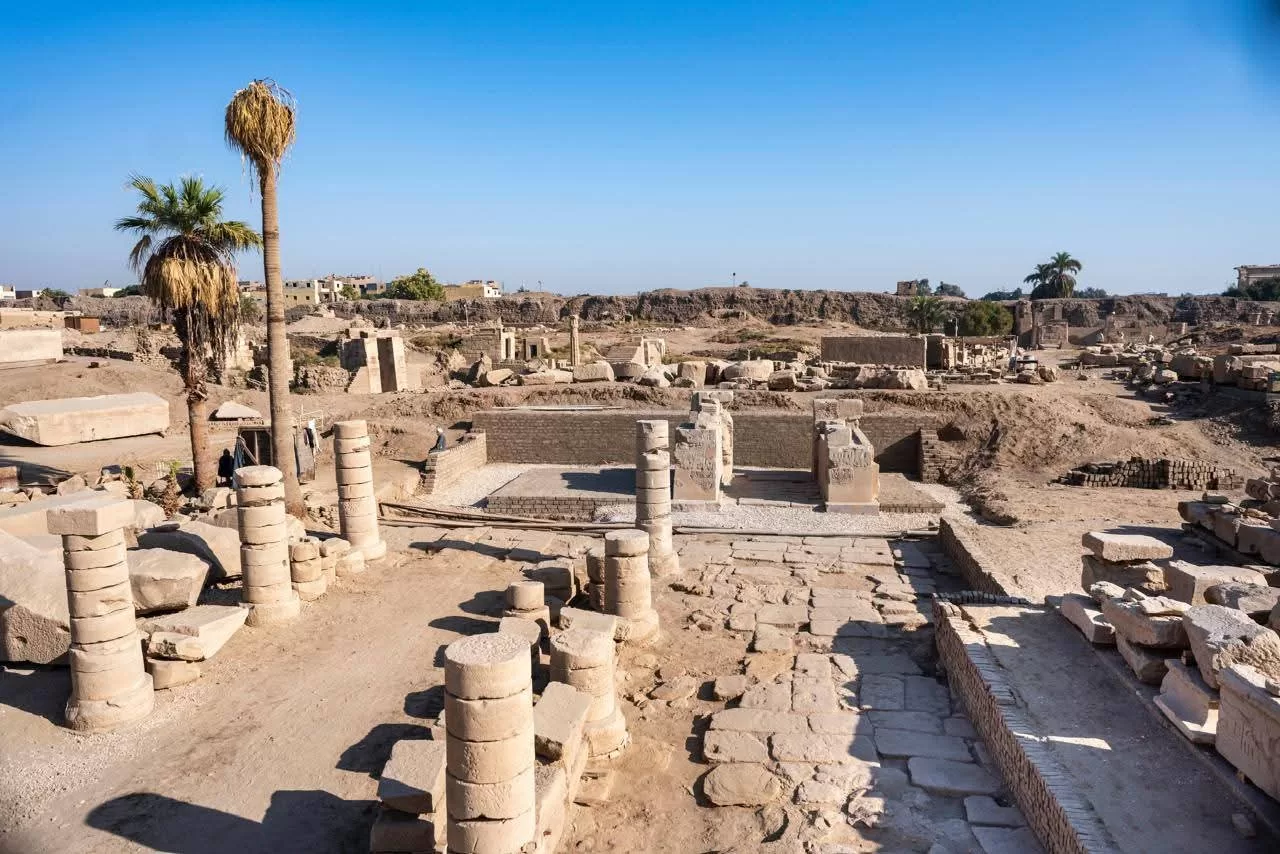
The Egyptian archaeological mission of the Egyptian-French Centre for the Study of the Temples of Karnak (CFEETK), in collaboration with the Supreme Council of Antiquities and the French National Centre for Scientific Research (CNRS), has successfully completed the reconstruction and restoration of the northern gate within the enclosure wall of King Ramses III at the Karnak Temples.
Undertaken between 2022 and 2025 in the north-western sector of the complex, the project represents a major achievement in ongoing conservation efforts, the Tourism Ministry said in a statement.
During the course of the work, the mission uncovered a sandstone stela dating back to the reign of the Roman Emperor Tiberius, measuring approximately 60 × 40 × 10 cm.
The stela depicts the emperor standing before the Karnak triad — Amun-Ra, Mut and Khonsu — and includes a five-line hieroglyphic inscription documenting the restoration of the enclosure wall of the Temple of Amun-Ra.
It was discovered within an archaeological layer associated with mud-brick structures from the Late Roman and Byzantine periods, the ministry also said.
Minister of Tourism and Antiquities, Sherif Fathy, praised the Egyptian-French co-operation, noting that the project forms part of a wider plan to develop the Karnak complex, including enhancements to the open-air museum and visitor services.
He highlighted that recent restoration work and discoveries contribute significantly to understanding the site’s evolution, particularly during the first millennium BC.
The restoration process involved dismantling, conserving, documenting and reassembling the gate using advanced scientific methods, the minister said, adding that the work also revealed reused decorated stone blocks from the reign of Amenhotep III, suggesting an earlier gateway at the same location.
Excavations further identified sections of the northern wall dating to the New Kingdom, with evidence of later restorations during the Greek and Roman periods.
In addition, a paved processional road linking the gate to the courtyard of the third pylon was reidentified during development works in summer 2025.
The restored stela will be displayed in a museum following completion of conservation and ongoing research, the minister concluded.

