



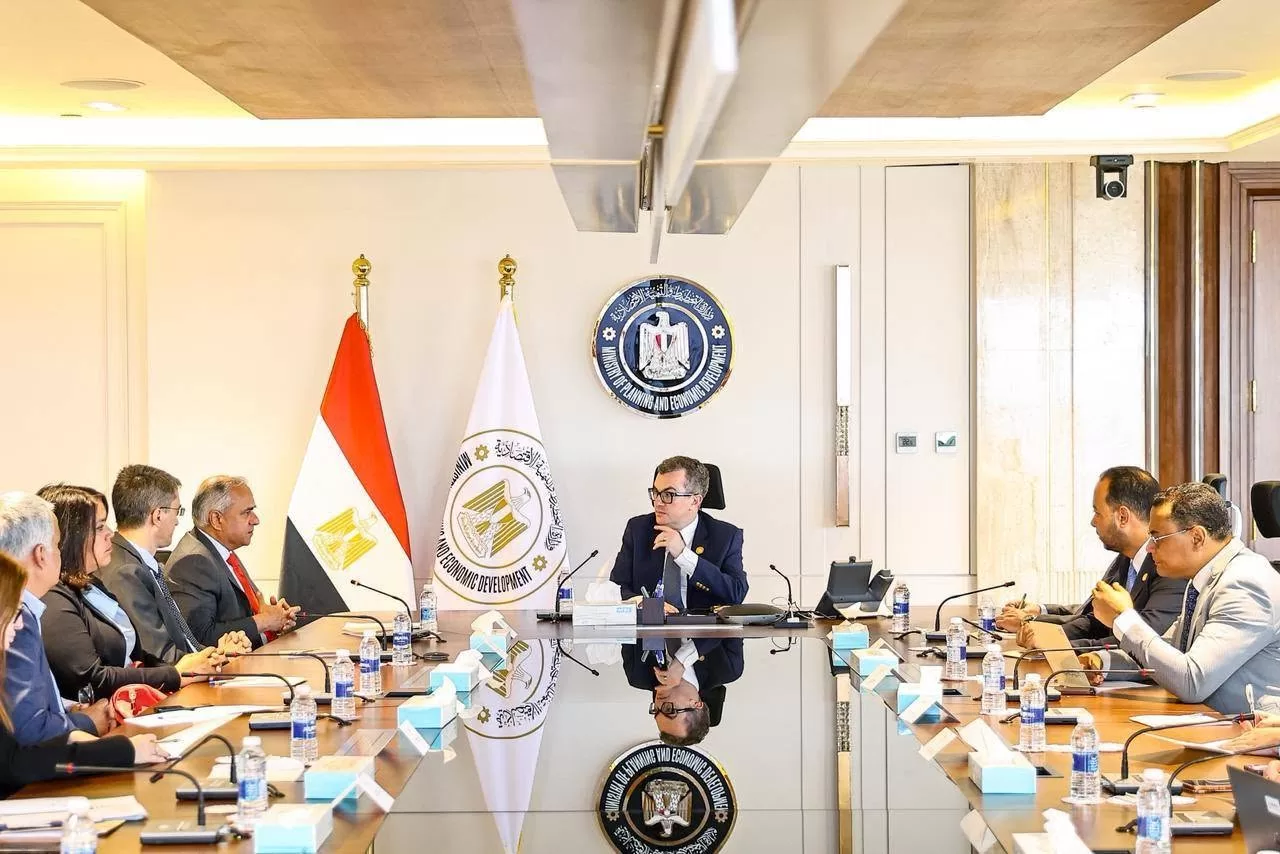
Minister of Planning and Economic Development Ahmed Rostom held talks on Tuesday with a high-level World Bank (WB) delegation to strengthen co-operation in various fields.
The meeting brought together Sandeep Mahajan, WB Regional Director for Prosperity Practice in the Middle East and North Africa, Stefan Gimbert, WB Regional Director for Egypt, Yemen, and Djibouti, alongside several senior World Bank officials.
At the outset of the meeting, Rostom praised the longstanding partnership between Egypt and the WB across a range of strategic areas, highlighting the institution’s technical support in economic analysis, public finance reviews, poverty studies, and statistical surveys.
The two sides discussed means to develop national data systems, as Egypt moves forward with updating its Vision 2030 strategy and formulating the broader framework for Egypt Vision 2040.
The minister stressed the strategic importance of surveys and national databases in supporting informed government decision-making, particularly during times of crisis.
Rostom underscored the need to maximise the value of existing datasets through the establishment of a unified index covering long-term databases, including labour market indicators, household income and expenditure surveys, financial data, economic censuses, and enterprise surveys. Such efforts, he said, would facilitate deeper economic analysis and support the formulation of reforms and policies based on accurate data and on-the-ground realities.
The minister revealed that the ministry is currently finalising the update of Egypt Vision 2030 while preparing the overarching framework for Egypt Vision 2040. He added that a comprehensive economic programme is also being developed to outline Egypt’s strategic priorities over the next three to five years.
Rostom also highlighted the government’s adoption of a more scientific approach to economic forecasting by presenting growth projections as ranges rather than fixed estimates, reflecting increasing global uncertainties and enhancing the credibility of economic outlooks.
On modernising Egypt’s national data ecosystem, the minister emphasised the importance of joint efforts to establish an integrated and continuously updated national database modelled on the WB’s World Development Indicators (WDI), enabling planners and decision-makers to access organised and digitally accessible data.
The WB representatives praised the productive co-operation with the Ministry of Planning and Economic Development and reaffirmed the Bank’s commitment to supporting Egypt’s efforts in strengthening economic analysis, expanding data accessibility and utilisation, and building a sustainable ecosystem for evidence-based development policymaking.

