



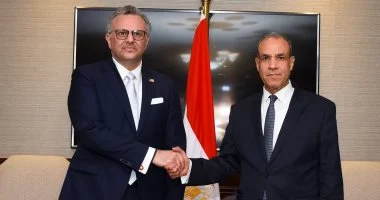
Egypt’s Minister of Foreign Affairs, International Co-operation and Egyptian Expatriates, Badr Abdel-Aati, and Advisor to the President of the United States on Arab and Middle Eastern Affairs Massad Boulos, have discussed bilateral relations and the pressing regional issues across the Middle East and Africa.
Abdel-Aati received Boulos on Monday, and held talks which reflected mutual appreciation for the depth of the Egypt–US strategic partnership, seen as a key pillar for promoting security and stability in both regions, Foreign Ministry Spokesperson Tamim Khallaf, said on Tuesday
The two sides stressed commitment to advancing co-operation across political and economic fields, while maintaining close coordination on shared concerns.
Regional developments featured prominently on the agenda of the talks, including the situation in Sudan, Lebanon, Libya and the Horn of Africa, as well as Egypt’s water security.
Abdel-Aati reviewed Cairo’s ongoing efforts to de-escalate tensions and support diplomatic engagement, particularly regarding US-Iran negotiations, stressing the importance of reaching a settlement that enhances regional stability.
On Sudan, the Egyptian chief diplomat underscored the need to preserve the country’s unity, sovereignty and national institutions, rejecting external interference. He also called for a humanitarian truce leading to a sustainable ceasefire and the delivery of aid, alongside launching an inclusive Sudanese-led political process.
Regarding Lebanon, Abdel-Aati reaffirmed Egypt’s support for its sovereignty and territorial integrity, the strengthening of national institutions-especially the army—and welcomed the recently announced ceasefire.
The minister also stressed respect for the sovereignty of Horn of Africa states, particularly Somalia and Eritrea. On water security, he reiterated that the Nile is an existential issue for Egypt and rejected unilateral measures on transboundary rivers.
For his part, Boulos praised Egypt’s central role in regional stability and affirmed Washington’s commitment to further strengthening bilateral ties and coordination.

