




Egypt’s Minister of Tourism and Antiquities, Sherif Fathy, said on Saturday that the recent archaeological discoveries in the Jabal al-Tayr area of Minya Governorate represent a significant addition to the country’s historical record.
Minister Fathy noted that the finds provide valuable new evidence to help trace the development of ancient Egyptian funerary architecture across different historical periods.
The discoveries were made by an Egyptian archaeological mission from the Supreme Council of Antiquities during excavations at the site.
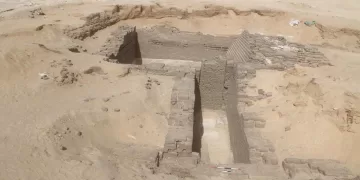
The team uncovered two tombs dating back to the Early Dynastic Period, alongside several burials from the Predynastic and Late Periods.
Hisham El-Leithy, Secretary-General of the Supreme Council of Antiquities, explained that the first tomb represents a rare architectural discovery due to its unique design, while the second tomb, which shares a similar layout, remains exceptionally well-preserved.
Preliminary studies indicate a remarkable resemblance between these two structures and the renowned tomb of King Den at Abydos.
This underscores the importance of the Jabal al-Tayr area as a major necropolis that was used continuously from the Predynastic Period through to the Late Period.
Professor Mohamed Abdel-Badi, Head of the Egyptian Antiquities Sector, stated that the first tomb features an innovative architectural design based on a gradual reduction in wall thickness from the base upwards.
He noted that this engineering concept may represent an early stage in the evolution of architectural thought that eventually led to the construction of step pyramids and, later, true pyramids.
Although parts of the first tomb appear to have been quarried in later historical periods, the surviving remains have revealed vital details about ancient construction techniques, including stone-cutting methods and the use of large wooden supports to reinforce the structure.
The second tomb, located just south of the first, follows a similar architectural design but escaped later quarrying, leaving many of its original features intact.
The mission also unearthed several individual and collective burials, some of which were contained within the remains of wooden coffins believed to date back to the Late Period, confirming the continuous use of the cemetery over successive eras.
Excavation work is ongoing as archaeologists continue to uncover further evidence of the site’s historical significance.

