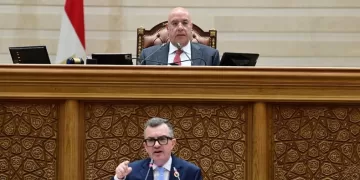





Egypt is aiming for higher growth, expanded private investment, and stronger social protection under its Economic and Social Development Plan for fiscal year 2026/2027 and the medium-term plan through 2029/2030, Planning and Economic Development Minister Ahmed Rostom said.
Presenting the main features of the plan before the House of Representatives on Wednesday, the minister said the plan prioritises improving citizens’ quality of life, upgrading public services, increasing productivity, ensuring energy and food security, building human capital, and accelerating implementation of the Universal Health Insurance System. It also places the “Decent Life” presidential initiative at the top of priorities, with completion of its first phase and launch of the second phase during FY2026/27, according to a press statement issued by the Ministry of Planning and Economic Development on Wednesday.
Rostom noted that the plan seeks to expand private sector participation in development process, advance education reform, strengthen infrastructure, and explore new economic opportunities driven by innovation.
Despite global shocks over the past two decades, Rostom told the parliament that the Egyptian economy has demonstrated resilience supported by proactive reforms, achieving growth of around 5.3% in the first half of the current fiscal year.
Rostom said Egypt’s economy is projected to grow by 5.4 per cent in FY2026/27, rising to 6.8 per cent by FY2029/30 under the medium-term plan. A more conservative scenario of 5.2 per cent growth has also been prepared in case of continued global uncertainty.
He noted that five key sectors will drive around 64 per cent of growth next year: manufacturing (29%), wholesale and retail trade (11.3%), tourism (9.3%), construction (7.2%), and agriculture (7%).
Nominal GDP is expected to rise from LE21.2 trillion in FY2025/26 to LE24.5 trillion in FY2026/27, reaching LE36.8 trillion by 2029/30. Agriculture, industry, construction, and trade together account for 62 per cent of GDP, the minister of planning said.
Total investments for FY2026/27 are projected at LE3.7 trillion, with public investment accounting for 41 per cent (around LE1.5 trillion) and private investment 59 per cent (roughly LE2.2 trillion). The investment-to-GDP ratio is expected to reach 17 per cent.
By 2029/30, the investment ratio is targeted to rise to 20 per cent, while private sector share is expected to increase to 64 per cent.
The minister reassured that Egypt is committed to advancing structural reform and sustainable development. He said success would not be measured solely by GDP growth, but by its impact on citizens’ lives.

