



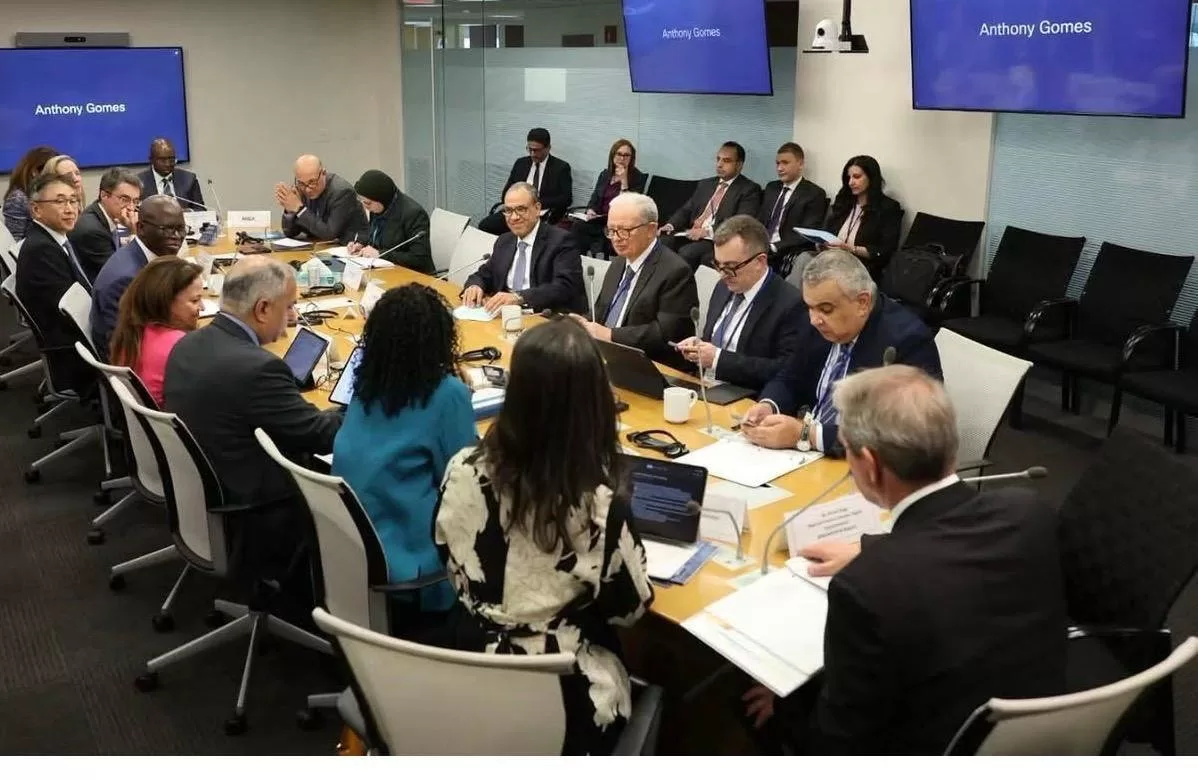
Egypt’s Minister of Planning and Economic Development, Ahmed Rostom, held a series of high-level meetings in Washington with senior officials from key international financial institutions, aimed at deepening co-operation and accelerating private sector-led growth.
Foreign Minister Badr Abdel-Aati and Investment Minister Mohamed Farid attended the meetings.
The discussions took place on the sidelines of his participation in the Spring Meetings of the World Bank and the International Monetary Fund, as part of a high-level Egyptian government delegation.
IFC partnership
In talks with Makhtar Diop, Managing Director of the International Finance Corporation (IFC), Minister Rostom stressed the importance of enhancing private sector participation across Egypt’s economy.
Rostom commended the IFC’s pivotal role in supporting private enterprise, particularly in priority sectors including renewable energy, green hydrogen, mining, infrastructure, and healthcare. He highlighted the resilience of the Egyptian economy in the face of ongoing geopolitical tensions, attributing its performance to a series of structural economic and monetary reforms implemented in recent years.
Diop reaffirmed the IFC’s strong and longstanding partnership with Egypt, pledging continued support through financing and technical expertise. He described Egypt as one of the region’s most promising investment destinations, noting that future co-operation would expand into infrastructure, high-growth sectors such as tourism and financial services, and clean energy.
WB supports key development sectors
In a separate meeting, Rostom held talks with Ousmane Dione, Vice President of the World Bank (WB) for the Middle East, North Africa, Afghanistan and Pakistan region.
The minister expressed appreciation for the recent visit of the World Bank President to Egypt, emphasising the importance of building on its outcomes to further strengthen bilateral co-operation, particularly in healthcare, water resource management, tourism, food security, and agriculture.
Discussions also explored expanding WB technical assistance across a range of strategic sectors, including the development of a comprehensive national system for innovation and artificial intelligence, promotion of the Suez Canal Economic Zone, enhancing energy efficiency, modernising ports, and advancing industrial localisation.
Dione praised Egypt’s ongoing reform efforts and its effective response to global economic challenges, reaffirming the Bank’s readiness to scale up support, particularly in tourism, innovative financing, and renewable energy.
MIGA: Strengthening investor confidence
Rostom also met with Tsutomu Yamamoto, Managing Director of the Multilateral Investment Guarantee Agency (MIGA), where discussions focused on enhancing the investment climate and strengthening investor confidence.
The minister praised MIGA’s vital role in supporting Egypt’s investment environment, noting that its guarantees have been instrumental in encouraging investment, particularly in strategic sectors such as renewable energy and banking.
He reiterated that empowering the private sector remains a central pillar of Egypt’s economic strategy, describing it as the primary engine of growth. Rostom outlined ongoing efforts to foster a more attractive investment climate through a comprehensive reform agenda, including tax and customs incentives, digital transformation to streamline procedures, and legislative reforms aimed at ensuring transparency.
Yamamoto, for his part, expressed appreciation for the strong partnership with Egypt, particularly across renewable energy, manufacturing, infrastructure, and financial services, and affirmed MIGA’s commitment to further expanding co-operation in support of Egypt’s evolving investment ecosystem.

