











CAIRO – Egypt’s Mufti and President of the General Secretariat for Fatwa Authorities Worldwide Nazir Muhammad Ayyad asserted that sound and well-grounded fatwas are an urgent necessity for societal stability and cohesion.
He stressed that regulated fatwas contribute to guiding societal behavior, entrenching moderate values and confronting extremism and intellectual deviation.
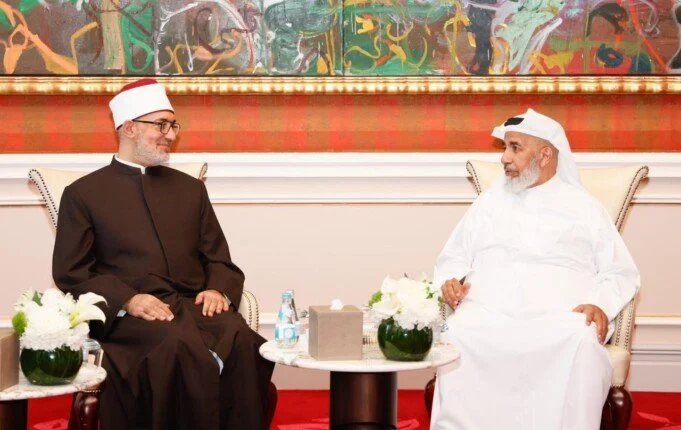
This statement came during his meeting with Qatari Minister of Endowments and Islamic Affairs Ghanem bin Shaheen bin Ghanem Al Ghanem on the sidelines of the session of the International Islamic Fiqh Academy (IIFA) held in Doha.
The meeting discussed ways to enhance cooperation between both sides in the fields of fatwa issuance and religious training as well as the signing of a memorandum of understanding between Egypt’s Dar al-Ifta and the Qatari Ministry of Endowments.
According to a statement issued on Tuesday, Ayyad clarified that the secretariat has become an inclusive umbrella organization that includes over 111 fatwa authorities and institutions from various countries worldwide.
The secretariat works on coordinating and integrating the efforts of official fatwa institutions and provides scientific, professional and technical support to develop fatwa practices in line with contemporary challenges, he said.
He noted that the secretariat has achieved a series of significant accomplishments in recent years, most notably the launch of the Global Fatwa Index, the organization of annual international conferences with participation of scholars and muftis, the establishment of centers supporting fatwa research, the development of training programs for muftis and Islamic researchers and the production of digital content that promotes sound religious awareness.
The Mufti highlighted specialized centers established by the secretariat to address intellectual and social challenges, such as the Salam Center for Extremism Studies and Combating Islamophobia, which monitors hate speech against Muslims, refutes extremist group claims and promotes the true image of Islam.
He also mentioned the Imam Al-Layth ibn Sa’d center for coexistence, which aims to promote a culture of pluralism and mutual respect and provides models of historical and contemporary Islamic jurisprudence on coexistence.
He stressed the importance of integration among religious institutions in the Arab and Islamic world, affirming that the Qatari Ministry of Endowments plays an important role in promoting moderation and renewing religious discourse.
He expressed the readiness of Egypt’s Dar al-Ifta to cooperate and coordinate to sign a memorandum of understanding, which would help launch joint initiatives and projects, exchange expertise, and build the capacities of religious cadres in the fields of fatwa, training, and academic research.
For his part, the Qatari minister praised the pioneering role played by Egypt’s Dar al-Ifta and the General Secretariat for Fatwa Authorities Worldwide in serving the issues of the Muslim nation.

