




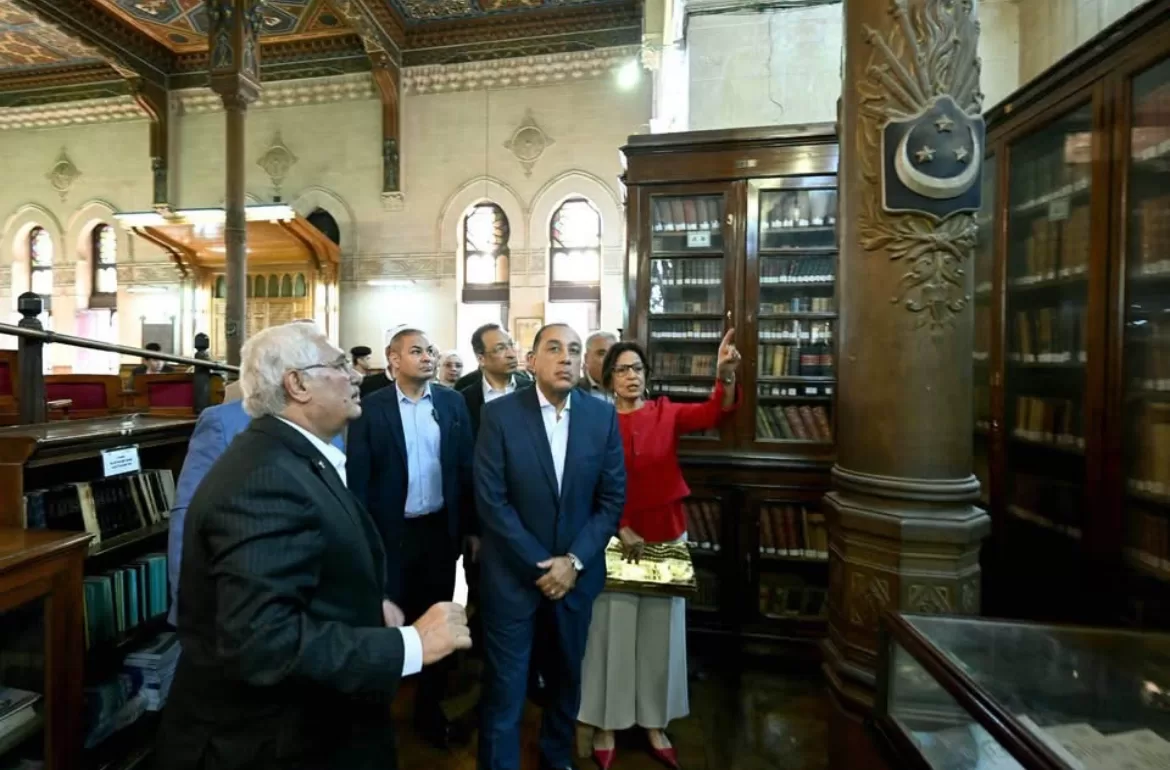
Prime Minister Moustafa Madbouli on Sunday visited the Egyptian Geographical Society as part of a tour of Cairo Governorate, underscoring government efforts to preserve and digitise the collections of one of the country’s oldest scientific institutions.
Founded in 1875, the Society is among the world’s oldest geographical organisations and houses a vast collection of rare books, manuscripts, maps, documents and artefacts chronicling the development of geography and modern Egyptian history.
Madbouli described the Society as an integral part of Egypt’s scientific and cultural heritage. He noted that the institution has occupied its current headquarters since 1923 and was designated a historic monument in 1992, stressing the government’s commitment to preserving its collections and safeguarding an important element of the nation’s historical memory.
Communications and Information Technology Minister Raafat Hindy said co-operation with the Society would continue through the “Digital Egypt Heritage” platform, under which books, academic journals, university theses and historical maps are being digitised and made available to researchers in Egypt and abroad.
Culture Minister Gihane Zaki said the ministry was working closely with the Society to document and promote its holdings, including rare maps and a diorama depicting the inauguration of the Suez Canal during the reign of Khedive Ismail.
During the visit, the prime minister toured the Society’s Royal Historical Hall, Ethnographic Museum, exhibitions dedicated to traditional customs and crafts, Africa and the Suez Canal, as well as its cartographic library.
The Society’s collections include around 40,000 books and reference works, 13,000 historical and modern maps, more than 600 rare atlases, in addition to a significant archive of manuscripts and historical documents, Secretary-General Ismail Youssef said.
Society Chairman, Mohamed Zaki El-Sudaimi, said more than 70,000 pages of the Society’s journal had already been digitised, alongside the restoration and digitisation of around 8,000 rare maps.
The historic headquarters requires restoration work to address deterioration caused by age, humidity and water leakage, noting that efforts are under way to secure funding for conservation and modernisation projects in line with international standards, he added.

