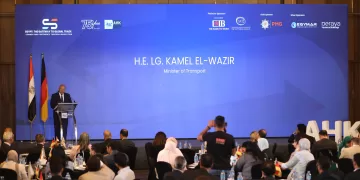









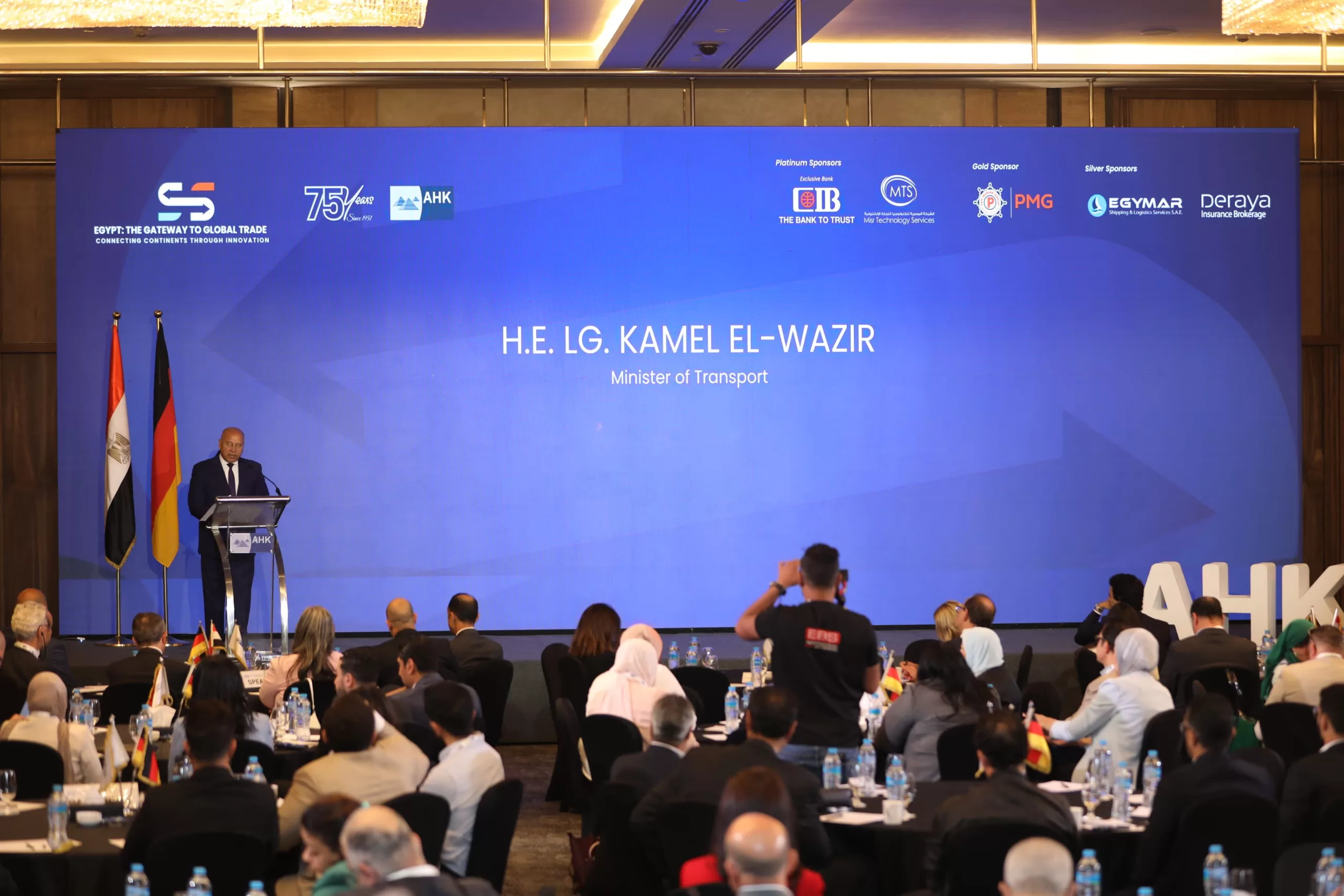
Minister of Transport Kamel el-Wazir affirmed on Tuesday that the Egyptian state has given great importance to enhancing the logistics system as a key pillar for supporting intra-Arab and international trade and efficiently linking markets, leveraging Egypt’s unique geographic location connecting continents and serving global and regional trade movement.
He noted that this comes in implementation of directives by President Abdel Fattah El Sisi to transform Egypt into a regional hub for transport, logistics and transit trade.
The remarks were made during his speech at a logistics conference held at the German-Arab Chamber of Industry and Commerce, in the presence of Finance Minister Ahmed Kouchouk, Chamber Chairman Ahmed El Sewedy and Chamber CEO Maren Diale.
At the outset of his speech, Wazir expressed his pleasure at participating in the conference, which addressed key developments in the Middle East and future plans for Egypt’s transport and logistics sector. He stressed that the sector has become a decisive factor in enhancing countries’ competitiveness and achieving sustainable economic development, especially amid challenges related to supply chains, energy security and transport costs.
He pointed out that the world has witnessed rapid transformations in global supply chains in recent years, underscoring that the efficiency of logistics systems is a cornerstone for modern economies.
Wazir said Egypt has adopted an ambitious and comprehensive vision in recent years to develop the transport sector in all its forms as a main driver of economic development and a key axis for connecting markets and maximising the benefits of Egypt’s geographic potential.
He added that plans are in place to establish seven integrated international development logistics corridors, linking production areas—industrial, agricultural and mining—with consumption and service zones, as well as seaports, dry ports, and logistics zones through fast and secure transport networks to facilitate domestic and international trade, support supply chains, attract investment and enhance economic competitiveness.
The corridors include Cairo–Alexandria, Tanta–Mansoura–Damietta, Gargoub–Salloum, Cairo–Aswan–Abu Simbel, Safaga–Qena–Abu Tartour, as well as Sokhna–Alexandria and Arish–Taba, which would integrate Egypt into global logistics corridors and boost multimodal transport efficiency in line with Egypt Vision 2030.
The minister noted that the importance of these corridors became evident amid regional conflicts and the closure of key maritime straits such as Hormuz and Bab el-Mandeb, as well as Saudi Arabia’s announcement of a logistics corridor linking the Gulf, Egypt and Europe, with a focus on NEOM Port as a central hub connected to Egypt’s Safaga Port and the Egyptian-Italian Ro-Ro line at Damietta Port.
He also highlighted the Arab land transport line linking Egypt and Jordan via Aqaba Port and the Arab Bridge Maritime Company, facilitating trade flows from Jordan, Iraq and Syria through Egyptian Red Sea ports to the Mediterranean and onward to Europe and the US.
In this context, Wazir praised co-operation between the Transport Ministry and several German and international companies such as Siemens and Eurogate.

