



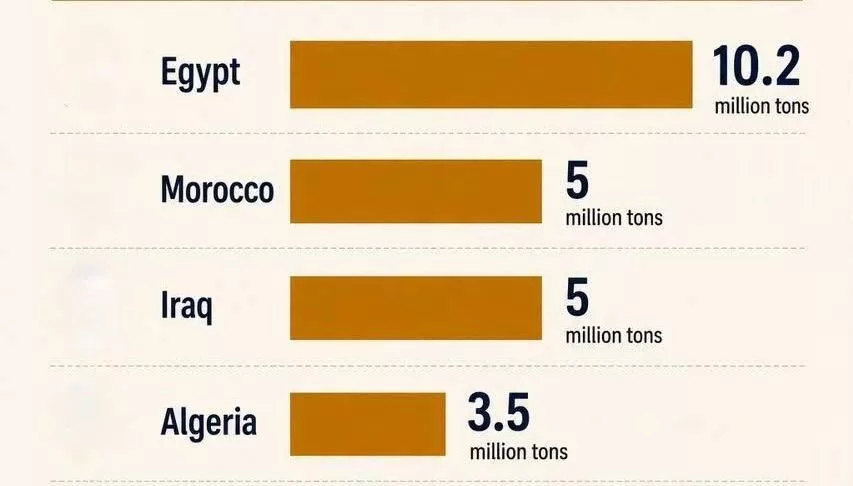
The Cabinet Media Centre said on Sunday that Egypt is expected to lead Arab countries in wheat production in 2026, according to Food and Agriculture Organisation (FAO) estimates, with output projected at 10.2 million tonnes.
The figures coincide with the conclusion of the wheat procurement season and reflect continued growth in domestic production, driven by expanded cultivated areas, higher productivity and the development and wider distribution of high-yielding, climate-resilient varieties, helping reduce reliance on imports.
Morocco and Iraq rank second with 5 million tonnes each, followed by Algeria with around 3.5 million tonnes, Tunisia with approximately 1.4 million tonnes and Saudi Arabia with 1.1 million tonnes.
According to the estimates, Egypt’s wheat production is expected to rise by around 7% in 2026 compared with the average production level, mainly due to the expansion of cultivated land.
Domestic production is also projected to increase by 6.5%, exceeding 10 million tonnes, compared with 9.4 million tonnes in 2025, while wheat imports are expected to decline to 12.5 million tonnes from around 13.2 million tonnes.
The wheat cultivation area reached a record 3.76 million feddans, an increase of 600,000 feddans compared with the previous season.Government procurement also recorded its highest historical level, with around 5 million tonnes supplied by the end of the procurement season.
The supply price was set at LE2,500 per ardeb, in line with President Abdel Fattah El-Sisi’s directives to incentivise farmers.
The increase in production has also been supported by the development and widespread adoption of high-yielding, climate-resistant varieties.

