




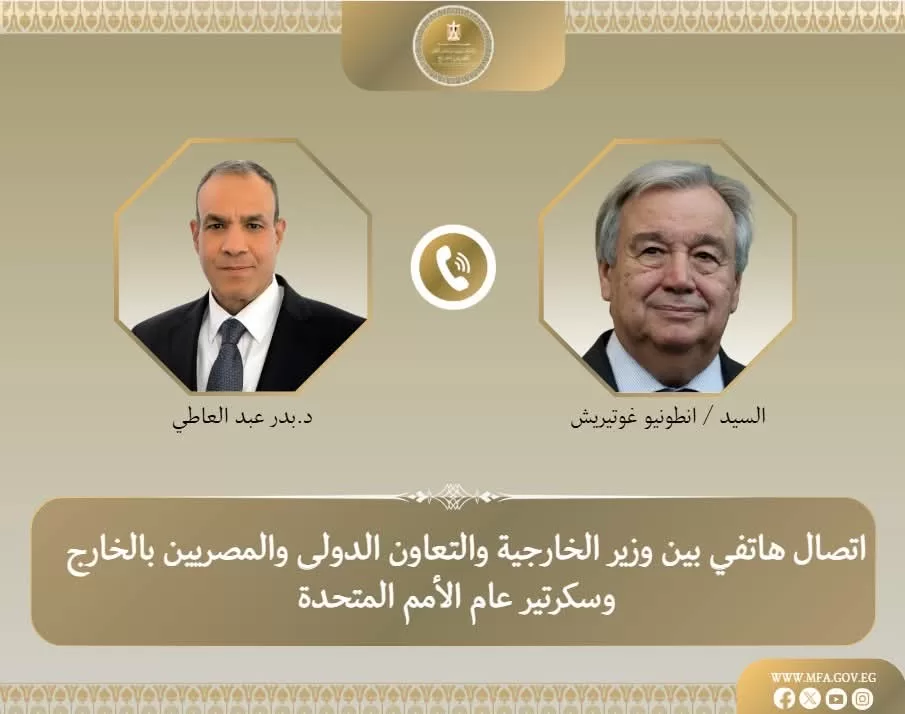
Egypt’s Minister of Foreign Affairs, Emigration and Egyptian Expatriates, Badr Abdelatty, received a phone call on Friday, March 27, from António Guterres, Secretary-General of the United Nations, to discuss ongoing efforts to de-escalate tensions in the Middle East and review the latest developments across several regional files.
According to Ambassador Tamim Khallaf, the official spokesperson for the Foreign Ministry, Guterres conveyed his sincere greetings and deep appreciation to President Abdel Fattah El-Sisi, praising Egypt’s pivotal role in promoting regional security and stability amid complex crises.
He also commended Egypt’s firm commitment to the principles of the UN Charter and its sustained efforts to advance international peace and security.
In this context, the UN chief expressed appreciation for Egypt’s mediation efforts under the leadership of President El-Sisi, particularly its cooperation with Turkey and Pakistan in supporting direct negotiations between the United States and Iran.
He affirmed the UN’s full support for these efforts aimed at reducing regional tensions.
The call also included an exchange of assessments regarding the ongoing military escalation in the region and its severe repercussions, particularly on freedom of navigation and global supply chains, with direct implications for food security and the availability of agricultural inputs such as fertilisers.
The two sides also discussed energy security concerns amid rising global oil and energy prices.
For his part, Abdelatty welcomed the appointment of Jean Arnault as the Secretary-General’s Personal Envoy to lead UN efforts on the Middle East conflict, expressing Egypt’s readiness to work closely with him to advance de-escalation.
On the Palestinian file, the Egyptian minister reviewed Cairo’s ongoing efforts to implement all elements of the second phase of the proposed US plan.
This includes the deployment of an international stabilisation force, enabling the Gaza administrative committee to assume its responsibilities, and paving the way for the Palestinian Authority to resume governance.
He also highlighted Egypt’s role in training Palestinian police forces and facilitating the operation of the Rafah border crossing.
Abdelatty stressed the urgent need to intensify efforts to protect Palestinian civilians in the West Bank, condemning attacks by Israeli settlers against civilians and their property as flagrant violations of international law that undermine prospects for peace.
Regarding developments in Lebanon, the minister briefed Guterres on the outcomes of his recent visit to Beirut on March 26. He underscored the necessity of an immediate halt to Israeli escalations and attacks on Lebanese territory, reaffirming Egypt’s firm rejection of any violation of Lebanon’s sovereignty, unity, or territorial integrity, as well as any targeting of civilian infrastructure.
He further emphasised the importance of empowering Lebanese state institutions and ensuring the full and non-selective implementation of United Nations Security Council Resolution 1701, alongside supporting the Lebanese state’s efforts to consolidate authority, control weapons, and extend sovereignty across its entire territory.

