






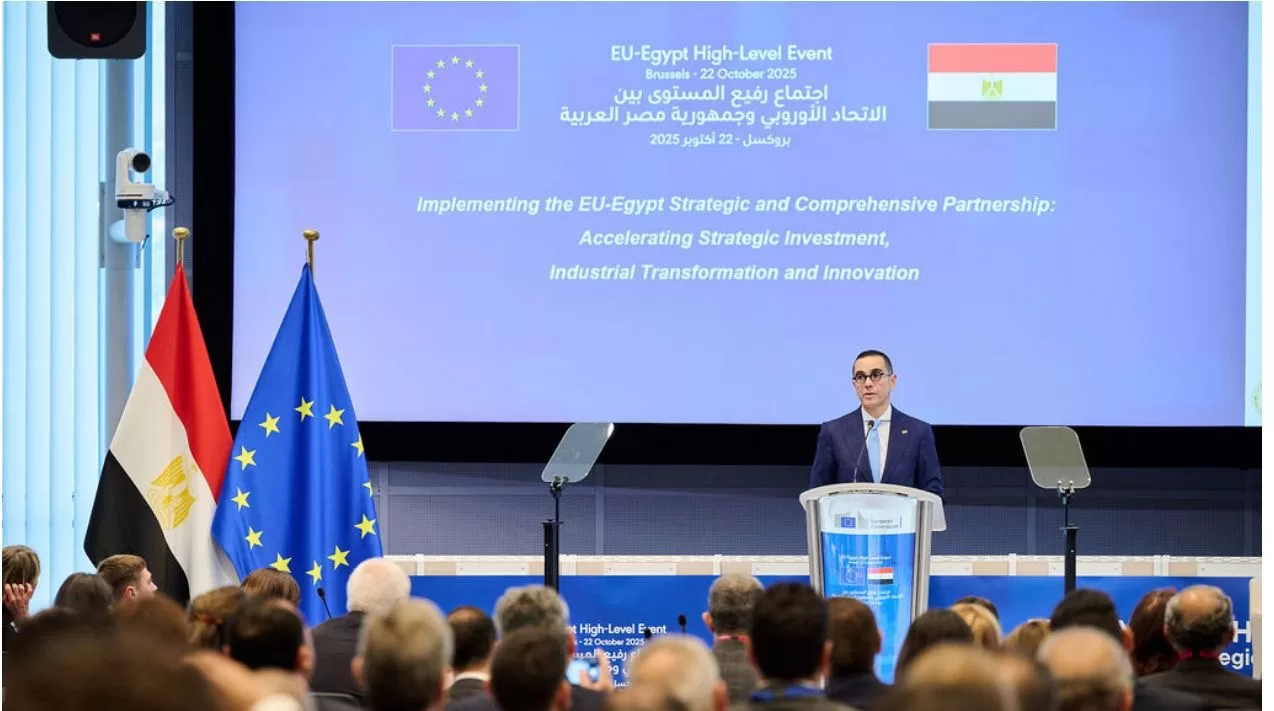
Minister of Investment and Foreign Trade Hassan el-Khatib affirmed that the first-ever Egypt–EU Summit marks a milestone in the evolution of bilateral relations, describing it as a vital platform for strengthening economic co-operation and advancing shared development goals. He noted that Egypt has witnessed an unprecedented transformation in its infrastructure, with investments exceeding $500 billion over the past ten years.
Speaking at the summit, held at the European Commission (EC) headquarters in Brussels, el-Khatib highlighted that these investments have delivered tangible progress across multiple sectors, manifested in a series of landmark national megaprojects. Among the most significant, he said, are the New Administrative Capital, New Alamein City, and Galala City, alongside the National Roads Project and a 7,000-kilometre transport network currently under development. These initiatives, coupled with major upgrades to railways, metro systems, and public transport, have laid the foundations for a modern, interconnected economy.
He pointed out that Egypt has also made substantial strides in modernising transport infrastructure, including new metro lines, monorail systems, and light and high-speed electric rail networks.
Reviewing the government’s broader reform agenda, el-Khatib noted that Egypt’s comprehensive reform strategy is built on four key pillars. The first focuses on monetary policy, which has reinforced macroeconomic stability and restored investor confidence. Inflation, he noted, fell to 11.6% in the second quarter of 2025, down from 28.5% a year earlier.
The second pillar centres on balanced and sustainable fiscal management, aiming to broaden the tax base by 35% annually, curb public expenditure, and address non-tax burdens through greater transparency and efficiency.
The third pillar targets trade liberalisation, with the objective of positioning Egypt among the world’s top 20 trading nations by 2030, through streamlined customs procedures and enhanced export competitiveness.
The fourth pillar, el-Khatib said, involves redefining the role of the state from a direct operator to a regulator and facilitator, thereby encouraging private-sector participation and driving sustainable growth.
He underscored that digital transformation lies at the heart of these reforms, citing the launch of a unified electronic licensing platform that integrates hundreds of government services. This will be followed by the Egypt Business Portal, providing digital investment services, and the National Trade Portal, designed to boost export competitiveness.
El-Khatib reaffirmed state’s commitment to the World Bank’s Business Ready (B-READY) standards, overseen by a high-level national committee working to secure Egypt’s inclusion in the global index by 2026.
To sum up, the minister asserted that Egypt’s strategic location — linking Europe, the Middle East, Africa, and Asia — positions it as a key player in global supply chains. Coupled with a diversified economy spanning services, industry, and agriculture, Egypt, he said, is firmly on course to strengthen its role as a regional economic powerhouse.

