




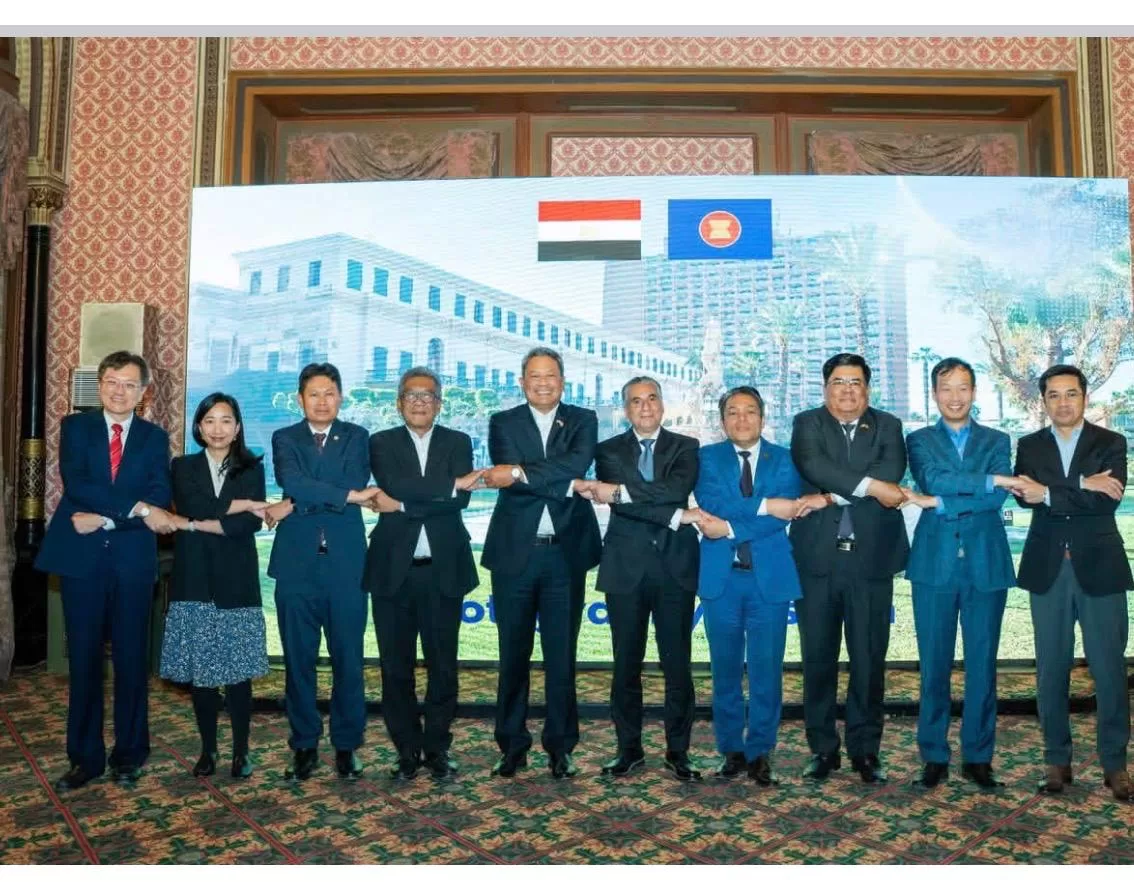
The Embassy of Malaysia in Cairo hosted a high-level dialogue featuring Assistant Foreign Minister for Asian Affairs, Ambassador Amr Hamza, drawing participation from ASEAN diplomats, officials from Egypt’s Ministry of Foreign Affairs, International Cooperation and Egyptian Expatriates, alongside representatives from the business community and media.
In his remarks, Ambassador Hamza offered an overview of the evolving regional landscape amid ongoing geopolitical tensions in the Middle East. He outlined Egypt’s diplomatic approach, stressing Cairo’s active efforts to support de-escalation and contain conflicts through sustained engagement and dialogue with all concerned parties.
He reaffirmed Egypt’s commitment to regional stability, emphasising the importance of diplomacy-led solutions and continuous communication channels. Egypt, he noted, remains a key stabilising force in the region, leveraging its diplomatic reach and strategic partnerships.
The session also served as a platform to advance discussions on strengthening relations between Egypt and the Association of Southeast Asian Nations (ASEAN). Participants exchanged views on enhancing cooperation at both the multilateral level and through bilateral ties with individual member states, highlighting opportunities across political, economic and people-to-people domains.
As part of efforts to boost connectivity, Malaysia proposed the resumption of direct flights between Cairo and Kuala Lumpur, including the potential involvement of low-cost carrier AirAsia. The move is seen as a practical step toward facilitating tourism, trade and investment flows.
During the session, Malaysia also presented its “Halal+ 2030” initiative—an ambitious framework aimed at advancing the global halal economy through digital innovation. The strategy focuses on integrating emerging technologies such as artificial intelligence, blockchain and the Internet of Things to enhance transparency and traceability across halal supply chains.
Positioned as both an economic roadmap and a form of soft power, Halal+ 2030 underscores Malaysia’s intent to combine market expansion with Islamic values while strengthening its global leadership in the sector. The global halal economy is currently valued at over $3 trillion and is projected to grow to $5 trillion by 2030, spanning sectors including finance, tourism and the digital economy.

