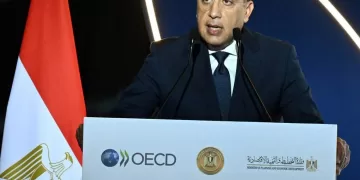





Prime Minister Moustafa Madbouli highlighted on Monday Egypt’s comprehensive economic reform agenda, undertaken in partnership with international stakeholders, and aimed at reinforcing macroeconomic stability, enhancing resilience and achieving sustainable growth.
The premier delivered these remarks at the high-level conference marking the conclusion of the first phase of the Country Programme between Egypt and the Organisation for Economic Co-operation and Development (OECD), held in the New Capital in co-operation with the OECD and the Ministry of Planning and Economic Development.
Opening his address, Madbouli welcomed OECD Secretary-General Mr Mathias Cormann, as well as attending ministers, ambassadors, OECD officials, and representatives of regional and international organisations and bodies.
The premier voiced his pleasure at participating in the closing events of the Country Programme, describing it as a key milestone in constructive cooperation between Egypt and the OECD since its launch five years ago.
The programme has witnessed continuous engagement and sustained efforts by both sides, resulting in the completion of numerous projects across various development sectors, the prime minister said, according to a statement by Cabinet Spokesman Ambassador Mohamed el-Homosani.
Madbouli underlined that the conclusion of the programme comes amid rapidly evolving international and regional challenges requiring more flexible and adaptive policies.
He pointed to Egypt’s comprehensive reform programme supported by strategic international partnerships, with the Country Programme serving as one of its most important tools in strengthening economic stability, resilience and sustainable growth.
“The programme has proven to be an effective instrument for supporting policymaking through strengthened institutional capacity, evidence-based policies, improved investment and business environments, and the development of legislative and regulatory frameworks aligned with international standards,” el-Homosani quoted the premier as saying.
The prime minister further noted the participation of around 20 national entities, reflecting a participatory approach that enhances policy coordination and integration.
The programme included around 35 projects under five main pillars: inclusive growth, innovation, digital transformation, governance and sustainable development,he explained.
Madbouli highlighted tangible outcomes in areas including SMEs, innovation, productivity, digital policies, statistical system modernisation, green transition, clean energy and low-carbon hydrogen. He reaffirmed Egypt’s commitment to improving the investment climate and supporting the private sector as a key driver of growth and employment.
Prime Minister Madbouli also noted Egypt’s co-chairmanship of the OECD Middle East and North Africa Initiative on Governance and Competitiveness for Development for 2026–2030 alongside Italy and Türkiye.

