



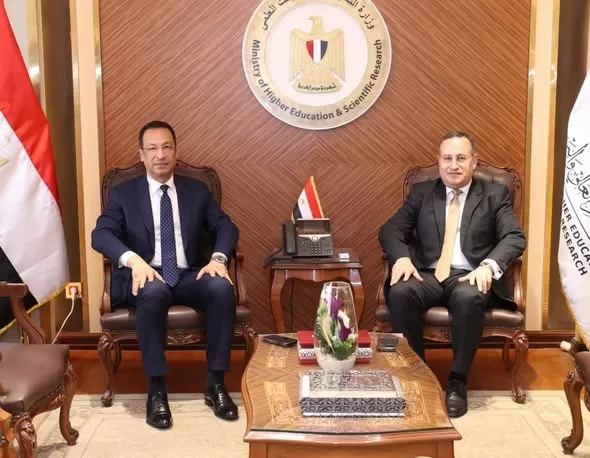
Minister of Higher Education and Scientific Research Abdelaziz Konsowa has reaffirmed the government’s commitment to embedding advanced technologies —particularly artificial intelligence — across Egyptian universities to enhance education quality, foster innovation, and better align academic outputs with national development priorities.
Konsowa made the remarks during a meeting with Minister of Communications and Information Technology (MCIT) Raafat Hindi on Wednesday, as part of ongoing efforts to advance digital transformation in higher education through closer institutional coordination and a comprehensive reform agenda.
The discussions focused on four key pillars: capacity building, artificial intelligence, digital transformation, and support for innovation and entrepreneurship. The meeting comes within the framework of the state’s broader strategy to invest in human capital and strengthen integration between the higher education and ICT sectors, with the aim of preparing a highly skilled workforce capable of keeping pace with rapid technological change and enhancing Egypt’s regional and global competitiveness.
Konsowa outlined his ministry’s strategic direction to expand the use of AI applications and digital tools within universities to support both education and scientific research. He stressed the importance of deepening co-operation with the Ministry of Communications and Information Technology to implement major digital transformation projects across the higher education system.
He also revealed plans to establish technology parks within universities to drive innovation and strengthen linkages between academia and industry, drawing on successful international models. In parallel, the minister highlighted the central role of the Science, Technology and Innovation Funding Authority in supporting competitive research projects and translating academic outputs into practical applications that serve society and the knowledge economy.
Supporting students and graduates remains a top priority, Konsowa said, particularly through advanced technological training programmes designed to generate meaningful employment opportunities. He further announced the launch of competitively funded graduation projects starting next academic year, alongside the organisation of technology and innovation competitions at the local, regional, and international levels to enhance students’ skills and competitiveness.
For his part, MCIT Raafat Hindi reaffirmed his ministry’s commitment to expanding collaboration with the higher education sector to build and scale human capital in key areas such as artificial intelligence, quantum computing, and emerging technologies.
He stressed that boosting the ICT sector’s competitiveness and increasing its contribution to the national economy requires not only advanced training and qualification programmes, but also the full implementation of digital transformation across Egyptian universities, supported by a robust innovation ecosystem.
Hindi also underscored the importance of developing specialised educational content in cybersecurity and advanced technologies, as well as integrating AI applications into the learning process to enhance student outcomes and modernise educational delivery.
He further highlighted ongoing efforts to position Egypt as a regional hub for technological education by attracting leading international universities and strengthening the global competitiveness of Egyptian graduates.

