



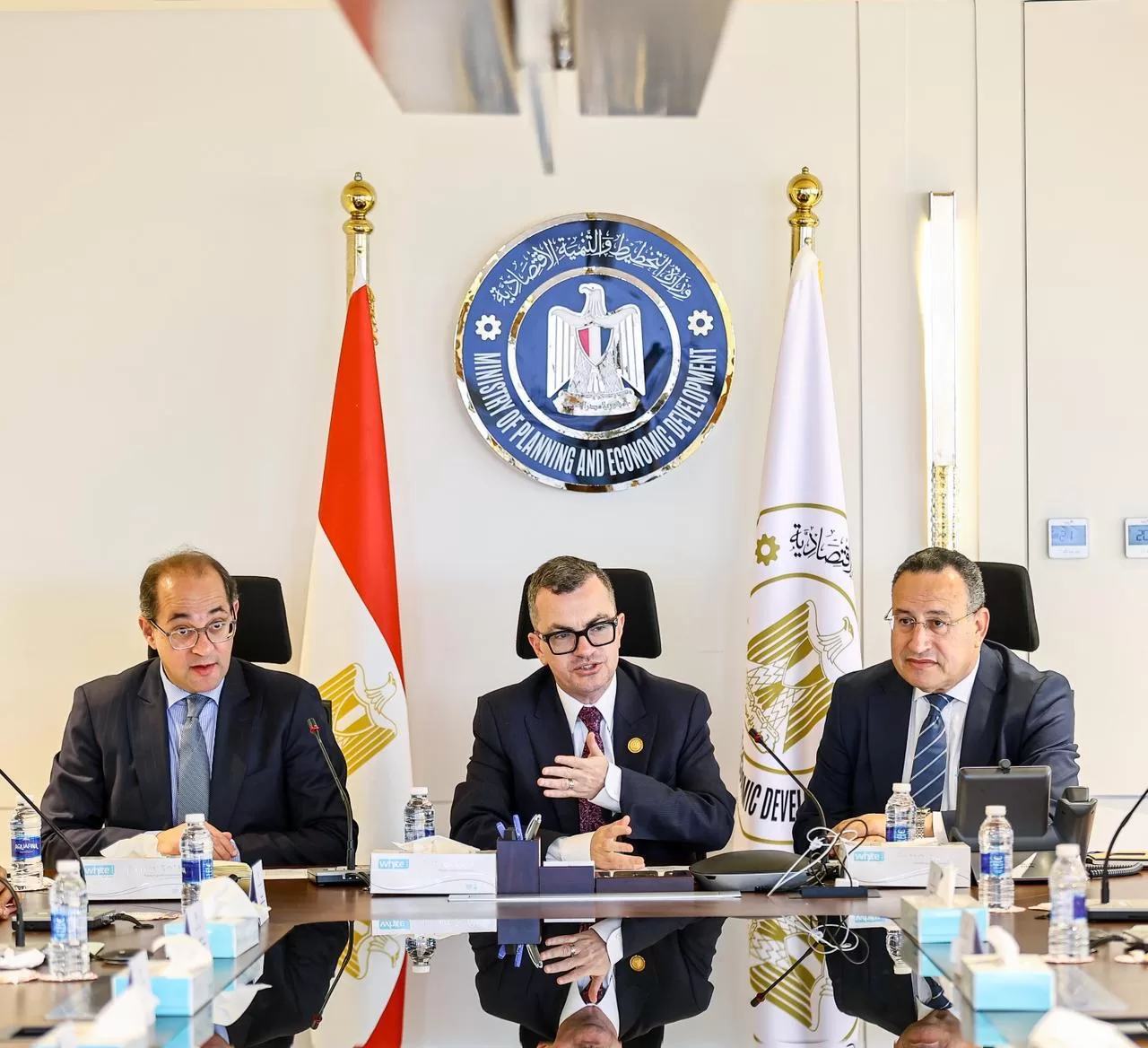
Egypt’s Minister of Planning and Economic Development Ahmed Rostom said that developing the education system is a key pillar for strengthening human development, stressing that the State places improving education quality and ensuring equal access to educational opportunities among its top priorities.
This came during his meeting with Minister of Finance Ahmed Kouchouk and Minister of Higher Education and Scientific Research Abdel Aziz Konsowa to discuss support for public and private universities, as part of efforts to enhance the role of higher education institutions in achieving comprehensive development goals.
Rostom said the meeting reviewed mechanisms to provide sustainable financing and develop educational and research infrastructure, contributing to improved quality of education and better alignment of its outcomes with labour market needs.
He added that discussions also addressed maximising returns on higher education investments by improving spending efficiency and linking funding to performance indicators.
He noted that, within the framework of Egypt Vision 2030, quality education plays a central role in building human capital, enhancing skills, and expanding employment opportunities, and supporting sustainable economic growth and a knowledge- and innovation-based society.
Rostom pointed out that the investment plan places increasing emphasis on the higher education sector as a key driver of human capital development and the knowledge economy, adding that the ministry is working to align investments with national priorities to enhance university efficiency and competitiveness.
He added that this includes supporting private and technological universities and developing research infrastructure to help produce qualified graduates capable of contributing to comprehensive development efforts.
For his part, Kouchouk affirmed his ministry’s commitment to supporting the higher education sector and ensuring the availability of necessary funding to sustain its development.
He noted ongoing coordination with relevant authorities to design innovative financing mechanisms that support educational expansion and enhance spending efficiency in line with Egypt Vision 2030.
Kouchouk added that the ministry is working to develop flexible and practical solutions to finance higher education projects without compromising fiscal sustainability, stressing the importance of expanding partnerships with the private sector and adopting innovative financing tools, alongside improving resource management efficiency to achieve optimal economic and social returns.
Konsowa said that private universities represent a key pillar in the development of the higher education system and support the State’s efforts to build a knowledge-based economy.
He noted that expanding private universities contributes to providing high-quality education and modern academic programmes aligned with labour market needs.
He added that strengthening co-operation with the private sector supports the development of sustainable financing models and enhances graduates’ competitiveness at regional and international levels.
He also stressed the importance of linking scientific research to industry, directing it towards applied research, and transforming outputs into practical applications through support for business incubators and technology valleys, thereby fostering innovation and boosting national competitiveness.
He further affirmed that coordination with the Ministries of Planning and Finance reflects an integrated vision to position Egypt as a regional and international hub for higher education and scientific research, while supporting sustainable development and human capital formation.
In a separate context, Minister of Planning Ahmed Rostom met with Minister of Finance Ahmed Kouchouk and Minister of Agriculture Alaa Farouq to discuss settling debts and resolving financial overlaps between the National Investment Bank and the General Authority for Agricultural Development, in the presence of Ashraf Naguib, Deputy Chairman of the National Investment Bank.
The meeting came in line with directives from Prime Minister Moustafa Madbouly to intensify efforts to resolve financial overlaps among government entities, enhance financial efficiency, and maximise the use of State-owned assets.
The ministers stressed the importance of settling financial entanglements between national entities to support comprehensive development efforts and strengthen the role of the National Investment Bank as the State’s investment and development arm.
They also stressed continued efforts to implement the national structural reform programme, improve public financial management efficiency, reduce pressure on the State budget, and optimise the use of underutilised assets to boost growth, employment, and competitiveness.

