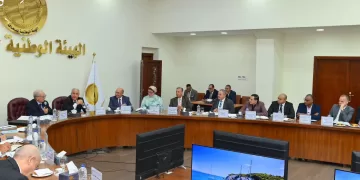





Egypt’s Deputy Prime Minister for Economic Affairs Hussein Eissa held two separate meetings at the National Press Authority (NPA) headquarters with officials from Akhbar El-Yom and Dar Al-Tahrir for Printing and Publishing to review restructuring plans aimed at boosting financial sustainability, developing revenue streams and improving institutional performance.
The meetings were held in implementation of Prime Minister Mostafa Madbouly’s directives.
NPA Chairman Abdel-Sadek El-Shorbagy, Deputy Chairman Alaa Thabet, Secretary-General Marwa El-Sisi, Investment and Projects Advisor Ahmed Mokhtar, Chairman of Akhbar El-Yom Investment Company Walid Abdel-Aziz, Chairman of Akhbar El-Yom Islam Afifi, and Chairman of Dar Al-Tahrir for Printing and Publishing Tarek Lotfy attended the meetings.
Discussions covered the challenges facing both institutions, as well as proposed studies, restructuring plans and practical mechanisms to enhance financial sustainability, develop revenue streams and improve efficiency, enabling the institutions to meet their financial obligations while continuing to fulfil their media and national missions.
The deputy prime minister stressed the state’s strong commitment to national press institutions as a fundamental pillar of Egyptian journalism, public awareness and enlightenment.
He described them as part of Egypt’s history and national memory, noting their longstanding role in shaping public consciousness and producing generations of journalists, thinkers and opinion leaders who have contributed to the country’s national, cultural and social life.
Eissa emphasised the need to maximise the value of institutional assets through investment-oriented strategies and integrated plans capable of generating sustainable economic returns. He also stressed the importance of integrating print publications with digital platforms to keep pace with rapid developments in the media sector.
The meetings examined outstanding tax and social insurance debts and proposals for their settlement, alongside efforts to finalise the rescheduling of commercial loans and banking obligations.
In this regard, Eissa stressed that financial restructuring must be accompanied by improved operational efficiency, higher revenues and sustainable business models.
For his part, NPA Chairman El-Shorbagy reviewed the authority’s efforts to achieve financial balance, improve professional and technological performance, and maximise the management and investment of its assets.
He highlighted plans to secure sustainable income, strengthen digital transformation, enhance print and digital content, and integrate the institutions’ assets and capabilities to increase returns and efficiency.
The meetings concluded with an emphasis on continued monitoring and co-ordination between the NPA and institutional management teams, according to clear schedules covering revenue growth, asset investment, debt settlement, and professional and technological development.

