










The decline below 300 is a signal, but it’s a relative signal — it tells you where Egypt stands in investors’ minds relative to the surrounding noise, not where it stands in absolute terms.
Analysis by Ahmed Kamel
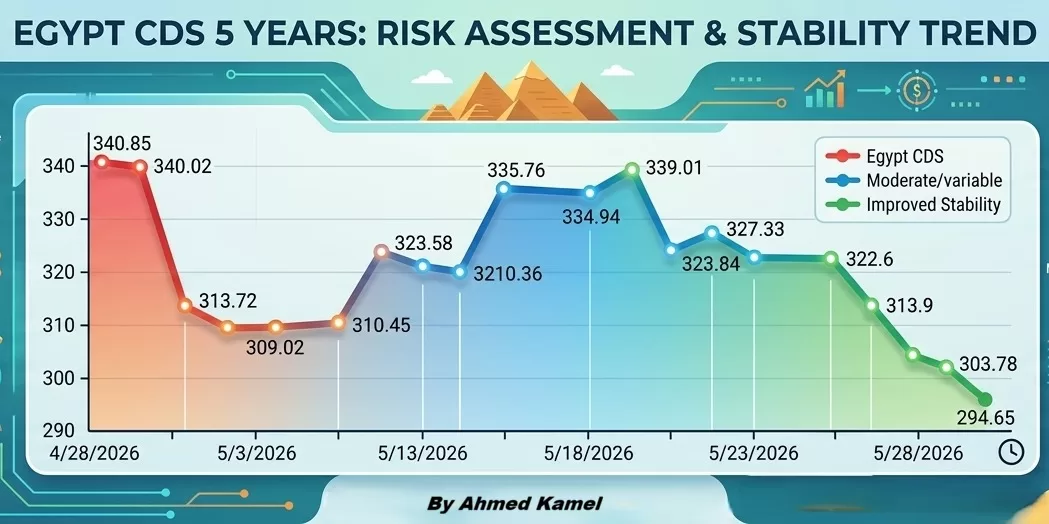
Egypt’s credit default swaps (CDS) fell to their lowest level since March 2020 on May 29. The drop in the country’s five-year CDS spread below 300 basis points has been treated in some quarters as a clean vindication of the stabilisation programme that began taking shape after the Central Bank of Egypt (CBE) floated the pound in March 2024 following the Ras El Hekma transaction.
Morgan Stanley noted last week that fiscal risks have “moderated”, citing the repayment of $5 billion owed to foreign oil partners and a reduction of the arrears backlog to roughly $1.2 billion. Tax revenues grew 31 per cent in the first half of the current fiscal year.
On paper, the fundamentals look better.
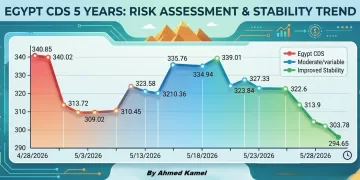
But the chart of May’s CDS trajectory tells a more textured story. The month opened near 340 basis points, and the path downward was anything but linear.
Two distinct episodes of compression — one in early May, another in the final week — were separated by a sharp reversal that briefly pushed spreads back above 335.
A spike to 339 around May 18 coincided with a period of broader emerging market (EM) risk-off sentiment, a reminder that Egypt’s risk repricing does not happen in a vacuum. When global investors get nervous, the premium demanded on Egyptian paper widens.
Scale of improvement
That context matters because the prevailing interpretation of a falling CDS as evidence of Egyptian-specific improvement is partly, but not entirely, accurate. The spread had been above 800 basis points during the acute stress of 2023 — a period of foreign-currency rationing, parallel market premiums, and mounting external obligations.
By that benchmark, 294 is a dramatic improvement. Against a post-Hekma baseline in the 300–400 range, the current level represents a narrower but still meaningful repricing. Morgan Stanley’s framing — that this could reduce borrowing costs on new issuances by roughly half a percentage point — is credible.
Where the analysis gets more complicated is in the transmission question. A falling sovereign CDS does not automatically translate into cheaper credit across the economy.
Trade finance, letters of credit, and import guarantees are priced off related but distinct risk metrics, and Egypt’s import-dependent economic structure means the cost of trade credit has a direct bearing on domestic inflation and business viability.
The gradual improvement in these costs is real but lagged, and it competes against the structural weight of elevated domestic interest rates — the CBE’s policy rate remains at 20 per cent — which reflect inflation dynamics that CDS spreads do not capture.
The real test ahead
Foreign investor flows into government debt instruments confirm the directional story but also reveal its fragility. Net purchases of $1.1 billion in May followed roughly $2 billion in April — a recovery from the $4.6 billion in net sales recorded in March, when global turbulence triggered a sharp withdrawal.
What the CDS decline does usefully signal is that the acute phase of external vulnerability has receded. Investors who were pricing in a meaningful probability of debt distress have revised that assessment downward. That is not nothing — it is, in fact, the prerequisite for everything else.
Cheaper external borrowing, improved trade terms, and gradual re-engagement of institutional investors who had gone cold on Egyptian assets. But none of these mechanisms operate quickly, and the distance between “the spread is falling” and “the economy is healing” is longer than the headline number suggests.
The real test lies ahead. Egypt still faces a demanding external repayment schedule over 2026–2027. The fiscal consolidation that has driven the tax revenue improvement must survive an election cycle and an economy where public sector wages and subsidy pressures are perennial.
The Ras El Hekma deal provided the CBE with a critical liquidity injection in 2024. However, there should be a structural, i.e., a more diversified export base, a reduced dependence on portfolio inflows, which remains more aspiration than reality.
A CDS below 300 is merely the starting point for structural reforms to take shape.


Discussion about this post