




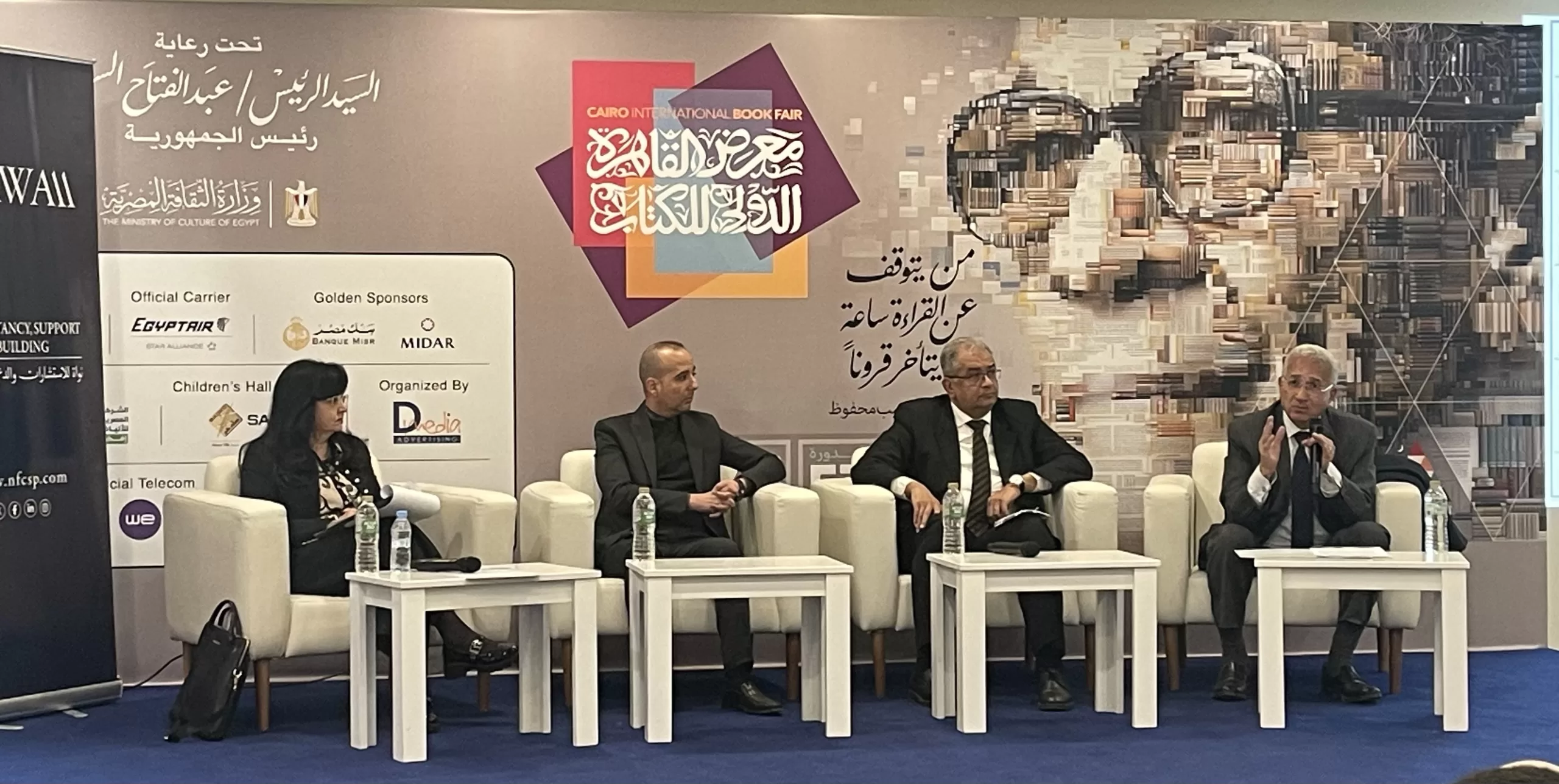
Experts and participants in a seminar titled “Water Security: A New Vision for Integration and Sustainable Resource Management in the Nile Basin” said that African countries have become fully convinced of the fairness of Egypt’s stance on the Grand Ethiopian Renaissance Dam (GERD).
The experts and participants said they understand the Egyptian narrative concerning the serious risks the dam poses to downstream countries.
The seminar was organized by the NAWA Foundation on the sidelines of the 57th Cairo International Book Fair.
Participants noted that African states appreciate the development projects implemented by Egypt across the continent, as well as its major efforts to support stability, achieve shared development, and boost the foundations of regional cooperation, in a way that enhances security and makes benefits to all African peoples.
They said the international community recognizes the Nile River as a lifeline for the Egyptian people, and views the Ethiopian dam as an existential threat to Egypt’s water security, in addition to constituting a clear violation of international law governing the use of transboundary rivers.
Participants stressed that Egypt will not give up a single drop of its historic water rights, expressing support for efforts aiming at resuming negotiations under the auspices of US President Donald Trump, in a manner that serves the interests of all parties within a fair and binding framework.
Noha Bakr, an advisor at the NAWA Foundation, underscored the importance of cooperation among states on river and water security issues, given their close interconnection, particularly in regions with transboundary rivers.
Meanwhile, ambassador Mohamed Hegazy, former assistant foreign minister, reviewed the strategic interconnection between Red Sea security, Nile River security, and maritime security, describing them as key pillars of regional integration.
Hegazy said that after 12 years of negotiations with Ethiopia over the water issue, it has become necessary to adopt a different approach, stressing that any dialogue on water is, at its core, a dialogue about life.
He explained that water is an existential issue for Egypt and must be handled with wisdom and prudence, pointing to opportunities for regional cooperation among Nile Basin countries, particularly Egypt, Sudan, and Ethiopia, as states sharing a single river.
Hegazy noted that Egypt has a legacy of historic and legal agreements regulating the use of Nile waters, reaffirming its firm rejection of any engineering projects on the river that could harm its interests.
He stressed that water issues are long-term in nature, and that the Nile should be a tool for cooperation rather than conflict, as it is a divine gift to all riparian states, not to one country alone.
Hegazy stressed the close link between Nile security and Red Sea security, saying that reaching a fair settlement for this file would be a victory for regional cooperation.
He cited Egypt’s contribution to building a water reservoir in Tanzania as a model that could be replicated with other African countries, particularly within the framework of cooperation in the Red Sea region as a corridor for development.
He concluded that cooperation and wisdom are the optimal path to resolving crises and achieving sustainable development.
For his part, Ayman Abdel Wahab, Director of Al-Ahram Center for Political and Strategic Studies, said that joint cooperation on water issues is a wise and rational option, noting that disputes between states stem not only from water scarcity, but also from weak cooperation and negotiation.
He said water issues have moved beyond the concepts of scarcity and shortage, becoming closely linked to desertification, drought, and climate change.
Abdel Wahab affirmed that cooperation among Nile Basin countries has been largely positive, with growing calls to enhance cooperation with Egypt, citing successful development projects implemented by Egypt in several African countries.
He also criticized Ethiopia’s negative behavior in handling the water issue and Egyptian interests, attributing it to historic sensitivities related to Egypt’s historic water rights.
He warned that developments in the Red Sea region, the Horn of Africa, and the Sahel threaten security and stability, and necessitate new approaches to regional architecture, particularly in light of conditions in countries such as Sudan, Somalia, and Congo.
He highlighted Egypt’s intensive efforts in Africa since 2014, driven by President Abdel Fattah El Sisi’s prioritization of African relations in Egypt’s foreign policy, which has resulted in the restoration of Egypt’s influence on the continent, increased reciprocal visits, and expanded trade.
Abdel Wahab warned that instability in the Sahel and Horn of Africa negatively affects prospects for stability and development, hindering the implementation of collective cooperation projects.
He stressed that water security cannot be separated from energy and food security, as key components of human security, noting that this complex and interconnected system requires a new vision and collective political will to achieve shared interests, warning that continued unilateral approaches threaten regional stability and development.
He also underscored the importance of Egypt’s active on-the-ground presence in African countries through development projects, both in support of friendly states and to protect Egyptian interests, highlighting the pivotal role of technology in advancing cooperation and maximizing benefits for all parties.
Abdel Wahab praised Egypt’s patience and wisdom in managing negotiations, as well as its sustained political and diplomatic engagement despite numerous challenges.
Meanwhile, Omar Al-Husseini Al-Nadi, a sustainable development expert, said that countries that delayed or lagged in implementing infrastructure projects saw their development and security prospects weaken, while those that invested early in infrastructure, modern technology, and renewable energy succeeded in improving development outcomes.
He noted that Egypt has succeeded in localizing renewable energy projects and implementing major national initiatives, including canal lining, desalination, and wastewater treatment and reuse, ensuring safe and sustainable water resource management.
Nadi stressed that water security is closely linked to energy and food security as core pillars of comprehensive development and stability.
Nadi concluded that water is the fundamental resource for life, noting that Egypt possesses a powerful asset in the form of knowledge, awareness, and determination to transform the Nile into a river of cooperation and shared benefit for all riparian states.

